Sold out on Day 1, banned after 5 days—Are AI phones making a comeback?
Sold out on Day 1, banned after 5 days—Are AI phones making a comeback?

By | Light Cone Intelligence, Author | Liu Junhong, Editor | Wang Yisu
In December 2025, the first-generation DouBao smartphone was limited to 30,000 units and sold out on launch day—launching at its peak from day one.
Differing from other smartphones at the time that merely carried the AI label, the core value proposition of the DouBao smartphone was AI-driven automation: performing tasks on behalf of users, comparing prices across apps, checking logistics across multiple platforms with a single tap, and automatically organizing files. On December 5, ByteDance announced the suspension of AI auto-operation in financial services, internet payments, game score boosting, and other scenarios—the Agent functionality effectively “cut off” overnight.
A smartphone went from release to being besieged in less than five days.
Yet, seven months later, this "dead" phone has become the most hardcore narrative in the smart hardware ecosystem.
Just ahead of this year’s WAIC, smartphones centered around the Agent concept quietly entered the game. Jieyue Stars unveiled its first generative model-native agent smartphone brand. Honor brought forward its Agentic OS framework. Nubia launched its second-generation DouBao AI Agent smartphone as its flagship strategic product. The concept of the “Agent smartphone” is rapidly becoming the new consensus in the smartphone industry.
Will the next generation of “DouBao smartphones” be better than the “1.0” version?
This question is extremely difficult to answer. When AI genuinely begins to “view screens, make decisions, and execute actions” on behalf of users, it no longer touches technical bottlenecks—it challenges the entire power structure of the mobile internet era. If an Agent can bypass the homepages, ads, search rankings, and payment funnels of apps to directly trigger final user behaviors, it poses a structural threat to all platforms dependent on traffic monetization.
Now, the second-generation players are back—with greater intelligence and caution. But the fundamental contradiction between AI and app ecosystems remains unresolved. The stronger the Agent capability, the more it must circumvent or reconstruct the existing app ecosystem; conversely, the more respect shown to the current ecosystem, the weaker the perceived capability appears—“not painful, not effective.”
But will consumers accept this new smartphone concept?
Compared to rigidly sticking to old models, there is still room for opportunity. According to IDC forecasts, due to rising storage costs, global smartphone shipments are expected to decline by 12.9% year-on-year—a record low in over a decade. Meanwhile, IDC warns that the era of sub-$100 budget phones has ended, even after storage prices stabilize. This means low-end volume-driven phones face structural elimination.
Industry distress implies smartphone manufacturers must justify higher prices to consumers while also clearly differentiating themselves from the 2024 wave of “AI phones.”
Perhaps today’s “Agent smartphone” trend is not just a technological race, but an ongoing battle for ecological positioning between smartphone makers and internet giants.
A phone that died once choosing to return to the stage suggests some trends can be delayed—but never reversed.
Is AI Phone 2.0 Really Here?
Since 2024, AI phones have been more about hype than substance.
Over the past two years, AI features have become standard across major smartphone brands: automatic album categorization, computational photography, intelligent summaries, privacy computing, meeting notes… the feature list keeps growing. Yet the actual generational difference experienced by users falls far short of the promotional claims.
To amplify the value of on-device AI computation, many vendors championed the “edge-cloud collaboration” model. In practice, however, users still rely on cloud-based model capabilities—new and old devices alike can achieve these functions via cloud invocation. For example, local AI photo editing offers little real advantage, as most smartphones require internet connectivity regardless of whether they support on-device AI editing. The result? Vendors pile on features, yet users feel it's “all the same.”
Yet sales data seems to keep the AI phone concept “face-valid” in appearance.
According to IDC, global AI phone shipments reached approximately 234.2 million units in 2024, up 363.6% year-on-year. The numbers look impressive—but note that IDC defines AI phones as those with on-device generative AI capabilities. Given recent iterations of smartphone SoC chips, this essentially means every device equipped with a new flagship chip qualifies as an AI phone. The so-called AI capability exists objectively, regardless of whether manufacturers actually use it.
If vendors invest more in AI, their phones can generate social media posts on-device, enable seamless integration between AI and app usage. To implement Agent-level capabilities, phones can “order coffee with a single phrase” or execute long-chain tasks across a few apps. But what they don’t say is that these demonstrations already represent the full extent of Agent capabilities.
However, in December 2025, the “DouBao Phone 1.0” completely broke through the AI dilemma.
In the initial days post-launch, reviews of the DouBao smartphone were overwhelmingly positive. AI moved beyond answering questions to performing actions. For instance, when users said, “Compare the same item on Meituan, Ele.me, and JD, then place the cheapest order,” the phone automatically switched apps, searched, compared prices, claimed coupons, and paused at the payment screen for confirmation. Checking multi-platform logistics, batch file organization, and even message replies in certain scenarios could all be done via voice command.
Sales data provided the most direct proof of demand. The 30,000 limited units of the first-generation DouBao Phone sold out on launch day, and the secondary market saw prices soar to tens of thousands of yuan—clear evidence of strong consumer demand for “complex long-chain task automation.” If AI can truly act on behalf of users instead of just chatting, its value shifts fundamentally.
Yet simultaneously, the DouBao Phone quickly revealed the cost of fulfilling such demand—not technical, but commercial.
Shortly after launch, apps including WeChat, Taobao, Meituan, Alipay, and China Construction Bank, Agricultural Bank, among others, responded swiftly. WeChat flagged “environmental anomaly,” while Alipay and several banks reported login failures, payment interruptions, or security warnings. On December 5, ByteDance officially announced the suspension of AI auto-operation in financial, internet payment, and game score-boosting scenarios, citing security and risk control concerns.
Certainly, the GUI-mode approach used by DouBao Phone—directly accessing system-level permissions—could technically be detected as cheating by apps. But the timing and intensity of the response suggest that security alone doesn’t fully explain this “ban.”
When an Agent can directly view screens, make decisions, and execute actions, it may bypass the carefully designed homepages, ad placements, search rankings, and payment funnels of apps, directly reaching user behavior and decisions. In this sense, AI is no longer just an assistant within the existing app ecosystem—it becomes a disruptive force above it. The DouBao Phone model triggered a structural shift in the power and resource allocation dynamics between the internet and smart hardware ecosystems.
In simple terms, the DouBao Phone took the most aggressive approach, preemptively staging the zero-sum conflict inherent in AI phones.
It didn’t win—but it didn’t vanish silently either. Seven months later, learning from past mistakes, new players are returning. But the question remains: Can the “Agent phones” of today resolve the contradictions of the “1.0” era?
Agent Phones, Dancing with Chains
To answer this, we must first understand the various implementation paths for Agent phones currently in the market.
At least five distinct Agent deployment strategies exist today.
The most aggressive is GUI simulation via click emulation—the path taken by the original DouBao Phone. It directly simulates touch inputs at the system level, but carries high risk of being flagged as a cheat.
The “DouBao Phone 2.0” proposes an A2A protocol: introducing a deeply embedded Agent layer on top of the Android base, enabling mutual invocation between Agents and apps—requiring explicit authorization from both parties. Compared to the first generation, the 2.0 Agent makes clear trade-offs: AI moves from “fully autonomous” to “human-AI collaboration,” from “I do everything for you” to “I coordinate apps to help you, with your confirmation at each step.” From a business perspective, this approach is more standardized and sustainable—but hinges on whether internet giants are willing to partially delegate their traffic entry points and decision-making authority to external Agents.
Jieyue Stars’ Step AOS adopts a hybrid model combining GUI and MCP. By decomposing core smartphone capabilities into atomic primitives (communication, applications, files, system tools), exposing them via the MCP standard for Agents to freely compose and invoke, while preserving visual understanding as a supplementary layer. Notably, to distinguish itself from prior GUI approaches, Jieyue states that Step AOS introduces NUI (Natural User Interface) mechanisms at the interaction level, supporting multimodal input including voice, vision, and text, and using contextual memory to auto-complete user identity and preferences. This path offers advantages in deployment speed and compatibility, but large-scale adoption still depends on whether app vendors are willing to open APIs or tolerate visual-level operations.
Honor’s solution involves deeper integration between AI and the operating system. According to Honor’s presentation at MWC in June, Agentic OS features four core traits: intent-driven, natural interaction, proactive intelligence, and native cross-device capability. YOYO (Honor’s Agent) serves as the foundational implementation method. Conceptually, the Agent acts more like a system-level proactive executor: when given a vague request, it autonomously breaks down tasks, invokes multiple system or app capabilities, coordinates across devices, and delivers results—or executes directly. While this model can indeed “get things done,” real-world effectiveness still depends on the manufacturer’s ability to control and restructure existing app ecosystems.
The most comprehensive solution may be Huawei’s HarmonyOS approach. HarmonyOS represents the most thorough system-level Agentification. Thanks to its microkernel architecture, AI Agent capabilities operate at the same level as other system services, enabling direct access and orchestration of system-level APIs and distributed capabilities.
This means AI can natively invoke Agents and Skills within the HarmonyOS framework without relying on GUI simulation or external protocols. This approach offers clear advantages in execution efficiency, permission management, and cross-device coordination—but imposes higher demands on the existing app ecosystem. To integrate with HarmonyOS, app vendors must provide AI-accessible interfaces according to established standards, meaning the pace of AI ecosystem development ultimately depends on developer cooperation.
The aforementioned pathways form a progressive sequence:
From the most radical—ignoring app consent and directly emulating clicks—to the most conservative—reconstructing OS-level rules from the ground up. Regardless of choice, the core challenge remains: smartphone makers must balance “Agent capability strength” against “app ecosystem compatibility.” The outcome is clear: routes requiring minimal app cooperation yield stronger capabilities but face higher suppression risks; routes heavily dependent on app cooperation are more sustainable but face immense implementation hurdles.
This implies that under the influence of power structures, every smartphone maker pursuing an Agent path is essentially “dancing with chains.”
Each vendor may claim their Agent architecture is optimal and future potential vast. But dancing beautifully doesn’t mean the chains can loosen themselves.
Can Agent Phones Reverse Industry Downturn?
In the long term, technological controversies can be resolved gradually through commercial means. But smartphone makers likely don’t have the luxury of waiting.
Due to rising storage costs, the global smartphone industry faced its most severe contraction on record in 2026. IDC’s February forecast predicts a year-on-year shipment decline of 12.9%, dropping to around 1.1 billion units—the lowest in over a decade. Subsequent projections from Counterpoint and others revise the drop to about 13.9%. In China, according to Counterpoint, smartphone sales during the month-long 618 shopping festival declined by 13% year-on-year. Moreover, throughout 2026, numerous smartphone manufacturers announced price hikes across their product lines to offset rising costs.
When will the storage supply shortage end? A telling reference point: expanding HBM (high-performance memory) production capacity requires at least 3–5 years.
Under these conditions, some smartphone makers see opportunity; others seek new sales frontiers.
Among them, Jieyue exemplifies a positioning strategy. As stated by Chairman Yin Qi of Jieyue Stars, the company’s first phase won’t focus solely on shipment volume, but “must achieve scale.” For a pure AI company, using hardware prototypes to push its own protocol and standards—even if selling devices isn’t the main goal—means gaining influence. More importantly, unlike legacy smartphone firms, Jieyue carries fewer institutional burdens.
For Nubia and Honor, “Agent phones” aim directly at new sales growth. Though, to some extent, the new form factor may not differ significantly from earlier “AI phones” in hardware. However, software-level differentiation could drive new demand. After all, the system-level AI capability to “act on behalf of users”—proven by the DouBao Phone 1.0—can create genuine market appeal.
Regardless, the tide of technological advancement cannot be stopped. Agent capability has become the central narrative for next-generation AI phones.
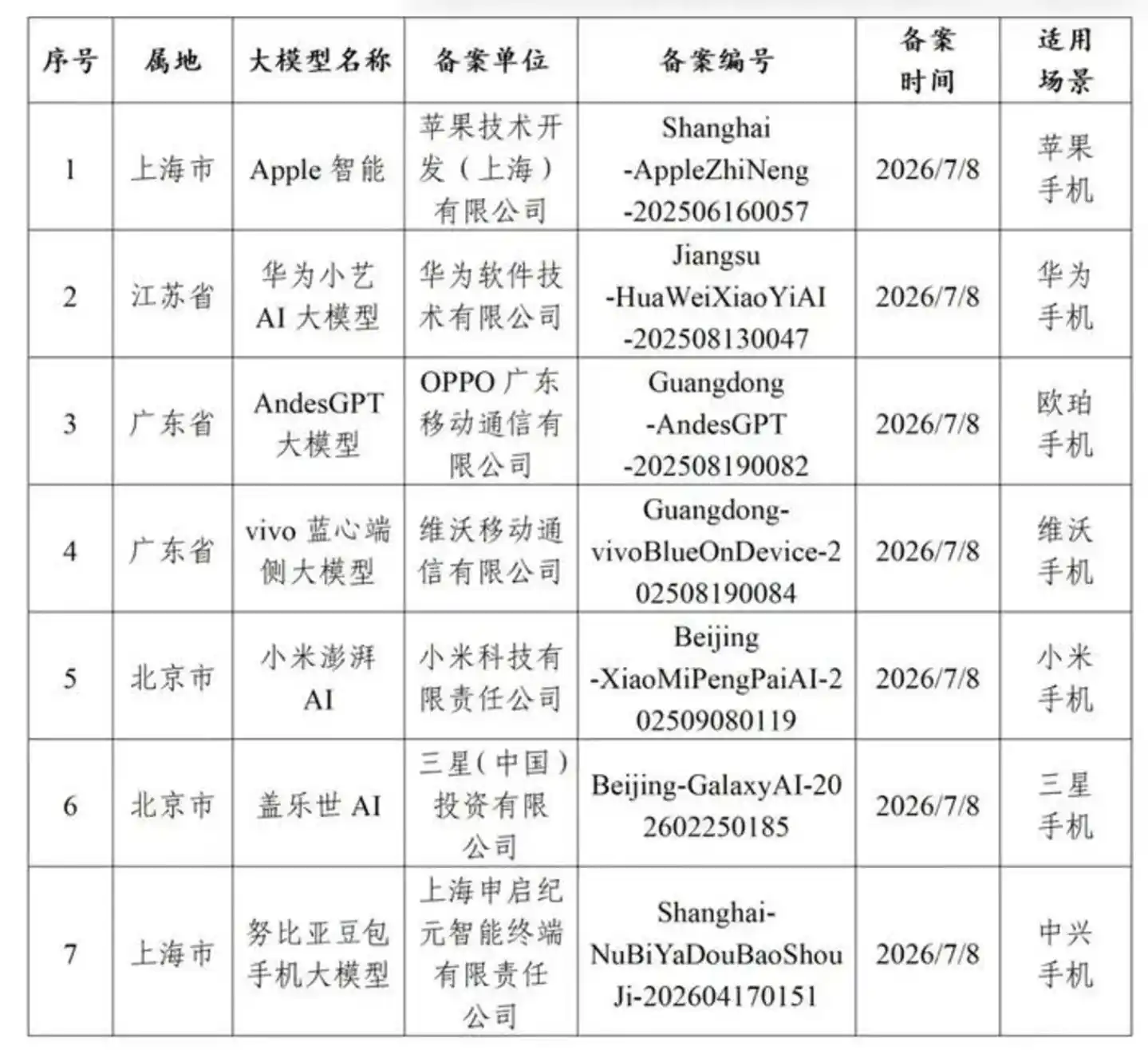
As of July 15, the Cyberspace Administration of China’s latest large model registration list confirms a new round of competition in smartphone AI models is underway. Especially with Apple’s much-hyped Apple Intelligence finally landing, Chinese smartphone makers will inevitably launch a counteroffensive to demonstrate superior capability.
On the other side, internet companies are gradually lowering their guard toward Agents. In June, WeChat announced partnerships with Huawei, Honor, Xiaomi, OPPO, and vivo to launch A2A assistant capabilities—enabling voice assistants on smartphones to initiate WeChat video calls or send messages to contacts.
Perhaps in the short term, “Agent phones” still fall far short of the heights achieved by the original DouBao Phone. Forced to compromise between capability and ecosystem compatibility, they dance with chains. But as more players join the dance, one day the chains may loosen at the other end.
The trend of “Agent phones” as a distinct category has begun.
Source: Light Cone Intelligence
Disclaimer: Contains third-party opinions, does not constitute financial advice


a16z: 80% of AI Budget is Idle
3 days ago
OpenAI Former CTO Unveils 975B Open-Source Champion
5 days ago
DeepSeek Races for Sci-Tech Innovation Board Listing: Valuation Reaches $71 Billion
5 days ago
26 People Sue Meta: Will AI Fire You for Taking Maternity or Sick Leave?
5 days ago
Liáng Wénfēng Becomes the New Richest Man in AI, 36 People Get Rich Overnight from Large Models
6 days ago
Today's Leaderboard for Large Model Token Usage
05-08
Doubao Launches Paid Model: Can AI Subscriptions Work?
05-06


