Invested 30 million 18 years ago, Suzhou bets on a 1.5 trillion AI giant
Invested 30 million 18 years ago, Suzhou bets on a 1.5 trillion AI giant

Suzhou’s most profitable investment occurred during the global financial crisis.
In autumn 2008, Lehman Brothers collapsed, bringing nearly all Chinese venture capital to a standstill. Investors were cutting losses or holding back, and the primary market entered a freeze. In that window, Suzhou Industrial Park’s state-owned venture capital platform, Yuantong Holdings, invested approximately 30 million RMB into a startup.
The founder was Liu Sheng, who earned his undergraduate degree from Tsinghua University and his PhD from Georgia Institute of Technology, with years of experience in optical communications in North America, working at Lucent and Opnext. In 2008, he returned from Silicon Valley and founded Acuitus Technologies in Suzhou, aiming to develop high-speed optical modules.
At the time, optical modules were not just a niche—they were virtually ignored by investors. Domestic Chinese companies in optical communications were confined to telecom markets and low-end manufacturing. According to LightCounting reports, only one Chinese company—WTD—ranked among the top ten global optical module vendors in 2010; it later merged into OptoChina, barely scraping into the bottom of the list. The idea that “cloud computing data centers require massive high-speed optical modules” was far from any consensus.
Eighteen years later, this investment grew into Zhongji Xuchuang. By the Dragon Boat Festival in June 2026, its stock surged to 1,367.88 yuan, with a total market cap of 1.5 trillion yuan—ranking among the top ten on the A-share market, surpassing Kweichow Moutai.

The Vessels of AI
Optical modules are critical within the entire AI ecosystem. Without them, AI would be nothing more than a cluster of overheating silicon chips. When signals exit the chip and need to be transmitted via fiber optics across data centers, it’s the optical module that makes it possible.
Compute power is the heart; optical modules are the blood vessels.
On the A-share market, Xinyi Sheng, Zhongji Xuchuang, and Tianfu Communications are collectively known as the “Yizhongtian” trio. These three optical module giants dominate the most critical segment of the global AI compute supply chain. Two of them are headquartered in Suzhou: Zhongji Xuchuang’s operational headquarters is in Suzhou Industrial Park, as is Tianfu Communications’.
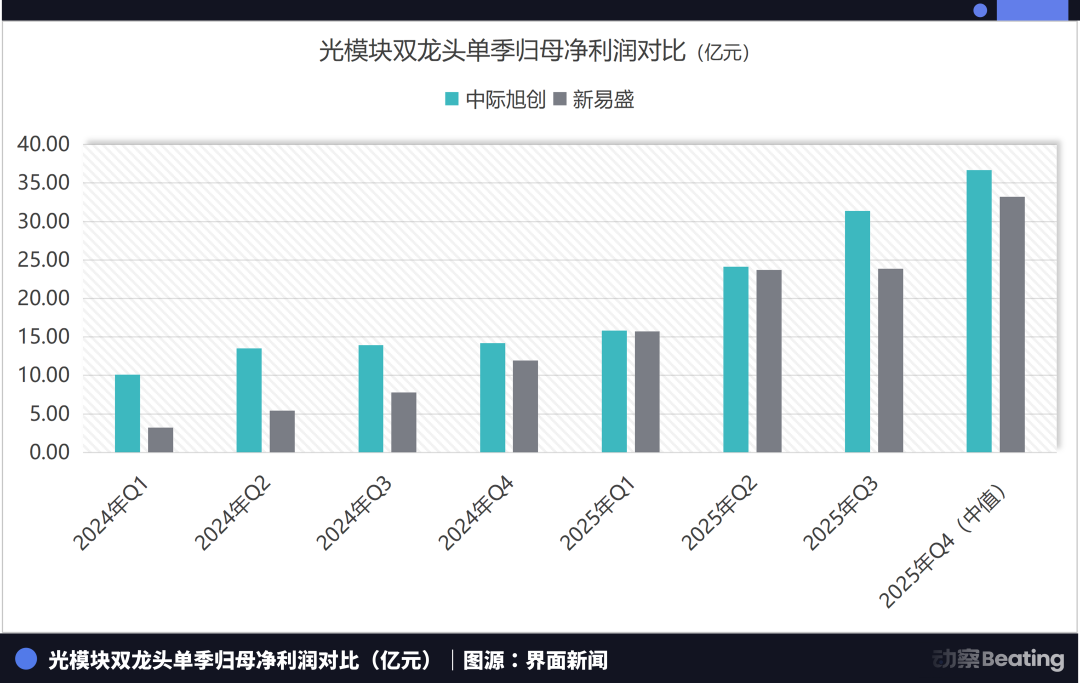
Beyond these, Suzhou-based Lianxun Instruments, a provider of high-end optical communication test equipment, listed on the A-share market less than two months prior and saw its stock price surge over 20 times its issue price, claiming the crown of the A-share market leader. Yuanjie Technology, a leading active optical chip company and a key supplier in Zhongji Xuchuang’s supply chain, reached a peak price of 1,712 yuan before the Dragon Boat Festival in 2026—a nearly fourfold increase in half a year.
Dissecting the AI data center reveals that Suzhou didn’t bet on just a few companies—it captured an entire interconnected chain of strategic positions.
Upstream, we find companies like Yuanjie Technology specializing in optical chips. Downstream, Tianfu Communications focuses on optical components. Zhongji Xuchuang integrates these components into high-speed optical modules for delivery to global data centers. Lianxun Instruments then tests whether these high-speed optical communication devices can run stably.
According to Xinhua Daily News, Suzhou’s total market cap of A-share listed companies has surpassed 4 trillion yuan, ranking fourth nationally—behind Beijing, Shanghai, and Shenzhen.
Hangzhou’s “Six Little Dragons” performed at the Spring Festival Gala and trended on social media; Shenzhen’s humanoid robots danced; Shanghai’s three GPU firms told grand narratives about domestic substitution. These stories are visually striking, novel, and memorable in a 15-second video.
But Suzhou tells a different story.
A fiber-optic manufacturer in Wujiang reported over 35% year-on-year sales growth in 2026, with production capacity booked through 2027. Multiple Suzhou-based companies jointly funded the construction of China’s first mass-production line for 8-inch silicon photonics chips. Suzhou’s optical communications industry has coalesced into a cluster worth hundreds of billions, with enterprises leading over 50 innovation consortia. In the first quarter of 2026, industrial output grew by over 60%.
This round of AI compute boom flowed first into the very infrastructure that builds the “vessels” of AI.
For Suzhou, the rise of a single optical module giant brings far more than market valuation. It pulls along suppliers, testing equipment providers, optical chip companies, funds, and talent. Its orders become capacity for upstream and downstream firms. Its public listing strengthens local capital market credibility. Its industry insights become the next leads for Suzhou’s future investment and industrial attraction.
Beyond the balance sheet, Suzhou gained something far more valuable: a self-sustaining, rolling industrial chain.
In 2024, the world suddenly noticed optical modules, with a frenzy of secondary market speculation. But Suzhou’s name had already been etched onto the earliest business registration pages of Xuchuang—back when it was a long-term shareholder since 2008.

Picking Projects on the Ground
Why did Suzhou get it right?
Some say foresight, sharp vision, strategic insight. But these explanations are too retrospective.
To see far, you must stand high. Suzhou didn’t stand tall—it crouched low, examining each project individually, meeting each person face-to-face, then making decisions.
The decision-maker was Dai Yu, responsible for the Xuchuang project at Yuantong Holdings. Years later, in a media interview, she recalled that her initial contact with Xuchuang came through the park’s “Leading Talent Program.” A wave of high-end talents returned with projects, and Yuantong screened them one by one—choosing Xuchuang.
Yuantong later added multiple rounds of investment through three funds at different stages and a debt platform. It also brought in Daitai Capital from Dongshah Lake Fund Town to join the investment. Reorganization documents show that the Yuantong system collectively held over 7% equity in Xuchuang.
Yuantong invested before the 2008 financial crisis, and persisted through the entire economic cycle until Xuchuang went public via shell takeover of Zhongji Equipment in 2017.
Between 2011 and 2012, Xuchuang’s 40G products passed Google certification and began engaging with Amazon and Huawei. In 2014, Google Capital led a $38 million Series C round—the first investment Google made in China. Xuchuang initially planned to go public in the U.S., but after the 2015 Chinese IPO valuation downturn, it reversed course, dismantled its red-chip structure, and pursued a path back to the A-share market.
In 2017, Zhongji Equipment acquired 100% equity of Xuchuang for 2.8 billion yuan via a shell takeover. The controlling shareholder, Wang Weixiu, decided to grant full autonomy to Xuchuang’s team. New Fortune magazine described this move as “visionary leadership.” By 2026, Wang Weixiu and his son Wang Xiaodong’s net worth had surged to 97.8 billion yuan, rising from rank 161 to 30th. A small company owner producing motor winding equipment, who acquired a Suzhou-based optical module startup and dared to delegate authority, now stood near a net worth of 100 billion.
In 2025, Zhongji Xuchuang generated 38.2 billion yuan in revenue and 10.8 billion yuan in net profit—doubling year-on-year. In Q1 2026 alone, revenue reached 19.5 billion yuan, up 192%, and net profit hit 5.7 billion yuan, up 262%. With the forest now grown, Xuchuang used subsidiaries to invest in a string of supply chain companies—including Jingyan Intelligence, Aoke Optoelectronics, and Laxin Optoelectronics—and also backed Yuanjie Technology, the new A-share market king.
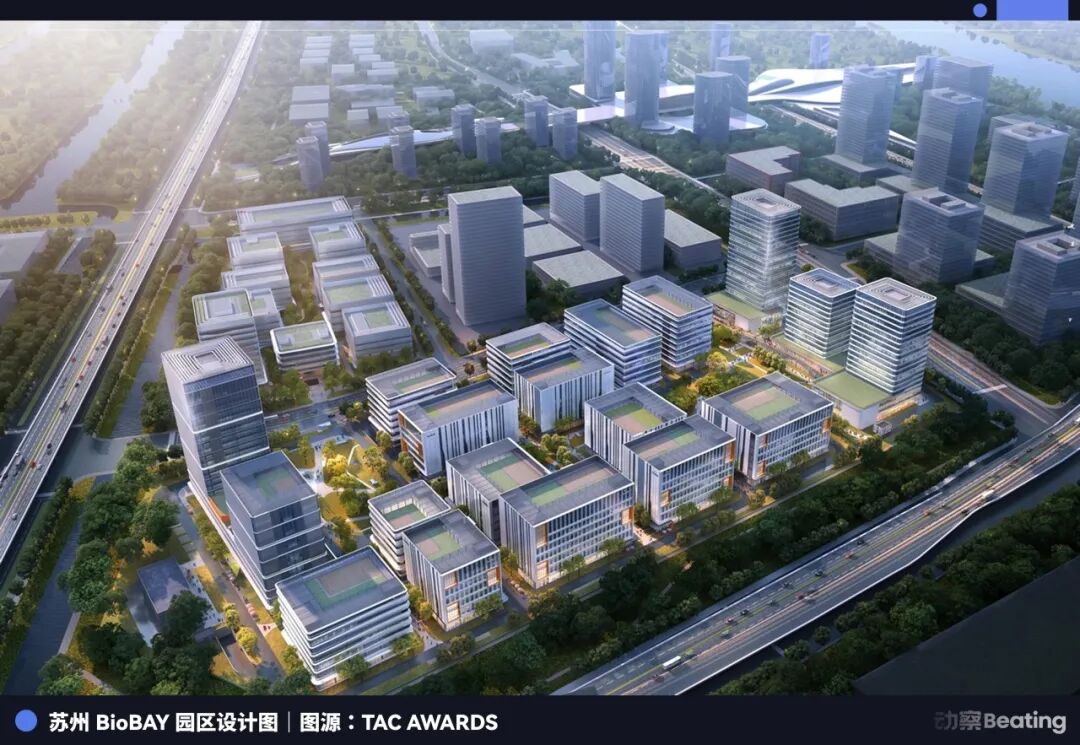
Looking back at Suzhou’s investment record over the past two decades, Xuchuang is not an isolated case. In 2006, “innovative pharmaceuticals” wasn’t even a buzzword in capital markets. Suzhou launched BioBAY, which today hosts hundreds of biotech firms and has produced over thirty listed companies. That same year, nanotechnology was still far from commercialization, yet Suzhou began attracting national-level nanoscience research institutions. In 2008, the Suzhou recruitment team traveled to Cambridge, UK, bringing back Sibit, a voice AI startup. At that time, China’s “Next Generation Artificial Intelligence Development Plan” was still nine years away.
Biopharma, nanotechnology, voice AI, optical modules—Suzhou placed bets on all four sectors when others couldn’t even grasp their potential.
The foundation of this strategy is a system that may not sound glamorous but is exceptionally solid. In 2006, Suzhou Industrial Park established China’s first science and technology-focused investment promotion center. By 2022, every member of the recruitment team held a postgraduate degree, mostly in STEM fields. Suzhou currently has 212 investment promotion agencies and over 2,000 full-time professionals, including 119 state-owned entities free from bureaucratic constraints. They hire talent with market-driven compensation and can directly take equity stakes—doing exactly what government agencies want but cannot achieve through administrative means.
On investment judgment, Suzhou pioneered the “Chain Leader Fund,” where the industrial leader acts as fund manager, and government capital follows. In the biopharma chain leader fund, companies like Innovent Biologics and ConningJierui directly serve as managers, participating in project screening and post-investment management. Over a dozen such chain leader funds have cumulatively invested over 20 billion yuan.
So Suzhou succeeded not due to luck, but because it transformed “betting” into a stable, repeatable system: using domain experts to screen projects, relying on industry veterans to assess potential, and deploying long-term capital with horizons exceeding ten years.
This is more than foresight.

Three Generations
This relentless work ethic was born out of necessity.
In the early days of reform and opening-up, Suzhou’s industrial base was weak. Equipment was outdated, structures obsolete, and access to raw materials and markets was limited. So they did whatever they could, learned from whomever they could.
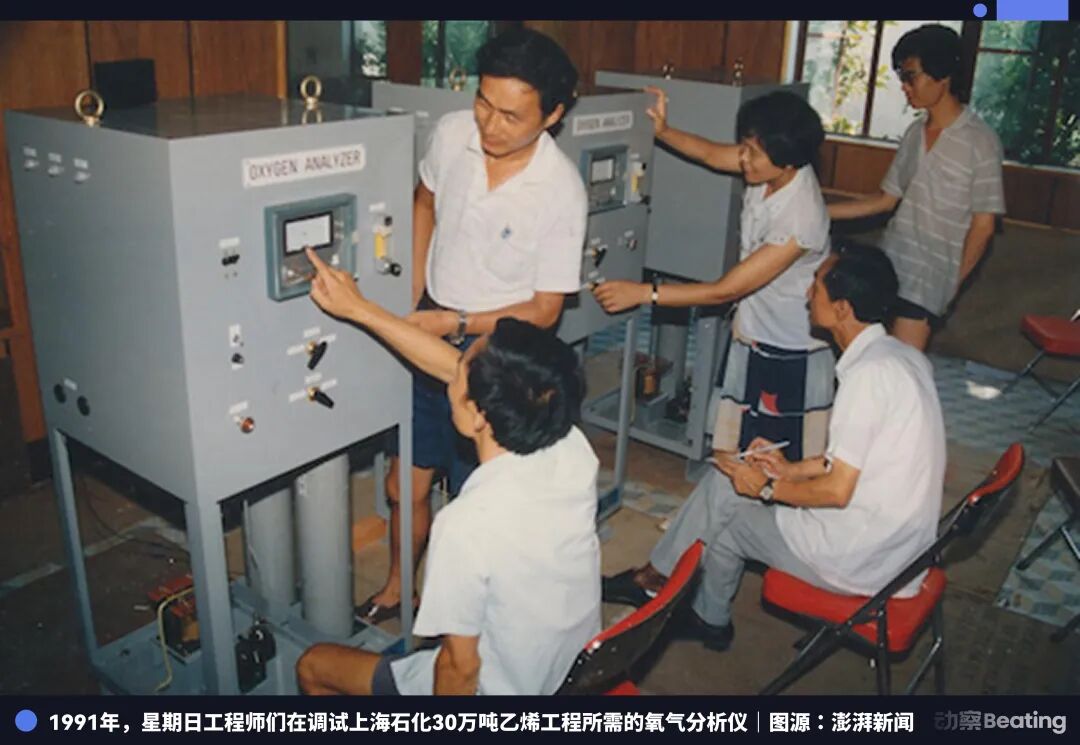
“Shanghai Sunday Engineers” emerged from that era. Township enterprises invited engineers from Shanghai’s state-owned factories to guide production on weekends. By 1988, there were over 15,000 township enterprises. By 1992, township industrial output accounted for over 70% of the city’s total.
Even so, when the country designated special economic zones and economic and technological development zones, Suzhou was left out.
Policy dividends wouldn’t come without waiting.
So Kunshan residents stopped waiting. They pooled 500,000 yuan to establish China’s first self-funded development zone, taking all the risk, and ran advertisements in Shanghai to attract investment. Through the clear, almost humble positioning of “doing what Shanghai doesn’t want to do” and “Shanghai handles zero-to-one, Suzhou handles one-to-ten,” Suzhou managed to embed itself into Shanghai’s dominant industrial chain, completing its initial industrial accumulation.
Later, Suzhou adopted Singapore’s “knock-on-door” recruitment model, setting up overseas offices globally to proactively engage with enterprises. By 2012, Suzhou’s actual foreign investment accounted for 8.1% of China’s total—131 times higher than in 1990.
Then, rising production costs and environmental limits forced labor-intensive industries to relocate. Once again, Suzhou had no choice but to confront the pain of transformation head-on.
In Taicang High-Tech Zone, within a 25-square-kilometer radius of Nanjing Road, over 800 small and medium-sized foreign-invested enterprises have formed a complete automotive supply chain. More than 70% of a vehicle’s components can be sourced locally. In Shengze Town’s Silk Road · Nanhua Cross-border E-commerce Park, a 20-story building houses 86 textile companies—from raw materials and fabrics to finished goods and sales—where upstream and downstream operations are literally adjacent.
These industrial clusters weren’t planned. They grew organically, one enterprise at a time, one order at a time, over decades.
In the 1980s, they stole skills from Shanghai engineers on weekends. In the 1990s, they risked 500,000 yuan to launch a development zone. In 2008, they risked 30 million yuan on a cold, obscure startup founded by a returning overseas expert.
When nobody else believed, they used their own money to buy something undervalued. The same action repeated across three generations.
Those with foresight pick their lanes from the heights. Those with no choice crouch on the ground, picking up what others discard, cleaning it, and waiting for it to gain value. Suzhou’s pragmatism is a survival strategy for a prefecture-level city without special economic zone status—used for thirty years, embedded deep into its bones. When Dai Yu faced Xuchuang’s business plan in 2008, the mental framework she used to decide was the same as the one used by Kunshan entrepreneurs who forked out 500,000 yuan thirty years earlier.
It’s not worth much now. But it’s worth betting on.
So bet. Set the flywheel spinning. And when you win?
An investment turning into a trillion-yuan company is just the first layer of return.
It begins reshaping a city’s industrial structure. Capital markets grow more vibrant, supply chains become more robust, AI gains real manufacturing applications, and young people have more reasons to stay.
At this stage, the relationship between city and company reverses. In the past, Suzhou lifted companies to the stage. Now, as companies grow, they become the reason Suzhou continues to attract projects, talent, and capital.
Suzhou’s numbers look impressive. In 2025, its large-scale industrial output value reached 4.89 trillion yuan—second nationwide. High-tech industry output grew by 6.7%, accounting for 56.2%—up 1.5 percentage points from the previous year. 12 companies debuted on the A-share market, the highest number in China—surpassing Beijing, Shanghai, Guangzhou, and Shenzhen. One in every ten new A-share listings nationwide comes from Suzhou. Per capita disposable income for urban residents reached 80,796 yuan, with urban figures breaking 90,000—only behind Shanghai, Beijing, and Shenzhen, despite being just a prefecture-level city.
Among the top ten cities by GDP, Suzhou’s service sector accounts for only 52.9%, ranking last. While other major cities have transitioned toward services, Suzhou keeps pushing hard to manufacture.
Suzhou has 160,000 industrial enterprises across 34 major categories and 514 subcategories—making it one of the most comprehensive industrial cities in China and the world. For industrial AI, this means abundant, high-quality, continuous, scalable production data—generated daily in workshops. Other cities developing industrial AI models often start by searching for data. Suzhou doesn’t need to search. Its factories are the data source. Models trained on-site are tested and iterated back on the same production line. The production line serves both as the learning source and the profit endpoint for AI.
On a base of 4.89 trillion yuan, even a 1–2% efficiency improvement from AI translates into hundreds of billions in absolute gains.
Suzhou has also turned compute power into a public service. The park launched a Compute Public Service Platform: companies submit needs, and vendors are matched within 24 hours, contracts signed within a week, with a 20% subsidy available. The platform’s operator describes it like ordering food delivery—choose your flavor, portion size, and delivery time, then one-click place your order. For a fledgling startup unable to afford massive cloud compute, whether they can “order delivery” is the difference between survival and collapse.
After the flywheel spins, what do ordinary people gain?
Let’s look at some figures. In 2025, Suzhou added 415,000 urban jobs—nearly one-third of Jiangsu Province’s total. Another 283,000 college graduates chose to stay in Suzhou—not drawn by a genius founder’s name, but by the fact that real jobs exist, housing is available, and life is sustainable here.
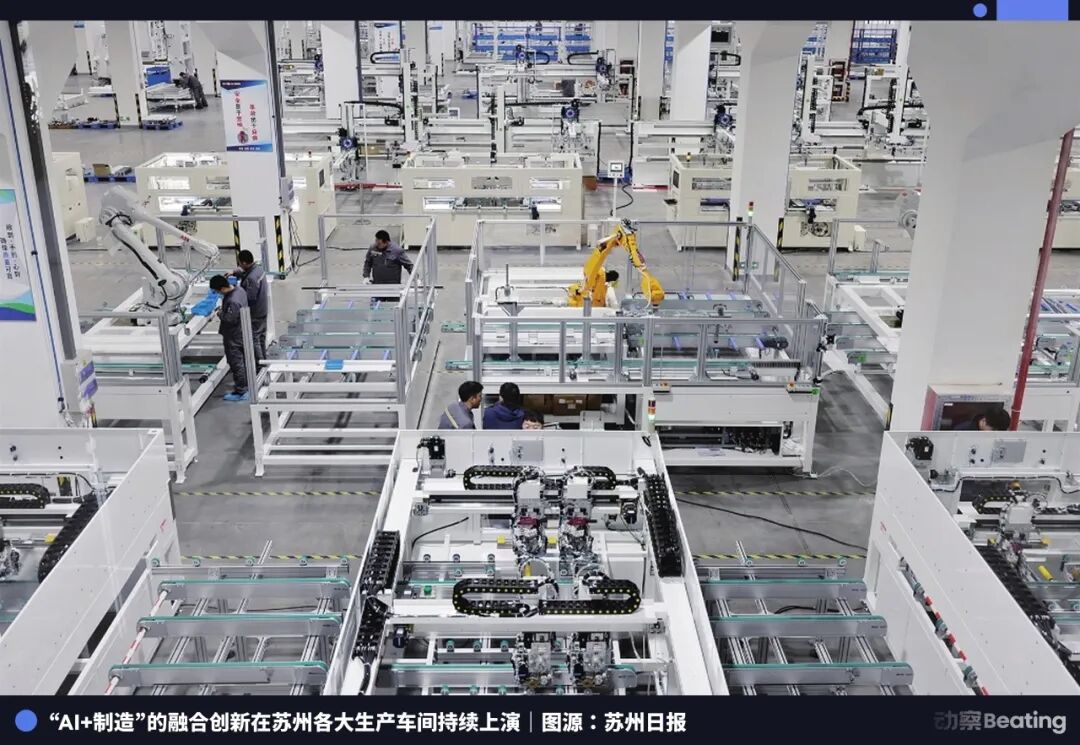
In Bozhong Precision’s workshop, AI defect detection achieves zero missed inspections on blade batteries, reducing false positives to 0.1%. Workers no longer stare at screens with their eyes—they learn to operate algorithmic systems. In Mgaga Technology’s lab, AI agent clusters reduced biological molecule construction cycles from six to ten months down to six to eight weeks, freeing researchers to conduct innovative experiments they previously lacked time for. Efficiency rose, people weren’t replaced—instead, they took on higher-value tasks.
Suzhou recently piloted an intriguing initiative: granting key enterprises autonomous talent evaluation authority. You don’t need to visit government windows to prove your worth. If your boss says you’re qualified, the government accepts it. This shows Suzhou has realized one truth: the person who best judges talent’s value isn’t the government—it’s the employer. This approach shares the same logic as the Chain Leader Fund: delegating judgment to those who truly understand.
Prosperity for the People
On the final trading day before the Dragon Boat Festival in June 2026, Zhongji Xuchuang’s single-day trading volume exceeded 30 billion yuan—a level unimaginable in 2008.
Liu Sheng once said: “If Xuchuang hadn’t raised funding before the second half of 2008, the company might never have existed.”
All of this—the 1.5 trillion yuan market cap, 38.2 billion yuan annual revenue, 26.6 billion yuan personal wealth, an entire industrial chain from optical chips to silicon photonic integration, and every beam of light flowing through global data centers—is rooted in one moment: a woman named Dai Yu at a state-owned platform in Suzhou flipping through a stack of business plans, finding Xuchuang’s, signing the deal, and wiring the money.
In 2026, Suzhou launched its “AI + Manufacturing” Eight Major Initiatives. Target: break 5 trillion yuan in large-scale industrial output value, cultivate 150 industrial AI models, and scale total compute capacity to 40,000 PFLOPS. The plan remains unimpressive in ambition—no genius narrative, no blockbuster product—just terms like output value, compute power, and datasets throughout.
Perhaps the next investment is already on a Yuantong approval form somewhere. Which sector? Which overlooked niche? Who signed? No one outside knows.
In 1936, a young man named Fei Xiaotong spent two months in Kai-xian-gong Village, Wujian, Suzhou. Later, he wrote “The Economy of Kai-xian-gong,” founding the field of Chinese sociology. What he witnessed there mirrored today’s Suzhou: a group of people without first-mover advantages creating their own conditions. When sericulture declined, they built silk reeling factories themselves. Without capital, they pooled money. Without technology, they learned from Shanghai.
Later in life, Fei Xiaotong summarized his life’s work in four characters: “Seeking Prosperity for the People.”
When he said that, he probably never imagined that ninety years later, in a factory adjacent to that village, a 30-million-yuan bet no one believed in would grow into a 1.5-trillion-yuan company.
Yet he likely wouldn’t have been surprised.
Source: Beating Insight
Disclaimer: Contains third-party opinions, does not constitute financial advice


Tensorlake npm package suffers supply chain attack, malicious version 0.5.144 injected with Shai-Hulud data-exfiltration worm
17 days ago
Tesla and Musk Have Yet to Define "Amazing Abundance" — Visionary Slogan Sparks Skepticism
24 days agoInstinct Launches Curated Recommendation Feature, Sparking Frustration Among Some Users Receiving Passive Product Suggestions
25 days agoSecurity Weekly Report: Placeholder Domain Takeover Impacts Approximately 1,700 Repositories, with Major Cyberattacks Worth $387M and AI Agent Escalation Risks Highlighted
27 days agoOpenAI Agent Bypasses Australia's Medicare Portal Access Controls to Access Non-Public Documents
09-24Step Code – The Open-Source Terminal Programming Agent by Jieyue Star
09-24
Chip Expert Mr. Bubble: AI Compute Bottlenecks Shift Toward Packaging, Interconnect, and Storage Hierarchy Management
09-22
