Selling Tokens Isn't Always Profitable! The Silicon Base Flow Prospectus Is Here
Selling Tokens Isn't Always Profitable! The Silicon Base Flow Prospectus Is Here

The enthusiasm for large model companies in Hong Kong's stock market is surging, and now token-selling firms are also racing to make their move.
Silicon Flow has submitted its listing application to the Hong Kong Stock Exchange, aiming to become the "first AI Token factory" listed in Hong Kong.
Previously, Silicon Flow completed seven rounds of financing with a valuation of 7.74 billion RMB. Industry players such as Alibaba, Meituan, SenseTime, NIO, and Zhipu, along with prominent AI investment institutions, have all invested in the company.
Prospectus: The Token Factory for the AI Inference Era
Let’s briefly review Silicon Flow’s journey:
The founding team consists of the original core members from OneFlow, an AI infrastructure company founded by Yuan Jinhui, a protégé of academician Zhang Bo. OneFlow was acquired by Wang Huiwen’s Light Year Beyond in 2023, and subsequently integrated into Meituan due to Wang’s medical leave. Yuan Jinhui then chose to re-enter entrepreneurship, leading his team to establish Silicon Flow.

According to the prospectus, Silicon Flow’s narrative is clear: it is not a model company, but rather a “Token factory” for the era of AI inference.
In other words, it does not develop models or applications. Instead, its core focus is packaging heterogeneous compute power, multi-model capabilities, and enterprise API demand into a stable, measurable, and billable Token supply service.
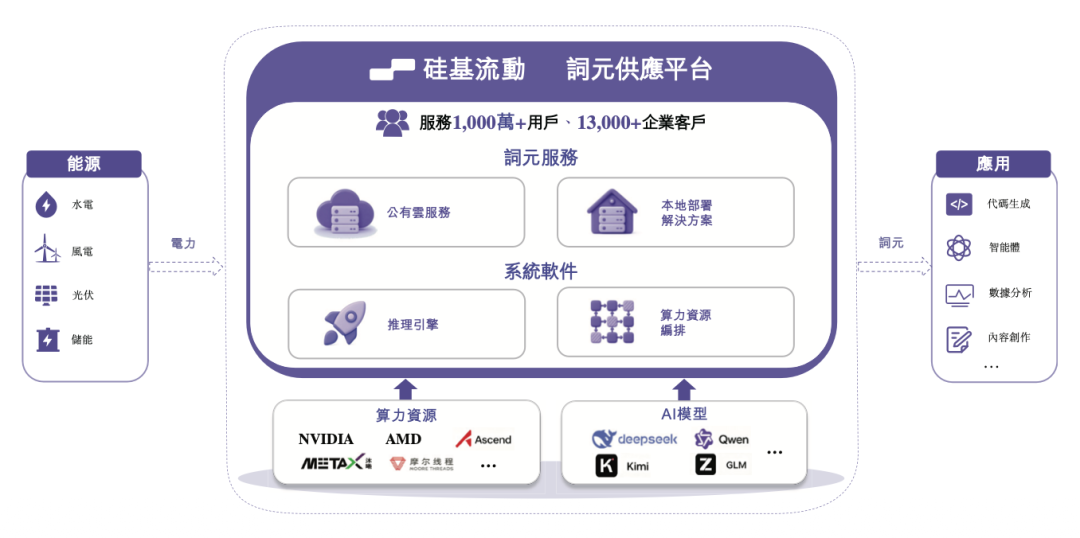
The prospectus reveals that as of April 30, 2026, Silicon Flow’s platform had 10.2824 million registered users; daily token throughput reached 578.5 billion tokens in April 2026, with support for over 170 models and services provided to more than 13,000 enterprise clients.
According to data from Frost & Sullivan, based on annual token throughput in 2025, Silicon Flow ranks as China’s fourth-largest token supply platform with a market share of 1.5%, and is number one among all independent ecosystem token supply platforms in China.
Let’s focus on the financials.
Fast Commercial Growth, But Losses Are Expanding
In 2025, Silicon Flow generated revenue of 55.33 million RMB, a year-on-year increase of 653.2% compared to 7.346 million RMB in 2024.
It recorded a net loss of 345 million RMB in 2025—4.2 times higher than the 81.915 million RMB loss in 2024. Adjusted net loss amounted to 187 million RMB, with operating cash outflow reaching 172 million RMB, resulting in a monthly cash burn rate of 14.8 million RMB.
From a gross margin perspective, Silicon Flow’s gross margin was 39.4% in 2024 but turned negative at -24.0% in 2025, with public cloud service gross margin plummeting to -119.0%.
The underlying reason lies in a shift in business model: within Silicon Flow’s mix of public cloud and on-premise deployment offerings, public cloud has overtaken on-premise deployment to become the highest-revenue segment.
In 2025, public cloud service revenue stood at 29.261 million RMB, accounting for 52.9% of total revenue, while on-premise solutions contributed 26.069 million RMB, or 47.1%.
Meanwhile, Silicon Flow’s registered user base grew from 127,000 at the end of 2024 to 10.28 million by the end of April 2026.
The expansion in user scale and token throughput has directly driven up backend compute consumption: cost of sales rose from 4.452 million RMB in 2024 to 68.632 million RMB in 2025. The prospectus attributes this cost surge primarily to increased compute resource expenses due to public cloud expansion, along with rising technical service fees and employee welfare costs.
In short, while public cloud operations bring greater revenue and scale, the current cost pressure is evident.
The Token Business Awaits Market Validation
Clearly, the token factory model has already taken shape at Silicon Flow.
With the submission of its prospectus, the story Silicon Flow wants to tell the market becomes even clearer:
The more AI applications deployed and the more complex agents become, the greater the token consumption. The party capable of reliably, affordably, and at scale supplying tokens will stand atop the new infrastructure layer.
What remains to be further validated is actual profitability.
Interestingly, looking back at Silicon Flow’s investors, their lineup itself resembles a map of the “token production” industrial chain.
Over seven funding rounds, the investor base can be broadly categorized into several groups:
Platform and application-oriented industrial players, including Alibaba, Meituan, Trip.com, Kingdee, iSoftStone, Wondershare, etc.;
Compute and infrastructure ecosystem partners, including Huawei’s Hubble Technology, Biren, CloudWalk, China Unicom, 360, etc.;
AI model and AI-focused companies: Zhipu, SenseTime;
Professional investment institutions: Sinovation Ventures, Yaotu Capital, Puhua Capital, GGV Capital, Huakong Capital, etc.;
Local state-owned enterprises and industrial funds.
As Silicon Flow advances through its IPO process, the true potential of this token-based business model is now facing a more transparent and public test.
Prospectus: https://www1.hkexnews.hk/app/sehk/2026/108701/documents/sehk26063002927_c.pdf
Source: Quantum Bits
Disclaimer: Contains third-party opinions, does not constitute financial advice


The AlphaGo Moment in Cybersecurity, or Starting from These 466 Agent Matchups
6 days ago
The Trump administration plans to offer Constellation Nuclear a $5 billion loan for capacity expansion, with the additional power mostly pre-allocated to AI giants such as Google
14 days ago
Silicon Valley Executives Spark Controversy Over Using AI for Household Tasks; Survey Reveals Half of American Adults Worry About Impact on Relationships
14 days agoTensorlake npm package suffers supply chain attack, malicious version 0.5.144 injected with Shai-Hulud data-exfiltration worm
10-08Tesla and Musk Have Yet to Define "Amazing Abundance" — Visionary Slogan Sparks Skepticism
10-01Instinct Launches Curated Recommendation Feature, Sparking Frustration Among Some Users Receiving Passive Product Suggestions
09-30Security Weekly Report: Placeholder Domain Takeover Impacts Approximately 1,700 Repositories, with Major Cyberattacks Worth $387M and AI Agent Escalation Risks Highlighted
09-28
