By mid-2026, embodied AI has raised 43.8 billion yuan in funding, with over half of capital betting on the "brain" of robotics
By mid-2026, embodied AI has raised 43.8 billion yuan in funding, with over half of capital betting on the "brain" of robotics

Capital in the field of embodied intelligence is flowing rapidly toward the "brain" of robots.
According to incomplete statistics by QuantumBit, as of June 12, 2026, domestic fundraising in the embodied intelligence sector reached approximately 43.8 billion RMB in the first half of 2026. This compares to around 55.4 billion RMB in 2025 and roughly 13.7 billion RMB in 2024. At this pace, 2026’s fundraising is poised to set a new record.
Over half of the capital has flowed into "Brain-First" companies. Unlike the previous generation focused on hardware or full-stack platforms, Brain-First firms emphasize their approach: "software-defined hardware, model-defined embodiment."
In contrast, companies centered on robot bodies—termed "Body-First"—secured only 12.8% of funding during the same period, even less than core component manufacturers (such as dexterous hands, sensors, joint modules), which received 14.4%.
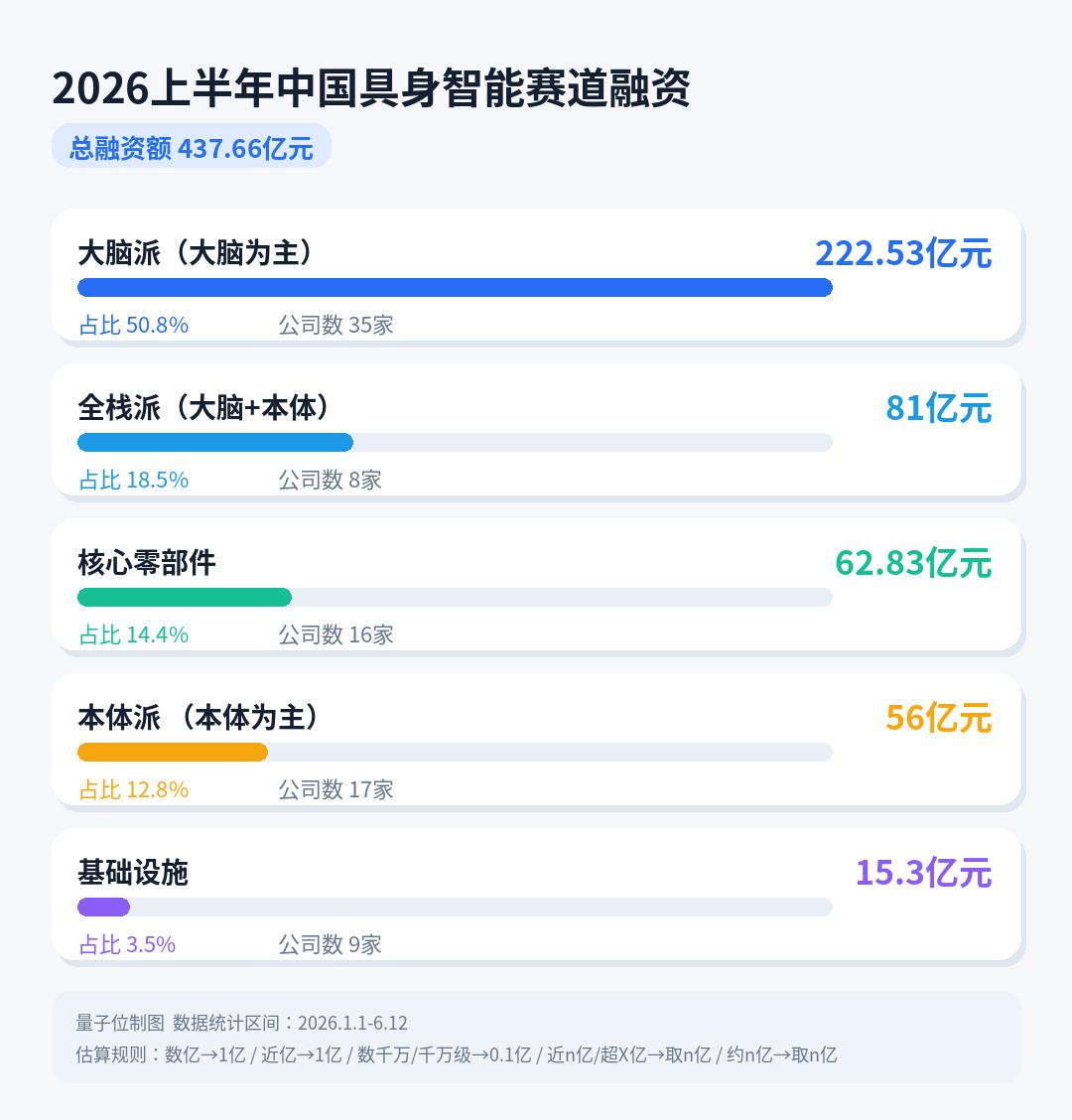
Many "Brain-First" companies are raising funds at rocket-like speeds—averaging one round per month has become industry standard. Some have even completed two rounds just two weeks apart.
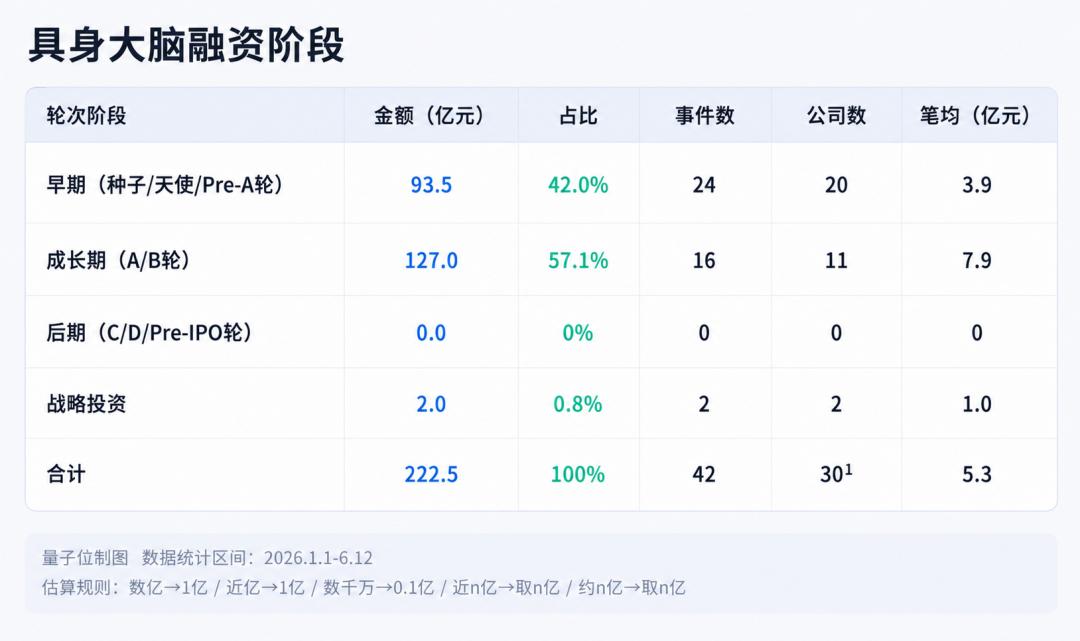
This is a young sector. Among the 35 Brain-First companies tracked by QuantumBit, most (20) are in early-stage financing (Seed/Angel/Pre-A rounds), with no company having entered late-stage rounds (C/D/Pre-IPO).
It is also a hot sector. QuantumBit reports that Pre-A rounds for embodied brain companies average 700 million RMB, while B rounds average 2.25 billion RMB—levels typically seen in C/D rounds across other industries.
We summarize several key trends currently shaping venture capital in embodied intelligence.
Funding Acceleration in Embodied Brains
The first trend: The pace of fundraising in the embodied brain sector has broken traditional logic, where milestone validation was required before advancing to the next round.
Since the second half of 2025, capital has flooded into the embodied brain space. In 2026, the pace accelerated further.
For example, Deta Intelligence, founded in January 2026, raised over 100 million RMB in three rounds within three months. Similarly, Octopus Dynamics, established around the same time, closed multiple rounds totaling hundreds of millions RMB in seed and nearly 50 million USD in angel financing within under two months. MoeDeep Intelligence completed five funding rounds within six months. Numerous similar cases exist.
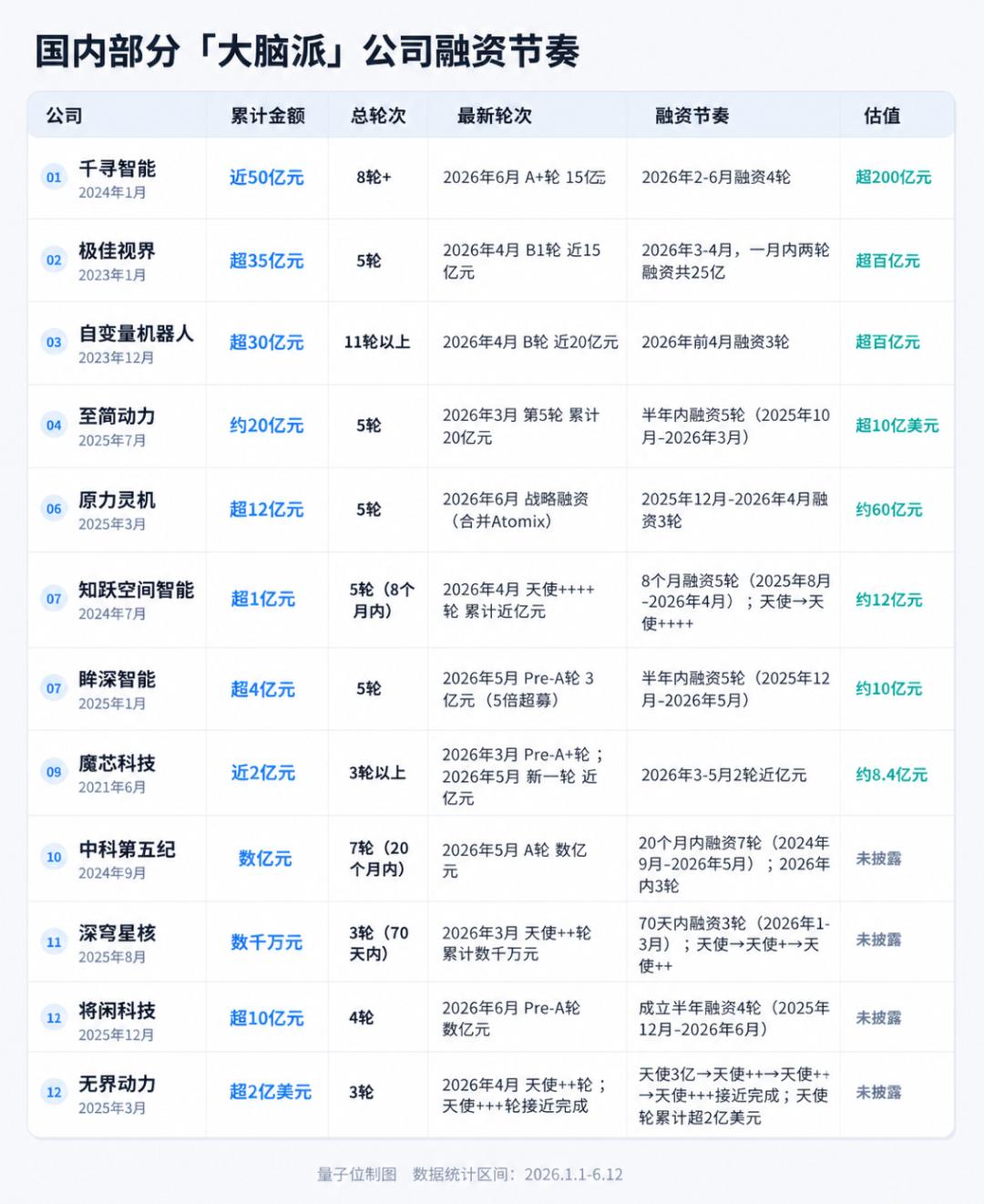
Moreover, many companies are raising amounts far exceeding typical benchmarks for their round stage.
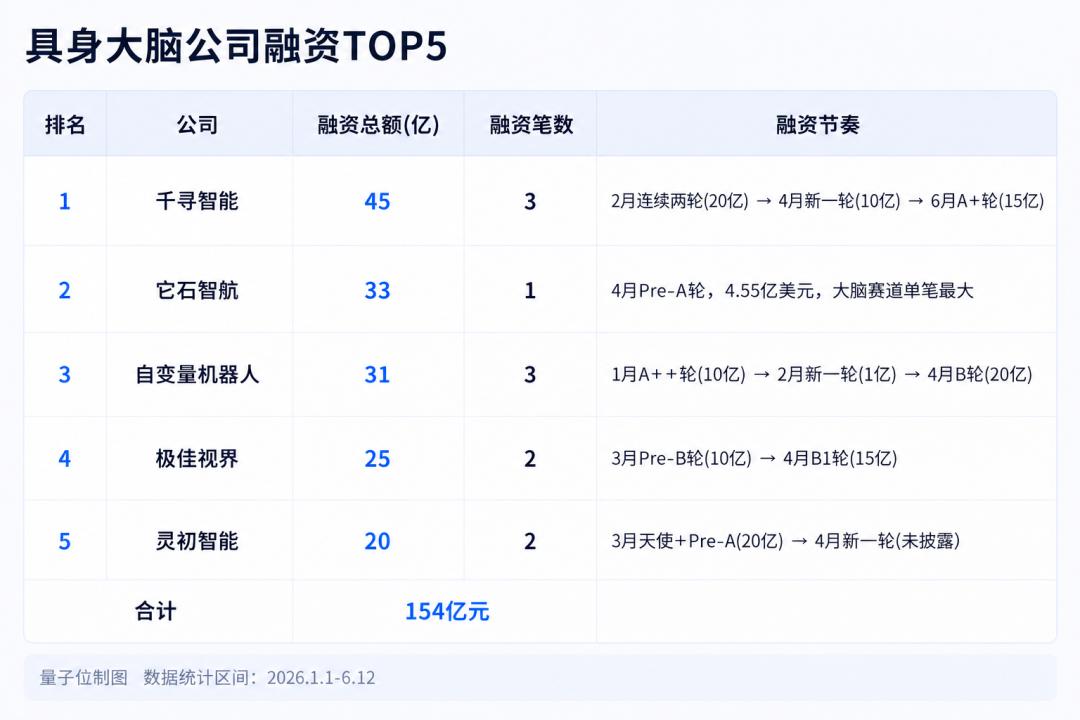
ItiZhihang raised 455 million USD (approx. 3.3 billion RMB) in its April Pre-A round—setting a new record for the highest single fundraising in China’s embodied intelligence sector—and surpassing most A/B-round valuations for other firms.
Some projects have attracted continuous follow-on investment during their angel rounds.
Shendong Xinxue completed a “triple jump” from Angel to Angel+ to Angel++ in under 70 days. Zhiyue Space Intelligence even secured an “Angel++++” round and closed two rounds within a single month in April 2026.
Typically, angel rounds focus on “idea and team,” whereas A rounds assess “business model and data.” Continued fundraising at the angel stage usually indicates that startups haven’t yet met the threshold for the next funding round.
Meanwhile, resources are concentrating on top-tier companies. The top five fundraisees collectively raised 15.4 billion RMB, accounting for about 70% of total sector funding.
Among them, Qianxun Intelligence is currently the most sought-after Brain-First company. From February to June 2026, it completed four rounds of financing totaling nearly 5 billion RMB, with a valuation now reaching 20 billion RMB.
Looking back, this surge in Brain-First entrepreneurship began in 2025 and continues today. According to incomplete statistics by QuantumBit, among the 35 Brain-First companies disclosing fundraising activity in 2026, more than half were founded after 2025—six of them established this year.
Conversely, Full-Stack companies, which balance both body and brain, were mostly founded prior to 2025.
Recently, some Full-Stack firms have also gained capital backing due to enhanced “brain” capabilities, leading to dramatic valuation increases and entry into the hundred-billion RMB club.
For instance, in March 2026, StarMotion announced a 1 billion RMB strategic round, pushing its valuation past 10 billion RMB. The key focus of the funding announcement highlighted breakthroughs in world models and VLA (Vision-Language-Action), as well as full-stack self-research and development capabilities.
Another Full-Stack firm with a valuation exceeding 20 billion RMB is StarSea Map. Its partner and CFO Luo Tianqi publicly stated that the current core variable driving robot industry development is the iteration of embodied brains.
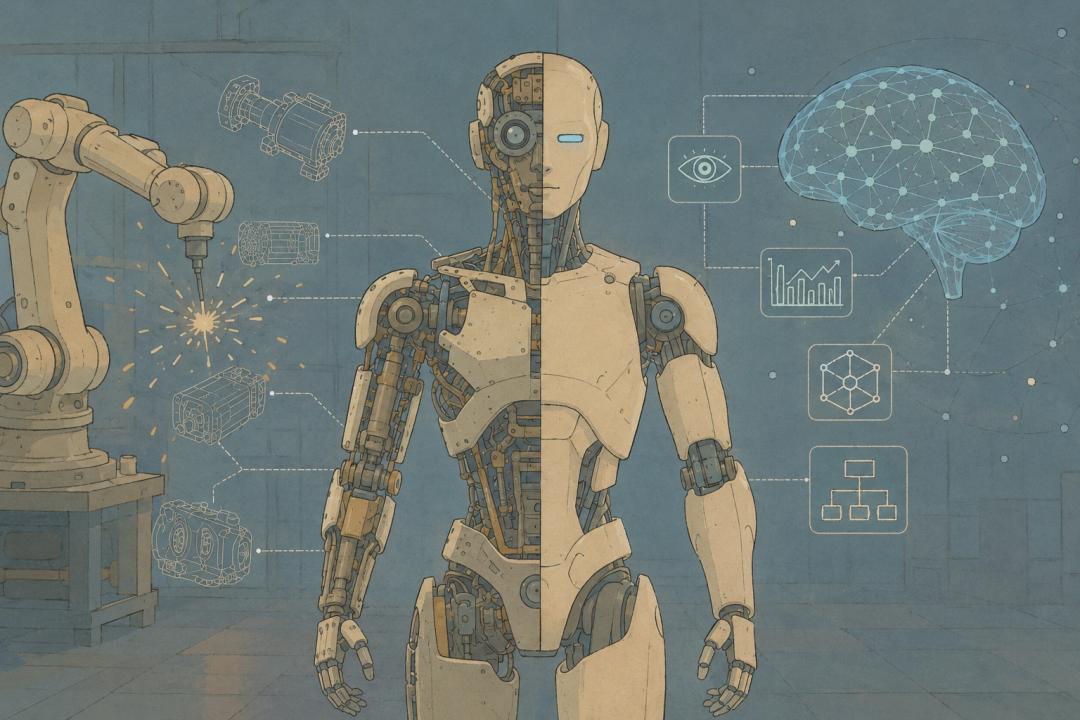
Why is the embodied brain currently so attractive to capital?
A common saying in the investment community: “The body sets the floor, but the brain determines the ceiling.”
Yu Wenxiang, Investment Director at Sanqi Interactive, told QuantumBit that although robot hardware remains imperfect, the real challenge lies in supply chain, cost control, and mass production—areas where China's manufacturing advantage can drive rapid evolution.
Current market consensus holds that the brain is the biggest bottleneck in embodied intelligence—and inherently carries higher valuation logic due to low marginal costs, reusability, and transferability.
At the 2026 AI Yuan Conference, Han Fengtao, Founder and CEO of Qianxun Intelligence, said if Iron Man’s JARVIS represents a 100-point robot, current mechanical arm maturity stands at 50 points, wheeled chassis at 40 points, quadruped systems at 30 points, while AI intelligence is only at 3 points. “But the speed from 3 to 50 will be very fast.”
Almost 80% of Companies Developing World Models
The second clear trend: World models have become the most favored technical pathway in recent funding rounds.
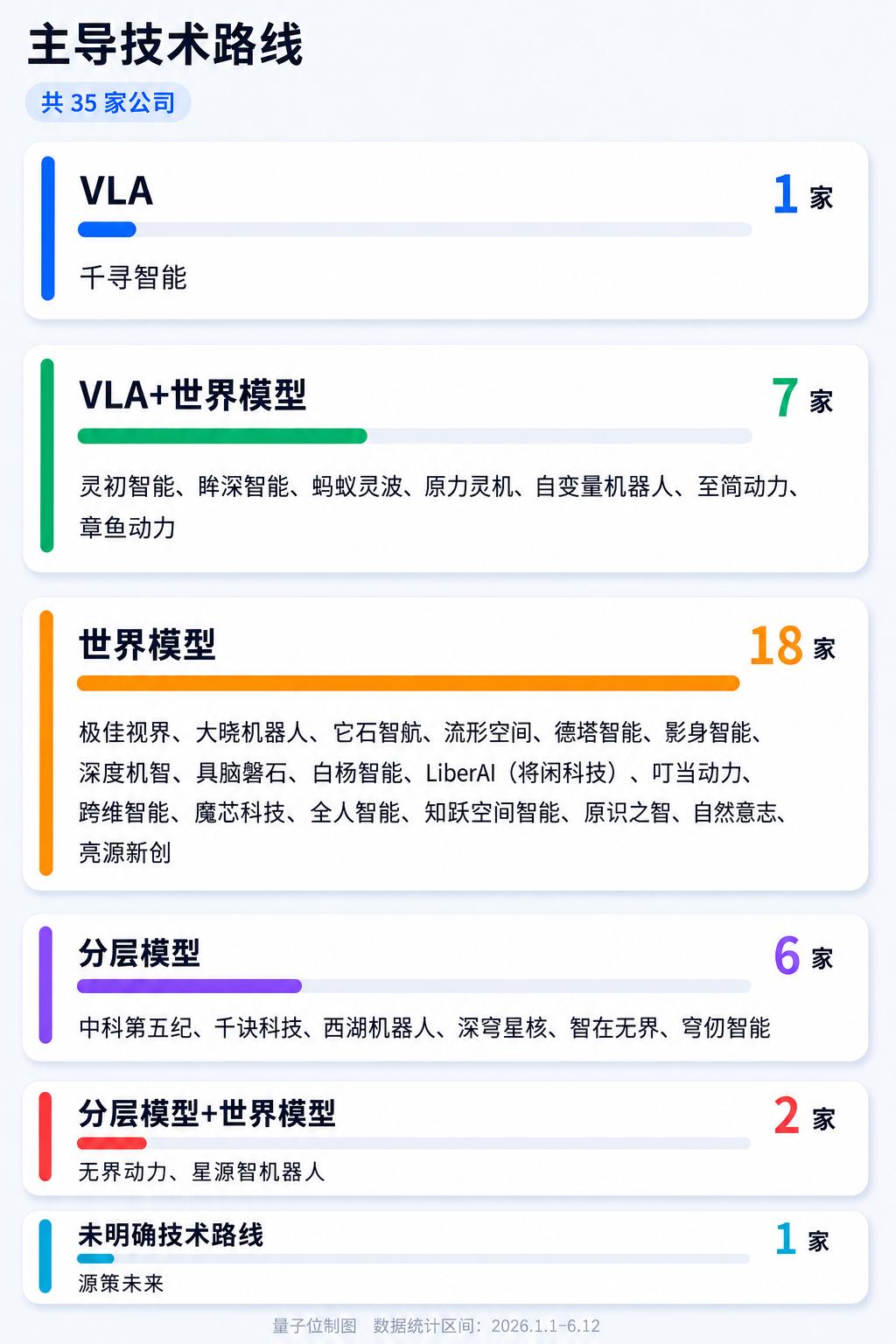
QuantumBit’s statistics show that among the 35 Brain-First companies with funding activity in the first half of 2026, 27 are developing world models—nearly 80%.
Embodied brains follow multiple technical routes, including VLA, world models, and hierarchical models.
In 2024, virtually all top robotics firms emphasized VLA, prioritizing real-world data. Today, however, “it feels like anyone not building a world model is already behind.” One investor told QuantumBit.
Yet, there is still no consensus on what a “world model” truly means. “World model is currently the most misused and semantically overloaded term in AI,” Li Feifei wrote in her latest long-form article.
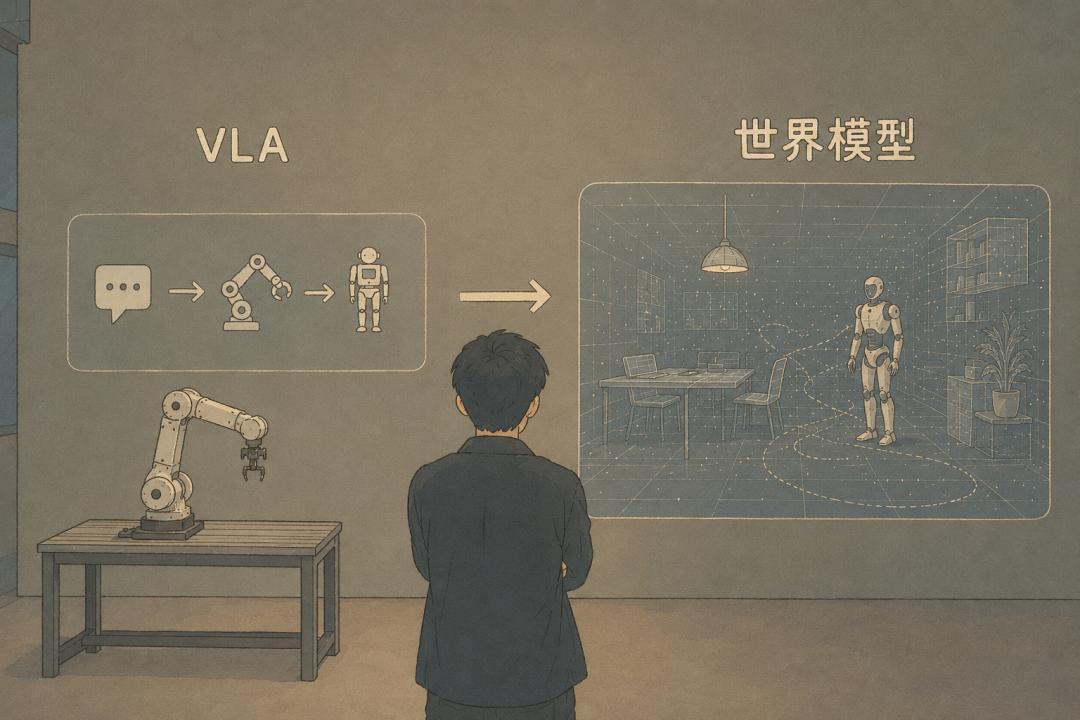
Jiang Ziyan, an investor at Guoke Capital, told QuantumBit that the main difference between most world models and VLAs in practical deployment is that the former uses video generation models as backbone, while the latter relies on language models.
He observed that besides academic teams and entrepreneurs from the AI 1.0 era, a wave of companies specializing in 3D graphics, video generation models, and simulation engines are now entering the world model space.
Despite this, most companies still actively adopt the “world model” label—clearly signaling to investors: “We’re different from the previous generation of VLAs.”
However, for robots themselves, strictly distinguishing between VLA and world model paths may not matter as much.
“Black cat or white cat—what matters is catching mice.” Now, many companies combine world models with VLAs instead of choosing one over the other.
To Jiang Ziyan, transitioning from VLA to world models is not difficult for early-stage embodied brain firms. Just as video generation models initially used U-Net architecture, the rise of Sora prompted the entire industry to shift to DiT (Diffusion Transformer) architecture.
“Use whatever technology works best—few founders stick to one path forever,” he said. “Two years ago, everyone thought VLA was the future; this year, world models are seen as the future. Next year, perhaps another new tech will emerge as the next frontier.”
Gan Ruyi, Partner and Algorithm Lead at Self-Variable Robotics, told QuantumBit that compared to debates over technical routes like world models or VLAs, the underlying data infrastructure is the true competitive edge.
This infrastructure covers data acquisition, training, and evaluation across the entire pipeline, forming a stable, scalable industrial-grade system.
“With this data infrastructure in place, even if a new technical architecture emerges, we can quickly catch up,” he said.
Academic Research Teams Drive Entrepreneurship
The third trend: As technical pathways remain unconsolidated, talent has become the primary factor for investors when evaluating teams.
“You can be flexible in judging technical routes, but you must be meticulous in assessing the team,” said one investor.
Entrepreneurs with academic backgrounds dominate the Brain-First landscape. QuantumBit found that 17 out of the 35 companies analyzed had founders from universities or research institutions—about half.
Even non-academic firms often recruit a university/research-affiliated co-founder or Chief Scientist to form their founding team.
Tsinghua University is the most significant talent source. Nine founders, co-founders, or chief scientists of these Brain-First companies hail from Tsinghua, with Yao Class, the Center for Neuromorphic Computing, and the Department of Computer Science serving as the three most concentrated talent pipelines. Representative companies include Jijia Vision, Yuanli Lingji, and CAS Fifth Century.
Following closely is Peking University, with five founders originating from PKU—such as Xingyuan Smart Robotics, Zhiyue Space Intelligence, and Zhizai WuJie.
Many founding teams blend top-tier institutions—e.g., Self-Variable Robotics and Deta Intelligence both have founders from Tsinghua and Peking University.
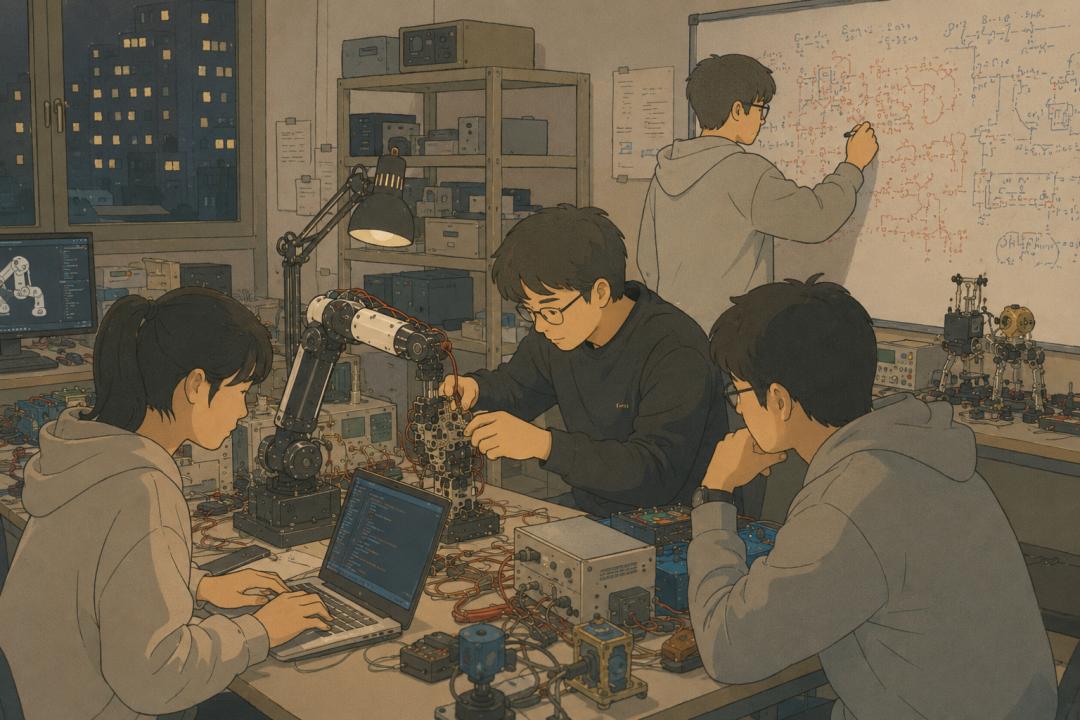
Besides academic teams, another major entrepreneurial force comes from veterans of the autonomous driving industry—companies like Horizon, Huawei, and Baidu. Their representative ventures include Jijia Vision, Dingdang Power, Octopus Dynamics, and Wujie Power—six companies in total.
Many practitioners view embodied intelligence as the next frontier after autonomous driving: both fundamentally involve enabling AI to perceive, reason, and act in the real world—except one drives cars, the other controls robotic bodies.
The remaining 13 companies fall into three categories: internet giants like Alibaba, JD.com, and Xiaomi; AI 1.0 firms such as SenseTime and Megvii; and robotics companies.
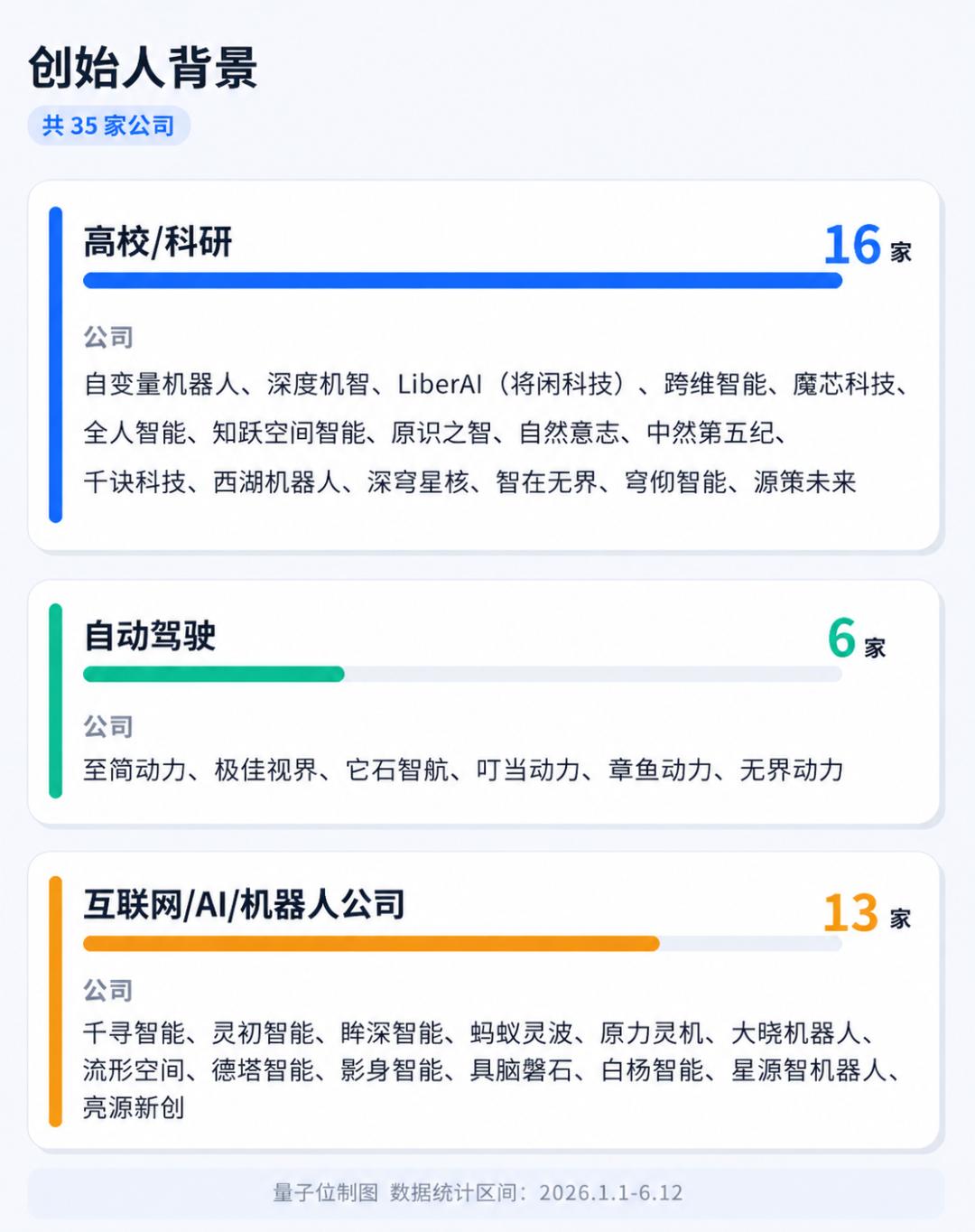
At the same time, the founder cohort is rapidly aging downward.
Liu Songming, one of the founders of LiberAI (Jiangxian Tech), is a Tsinghua 00s recipient of the Special Prize. Chen Yuanyu, co-founder of Lingchu Intelligent, is also a 00s graduate of Peking University and previously studied under Fei-Fei Li at Stanford, turning down a million-RMB annual offer from Huawei’s “Talent Genius” program. Both have drawn strong capital interest.
“A few years ago, many founders were university professors; this year, professors are fewer, and young PhDs are increasingly popular,” noted one investor.
Compared to seasoned founders, Jiang Ziyan also favors younger teams. In his view, while experienced professionals may boast impressive resumes, they aren’t always at the forefront of technological evolution. Younger founders tend to be more familiar with cutting-edge developments, have more open minds, lower communication costs, and are less constrained by existing paradigms.
“Questioning the Bubble, Understanding the Bubble, Embracing the Bubble, Enjoying the Bubble”
Beneath the intense heat of the embodied brain boom lies another subtle shift: the relationship between startups and investors is evolving.
Previously, founders pitched to investors to secure funding. Now, increasingly, investors proactively seek out opportunities.
“Companies that need to initiate contact with investors for funding are usually not doing well,” said Tan Keming (a pseudonym), a long-term observer of embodied intelligence investing, to QuantumBit.
For companies with strong IPO ambitions, investors are now “rushing to pour money in,” while the companies themselves often remain indifferent.

Two years ago, when Tan Keming invested in a Brain-First company, its valuation was only in the tens of billions. He could casually chat with the founder for hours. Now, the company’s valuation has surged to 200 billion RMB—even as a “major investor,” he sometimes doesn’t get replies when messaging the founder.
Now, when visiting these star companies, he usually only meets the CFO or Secretary—getting to speak with the CTO is considered a favor.
Tan Keming says some companies even run two funding rounds simultaneously. They directly tell investors: “If you can close quickly, you can join at a 100 billion RMB valuation in this round. If your process drags, you’ll have to wait until the next round at 150 billion RMB.”
Some investors grow even more anxious—those who once held pricing power now fear missing out.
Startups now hold the upper hand, controlling the timing and rhythm of fundraising, while investors are forced to chase.
In the secondary market, soaring stock prices of large model firms like MiniMax and Zhipu, coupled with IPO news from embodied intelligence players like Unitree, continuously stimulate investors.
Yet, compared to large model firms like MiniMax and Zhipu, embodied intelligence faces greater uncertainty.
“No one doubts the value of large models—debates center only on whether valuations are too high. But embodied intelligence is different—if its generalization fails to materialize, the actual deployable scenarios may be extremely limited,” said Tan Keming.
This implies that today’s massive capital inflow might ultimately go to waste.
From the initial “battle of a hundred models” to today’s consolidation into just a few survivors, the convergence of large models occurred rapidly within two to three years. But embodied intelligence is different—neither technical pathways nor business models show signs of convergence.
Even though everyone knows only a tiny fraction of these companies will survive, no one wants to miss out before the dust settles. Thus, the safest strategy becomes betting on multiple companies.

Ultimately, a brutal elimination race awaits embodied intelligence firms.
There’s a broad consensus in the industry: over 90% of embodied intelligence companies may disappear, leaving only a handful to prevail.
Qianxun Intelligence’s founder and CEO Han Fengtao said at the AI Yuan Conference that today, every company is hoarding resources and fighting for position, amassing ammunition for the future.
“If you don’t secure funding and valuation levels matching industry leaders this year, you won’t even get a seat at the table in the first wave of embodied intelligence entrepreneurship,” he said.
Bubbles do exist—but one investor told QuantumBit that moderate bubbles are necessary in the early stages of industrial development. “Without bubbles, it would be hard to rapidly gather capital, talent, and social attention.”
“Investors start by questioning the bubble, then come to understand it, embrace it, and eventually begin enjoying it,” said Tan Keming.
One investor summarized: “The confluence of scarcity × technical uncertainty × institutional competition” has fueled unprecedented prosperity in the embodied brain sector.
Right now, this capital frenzy shows no sign of ending. The story being told in the embodied industry is that future robots will sell at car prices and smartphone volumes—a market capable of generating trillions in scale.
When AI truly transforms the physical world, the industrial value unleashed by embodied intelligence may far exceed even the most optimistic projections of today’s capital markets. That is what makes this story truly captivating.
This article comes from the WeChat public account “QuantumBit” (ID: QbitAI), authored by followers of frontier technology, published with authorization by 36Kr.
Source: 36Kr
Disclaimer: Contains third-party opinions, does not constitute financial advice


IBM Unveils Dual-Architecture Host Chip with Native Support for IBM and Arm Instruction Sets, Integrated AI Accelerator
1 day ago
Flock Safety CEO Calls for Compromise on Privacy and Security, Company Faces Accusations of Surveillance Abuse
3 days agoFTC Urged to Investigate AI Firm's Practice of Purchasing and Destroying Books for Training Data
4 days agoOpenAI to Launch Astra Within Weeks: Employees Already Testing New Version in Codex
6 days agoTerraPower plans to unveil its first AI-powered data center nuclear project this year, featuring a molten salt reactor with integrated energy storage to address load fluctuations
7 days agoRivian spin-off Also Secures $150 Million in Series D Funding to Accelerate Development of Autonomous Delivery Vehicles
7 days agoU.S. legal AI company Harvey launches its proprietary legal model Tenet, powered by the Moonshot AI Kimi K3 foundation model
7 days ago