$138 Billion in Indian Remittances Behind the Scenes: Shift from Low-Skilled to High-Talent Emigration
$138 Billion in Indian Remittances Behind the Scenes: Shift from Low-Skilled to High-Talent Emigration

On the scorching construction sites of Dubai, laborers from Kerala, India, toil day after day; in the tech headquarters of San Francisco, Indian-origin executives steer the trajectory of global internet and technology development.
These two starkly contrasting scenes together paint the most authentic picture of modern Indian migration.
Some migrate across oceans for livelihood, while others rise to the pinnacle of global industries through talent and skill—connecting millions of overseas Indians to their homeland are remittances that traverse continents and seas.
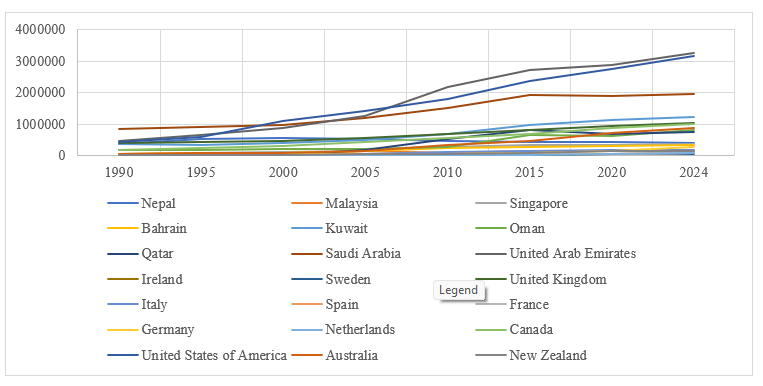
UN Department of Economic and Social Affairs, 2025: India's Migration Trends (1990–2024)
According to the International Organization for Migration’s 2026 World Migration Report, India’s remittance inflows reached $138 billion in 2024, ranking first globally—and the only country in the world to surpass the $100 billion threshold.
This capital improves living standards and strengthens national economic resilience. The evolution of Indian diaspora and remittances is a true reflection of the past century of globalization.
Indian cross-border migration originated during the colonial era, when vast numbers of Indians were transported as indentured laborers to work grueling jobs under harsh conditions—marking the beginning of sustained international migration.
After independence, migration progressed slowly until the 1970s, when rapid economic growth in Gulf states created massive labor shortages, drawing large numbers of Indians to work abroad. Kerala emerged as a primary source region, with its economy significantly boosted by remittances.
In the 1990s, India accelerated its opening-up policies, making travel and cross-border employment increasingly accessible. Workers no longer confined to the Middle East, diversifying job markets—professionals with specialized skills began entering global labor markets.
Entering the 21st century, Indian migration underwent transformation—from traditional labor export to high-end talent export. Top-tier Indian professionals now thrive in global sectors including technology, healthcare, and engineering.
In recent years, the number of Indian students studying abroad has surged dramatically, while India actively collaborates with multiple countries to facilitate professional mobility across borders.
Today, the Indian diaspora spans 207 countries, totaling 34.4 million people. Overseas Indians are broadly categorized into two groups: low-skilled laborers and high-skilled professionals.
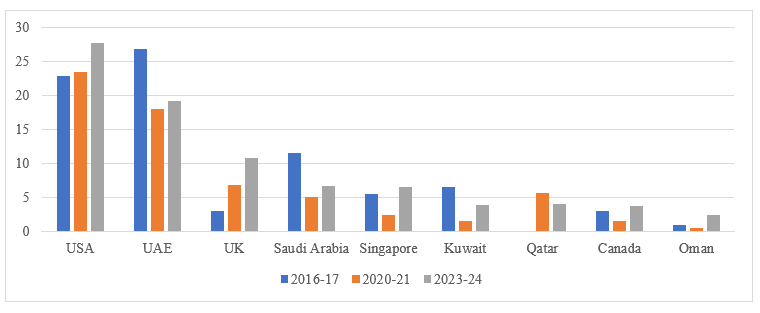
Reserve Bank of India, 2025 Data (Indian Migrants by Country)
The Gulf region remains the core hub for Indian low-skilled labor migration, maintaining the foundational base of traditional labor export.
Official data from 2021 to 2025 show India issued 1.7 million work permits abroad, with over 80% directed to Saudi Arabia, UAE, and Kuwait—the three major Gulf nations.
In the UAE, 3.9 million Indians constitute the largest group among foreign residents; in Saudi Arabia, 2.7 million Indian migrants predominantly work in traditional sectors such as basic services and construction.
These laborers, far from home, quietly anchor themselves in entry-level roles, earning livelihoods through relentless effort and sending small but vital remittances that sustain families back home.
In sharp contrast, elite Indian professionals have established deep roots in advanced economies like the US, UK, Canada, and Australia—where a significant portion of high-education, high-skill talent resides. In the US alone, there are 1.9 million Indian expatriates.
In Silicon Valley, Indian engineers account for over 30% of the workforce—forming the backbone of the tech industry. In healthcare, finance, and scientific research across Europe and North America, Indian specialists occupy critical positions.
Through their expertise, they secure high salaries, achieving upward social mobility—and simultaneously becoming the core source of India’s high-quality remittances today.
Notably, while India is a major exporter of migrants, it is also a significant recipient of immigrants, forming a unique two-way demographic flow.
Internal migration within India is extremely frequent: the 2011 census revealed that one in every three Indians had migrated domestically.
International inbound migration primarily comes from neighboring countries such as Bangladesh, Nepal, and Pakistan—supported by geographic proximity, cultural affinity, and open border policies, creating stable transnational population movements.
Among the world’s top ten cross-border migration corridors, India occupies four—underscoring its central role in the global migration system.
The persistent efforts of millions of overseas Indians have fueled a remittance economy worth hundreds of billions. This capital flowing across oceans has long become an invisible yet pivotal force shaping Indian livelihoods and stabilizing the national economy.
Looking back at remittance data over the past decade, growth has been striking: in 2010, India’s total remittances stood at $53 billion; by 2024, they surged to $138 billion—a near 1.6-fold increase—consistently leading all nations and vastly outpacing major remittance-receiving countries like Mexico and China.
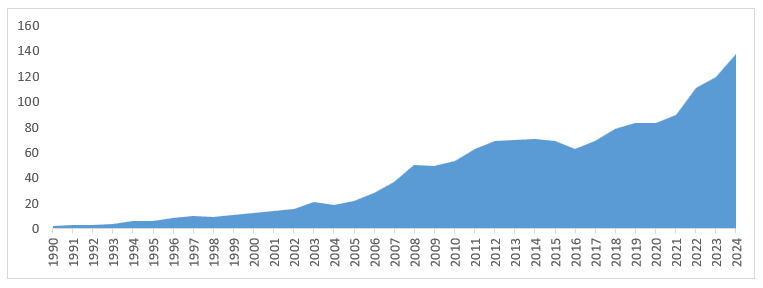
World Bank, 2025 Data
Unit: Billions of USD
More critically, the composition of India’s remittance sources is undergoing a transformative shift, fundamentally breaking away from the long-standing reliance on Gulf labor remittances.
Today, the United States has surpassed the UAE and Saudi Arabia to become India’s top remittance source. The inflow of funds from high-skilled professionals in Europe and America has liberated Indian remittances from the stigma of “laborers’ sweat money,” shifting toward high-quality, stable returns driven by human capital.
Salaries earned by high-tech professionals far exceed those of traditional laborers, not only elevating the overall scale of remittances but also significantly enhancing the resilience of capital flows against economic shocks.
For ordinary Indian households, remittances serve as a crucial lifeline. Many families rely on overseas income to cover essential expenses such as food, clothing, healthcare, and education—with surplus funds used for housing and small savings.
Consistent external income has also incrementally increased women’s decision-making power within rural households, reshaping traditional family structures.
At the macro level, remittances form a stable external financial pillar for India. Accounting for 3.4%–4% of GDP, they effectively supplement foreign exchange reserves and hedge against trade deficits.
Compared to volatile foreign direct investment, remittances exhibit stronger risk resistance and maintain consistent, reliable inflows—making them India’s most dependable source of foreign revenue.
However, remittance distribution across India shows pronounced regional imbalances. Four southern states—Maharashtra, Kerala, Tamil Nadu, and Karnataka—collect nearly 60% of national remittances, benefiting significantly from enhanced consumption and infrastructure development.
In contrast, remittances from northern labor-exporting states are largely spent on daily consumption, with minimal impact on local industrial upgrading.
Brain drain remains a structural challenge for India. A large cohort of homegrown high-skilled talent continues to emigrate to Western markets, leading to a loss of domestic educational resources and constraining the pace of growth in India’s high-tech industries.
Indian expatriates face severe disparities in living conditions. Low-skilled workers in the Gulf and Western countries often endure poor working conditions, limited wages, restrictive visas, and racial discrimination. Yet, their presence effectively fills labor gaps in host nations—despite being frequently overlooked in public discourse.
India’s overall remittance utilization efficiency remains relatively low. Most of the hundreds of billions in remittances go toward consumption, with minimal investment in real estate, entrepreneurship, or R&D—hindering long-term industrial momentum.
Additionally, cross-border remittance costs remain high, and data blind spots persist in migration statistics, posing challenges for policy formulation.
India’s migration structure is shifting from labor export to high-skilled talent export. Gulf countries’ localization policies are reducing employment opportunities for low-skilled workers, while sustained demand for skilled professionals in the West is driving India’s migration toward knowledge-intensive fields such as technology, healthcare, and research.
Simultaneously, remittance sources are evolving: Europe and America are gradually replacing the Gulf as India’s primary remittance origin, offering higher quality and greater stability.
The widespread adoption of digital finance is further reducing cross-border transfer costs and improving capital return efficiency.
India is continuously refining its migration governance framework. Through deeper international talent cooperation, expanded channels for high-skilled mobility, and strategic redirection of remittance flows toward real economy and innovation sectors, the nation is building a more sustainable diaspora model.
Authorities are also steadily improving migration statistical mechanisms to address existing data gaps.
Source: Huixiu
Disclaimer: Contains third-party opinions, does not constitute financial advice


Zhu Jia claims AI is reshaping private equity paradigms, with China shifting toward industrial application deployment due to chip restrictions
12 mins ago
ByteDance and ZTE Advance New Generation DouBao AI Smartphone Release May Be Delayed, Supply Chain Information Exposed
12 hours agoJPMorgan upgrades IBM rating, citing increased confidence in the acceleration of its software business
14 hours agoMorgan Stanley upgrades CDW rating and raises price targets for IBM, Dell, and TD Synnex, citing enterprise server demand underpinning computing infrastructure
14 hours agoApollo's Chief Economist: Middle East Geopolitics, AI, and Inflation Emerge as Wall Street's Three Key Macro Risks
14 hours agoSpaceX Signs Cloud Computing Agreement with AI Startup Reflection, Potential Contract Value Reaches $6.3 Billion
1 day agoJiangxing Intelligence has recently completed strategic financing rounds C and D, raising hundreds of millions of yuan, with funds allocated toward the construction of computing centers and physical AI production lines.
1 day ago