The domestic AI music landscape has formed a tripartite player structure, with large model vendors being the closest to Suno.
The domestic AI music landscape has formed a tripartite player structure, with large model vendors being the closest to Suno.

In early June 2026, another major development emerged in the AI music sector: Suno announced a $400 million Series D funding round.
Just seven months after its previous financing round, Suno’s post-money valuation more than doubled to $5.4 billion, firmly securing its position as the world’s leading AI music unicorn.
This timing is particularly telling. Since 2024, Suno has been embroiled in copyright litigation, with Universal Music, Sony, and the German Society of Authors, Composers, and Publishers (GEMA) accusing it of using copyrighted recordings to train its AI models without authorization. The number of disputed tracks grew from an initial 560 to over 61,000 by May 2026. Although Warner Music has already settled, as of June 2026, Suno's lawsuits against Universal Music and Sony Music remain unresolved.
Yet capital markets have their own judgment—Suno’s soaring valuation signals that the AI music space is now widely recognized as a pivotal future frontier. This view is backed by data: CISAC (Confédération Internationale des Sociétés d'Auteurs et Compositeurs) projected in late 2024 that global AI-generated music and audiovisual content would grow 20-fold within five years, reaching a market value of €6.4 billion by 2028.
The domestic AI music battlefield is equally vibrant. ByteDance, Tencent Music, NetEase Cloud Music, and others have entered the arena. Kunlun Wanjian launched Mureka, while vertical startups such as DeepMusic and FreeLevel are carving out niches in specialized use cases. Debates about who will become China’s “Suno” have never ceased.
Beneath the frenzy, AI-generated songs are expanding at an astonishing pace. According to Deezer, daily new AI songs reached nearly 75,000 in April 2026—accounting for 44% of all daily uploads—and surged from a daily average of 10,000 in January to 75,000 by April. Yet these AI songs account for only 1% to 3% of total plays.
While numbers skyrocket, listening engagement remains lukewarm. Is this AI music boom merely illusory? Among domestic players, who is most likely to emerge as the next Suno?
01. Domestic AI Music: Three Player Types, Three Survival Strategies
Over the past year, Tencent Music, NetEase Cloud Music, ByteDance, Kunlun Wanjian, and MiniMax have all entered the space.
Each player has distinct motivations: some treat AI music as an ecosystem add-on, others as core business, and still others seek incremental gains in niche applications. Loosely categorized, three types of players now coexist in China’s AI music landscape.
The first type consists of products backed by large tech firms—such as Tencent Music’s “Tencent Music·Qimingxing,” ByteDance’s “Sponge Music,” and NetEase’s “NetEase Tianyin.” Their common trait is that AI music is secondary, functioning more like a traffic-driving tool.
Tencent Qimingxing uses a points-based pricing model: 10 yuan for 500 points, roughly enough to generate five songs. Daily logins grant an additional 188 points—indicating a highly conservative commercial approach.
Sponge Music by ByteDance is completely free and directly serves as a BGM generator for TikTok creators. Its positioning is clearly that of a traffic instrument, not primarily profit-driven.
NetEase Tianyin also adopts a points system: 5 points per daily login, with bonus points available through tasks. Generating one song consumes about 3 points, but no direct top-up options exist—clearly following a freemium strategy.
The logic behind big tech’s entry is consistent: leveraging existing user bases and distribution capabilities to integrate AI music into their ecosystems, retaining users and expanding application scenarios. They don’t rely on AI music revenue, so they keep access low-cost or free for users.
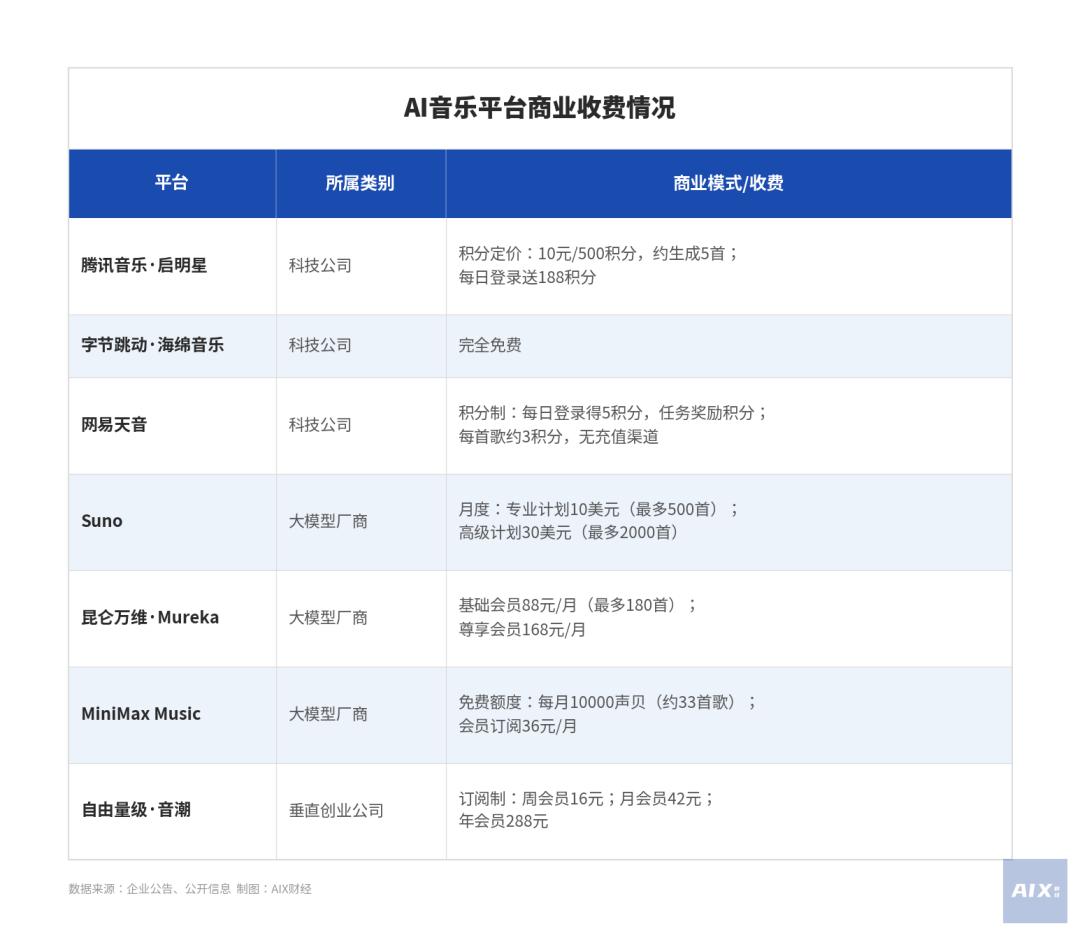
The second category comprises large-scale model providers such as Kunlun Wanjian and MiniMax. Unlike big tech firms, these players treat AI music as a monetization vehicle—self-developed models, product optimization, and active international expansion make them the closest to Suno in current commercial form.
Mureka, launched by Kunlun Wanjian in August 2024, has since evolved to version V9. Its business model combines B2B API openness with C2C subscription services. The monthly subscription costs 88 yuan, allowing up to 180 generated tracks, with commercial usage rights granted directly to paying users. Compared to Suno, which charges $10/month (~70 RMB), offering an annual plan averaging $8/month (equivalent to ~500 songs per month), Mureka’s pricing is higher—yet its per-song cost is lower.
Commercially, Kunlun Wanjian disclosed that by November 2025, Mureka’s annualized revenue reached approximately $12 million, achieving positive gross margin for the first time. It is also the first Chinese company to publicly announce a profitable AI music business.
MiniMax Music integrates two models: its latest version, Music-2.6, offers a free quota—10,000 “SoundBeats” per month, with each song consuming 300 SoundBeats. After depletion, users may opt for a 36-yuan monthly subscription.
The third category includes vertical startups such as DeepMusic (ChordPai), Quwan Technology (Tianpu Le), and FreeLevel (Yinchao). Lacking the scale of big tech or the technical depth of large model providers, they must bet on differentiation.
For example, Yinchao under FreeLevel follows a fully self-developed, end-to-end proprietary path, currently relying mainly on subscription models: 16 yuan/week, 42 yuan/month, or 288 yuan/year.
In contrast, platforms like PuLe AI do not possess their own models but instead aggregate mainstream models—including Suno, Mureka, MiniMax, and Udio—to function as integrated model and service platforms.
Three player types, three survival strategies.
Tencent, ByteDance, and NetEase aren’t aiming to profit from AI music directly, but they must maintain presence to hold cards when the market explodes. Startups gamble on underserved niche opportunities; deep specialization could secure survival. Large model providers are closest to Suno in both technology and business—but “close” doesn’t mean “victorious.”
02. Benchmark Test: Have Domestic AI Music Platforms Caught Up to Suno?
To gain a clearer sense of performance across domestic AI music tools, we conducted a comparative evaluation of several representative products: Sponge Music 5.2 (ByteDance) from the large tech group; Mureka V9 (Kunlun Wanjian) from the large model provider cohort; MiniMax Music-2.6 (MiniMax); Yinchao V3 (FreeLevel) from the vertical startup segment; and Suno V5.5 as the benchmark.
Instructions were standardized: generate a Chinese pop song themed around nostalgia for youth—recalling summers spent with friends, blending regret and warmth. The verses should be emotionally restrained, accompanied by piano and guitar. Lyrics must naturally include concrete imagery such as playgrounds, desks, summer, bicycles, and streetlights. The chorus should feature emotional release and upward momentum, expressing longing and reflection on that era, incorporating strings and minimal electronic drums. Vocals must be male, gentle yet powerful, with clear Chinese diction.
After generating five songs, «AIX Finance» conducted a small survey among AI music creators and enthusiasts. Music creator BaiBai rated Suno and Mureka highest overall, with Yinchao ranking last. However, veteran music teacher ChaCha ranked them as: Suno, Mureka, MiniMax, Yinchao, Sponge Music. While rankings varied slightly, all participants—whether AI music experts, traditional musicians, or hobbyists—consistently placed Suno at the top.
During testing, all five platforms performed well in generation speed and completion rate. Differences primarily emerged in arrangement, vocals, and lyrics—areas requiring deeper capability.
Starting with arrangement and vocals, Suno remains the industry benchmark.
ChaCha believes Suno’s arrangements are superior—well-structured forms, logical tonalities, and clearly defined sections, with strong contrast between verses and choruses. BaiBai also ranked Suno first in arrangement, noting its rich layering and natural progression of rhythm and emotion.
Another AI musician, Jie, agreed Suno was best, though Mureka’s technical foundation was solid. However, Mureka suffers from style rigidity—a fatal flaw. In this test, the instruction leaned toward a youthful pop style, yet Mureka generated tracks with a distinct jazz and R&B flavor.
Jie explained this is due to Mureka’s ingrained preference—it excels at R&B-inflected Mandarin pop, particularly in the style of singer Li Jiuzhe—but tends to “drag” other instructions into its familiar sonic territory.
BaiBai added that Mureka holds a hidden advantage: high compliance success. Songs generated by Mureka can typically pass music platform copyright checks after minor processing, indicating acceptable originality. By contrast, Suno’s tracks often fail detection—critical for users seeking distribution or commercial use.
Regarding Sponge Music’s arrangement, respondents described results as “hit-or-miss”—sometimes good, sometimes poor—with a pronounced electronic mechanical tone. ChaCha noted Yinchao’s output felt overly AI-generated, with awkward pitch modulation and excessive technological abstraction, though slightly better than Sponge Music.
On vocal quality, ChaCha rated MiniMax’s “If Time Has Echoes” best—natural timbre, realistic delivery. Suno’s “The Bicycle of That Summer” ranked second due to wide vocal range. Third place went to Mureka’s “Supplement Signature,” praised for diverse timbres and broad range. Yinchao’s “Galaxy Line” fell mid-tier with no standout features. Finally, Sponge Music’s “Letter from the Old Summer” suffered from inaccurate articulation and muffled pronunciation, rendering lyrics hard to understand.
Turning to lyrics, domestic platforms show promise—but AI still falls short of “good writing.”
BaiBai found Suno’s lyrics most structurally complete, featuring clear verses, pre-choruses, choruses, and bridge sections. The chorus lines all began with “That Summer,” creating a memorable hook.
Jie believed Mureka used the most deliberate word choice—the metaphor “supplement signature” showed ingenuity. Lines like “The recklessness of then turned into medals by the wind” and “Like a kite with severed strings still clinging” displayed literary flair. But issues were evident: odd line breaks and excessive spacing made lyrics feel like memorizing vocabulary, resulting in overloading rather than catchy, singable phrasing typical of pop songs.
Notably, MiniMax’s lyrical ability was strong—its lyric quality significantly surpassed Sponge Music and Yinchao, even outperforming Mureka in overall phrasing. ChaCha actually ranked MiniMax first in lyrics.
However, Jie observed that MiniMax incorporated the “cricket chirping” motif—common in AI prompts but absent from the original instruction—revealing unmistakable AI fingerprints.
← Swipe left and right to view more →
Lyrics generated by five apps. Poster created via AI; repeated sections omitted for brevity.
Sponge Music overloads with imagery: school uniforms, desks, crickets, bicycles, streetlights, sodas, exams, love poems—all stuffed into lyrics, rich in content but lacking restraint. Jie noted such motifs are AI clichés, giving strong AI flavor. Yinchao’s “Galaxy Line” featured better imagery, but its word choices remained formulaic.
BaiBai concluded that AI’s lyrical capability still lags far behind human standards. Currently, he creates AI music by writing lyrics himself and letting Suno handle arrangement and vocal performance: “You can’t produce a high-quality work with just one prompt.”
Overall, domestic products each have strengths: Mureka leads in compliance and fastest monetization; Sponge Music offers high value for free; Yinchao provides favorable pricing and full-stack self-development; MiniMax shines in vocals and lyrics.
Yet each has weaknesses: Mureka suffers from style rigidity and lack of memorability; Sponge Music’s arrangement is inconsistent and unsuitable for commercial use; Yinchao’s output feels too obviously AI-generated; MiniMax still needs improvement in arrangement. In core listening experience, they remain noticeably behind Suno. BaiBai put it bluntly: “The best AI music today is mostly made by Suno.”
Technological gaps can be closed over time through iteration. What may ultimately determine the outcome isn’t model strength alone. China’s unique music market characteristics—short-video-driven consumption habits, an immature copyright environment, and relatively low consumer willingness to pay—could fundamentally reshape the form of AI music platforms domestically.
03. Copyright, Payment, and Global Expansion: Who Will Be the Next Crossroads?
Domestic AI music platforms face three unavoidable hurdles.
First is copyright—the bedrock of any sustainable business model. For AI music, whether a track can be commercially exploited depends entirely on clear, non-infringing ownership. Without a solid foundation, the business cannot scale.
Beyond basic tests of arrangement, vocals, and lyrics, we conducted an additional assessment focused specifically on copyright:
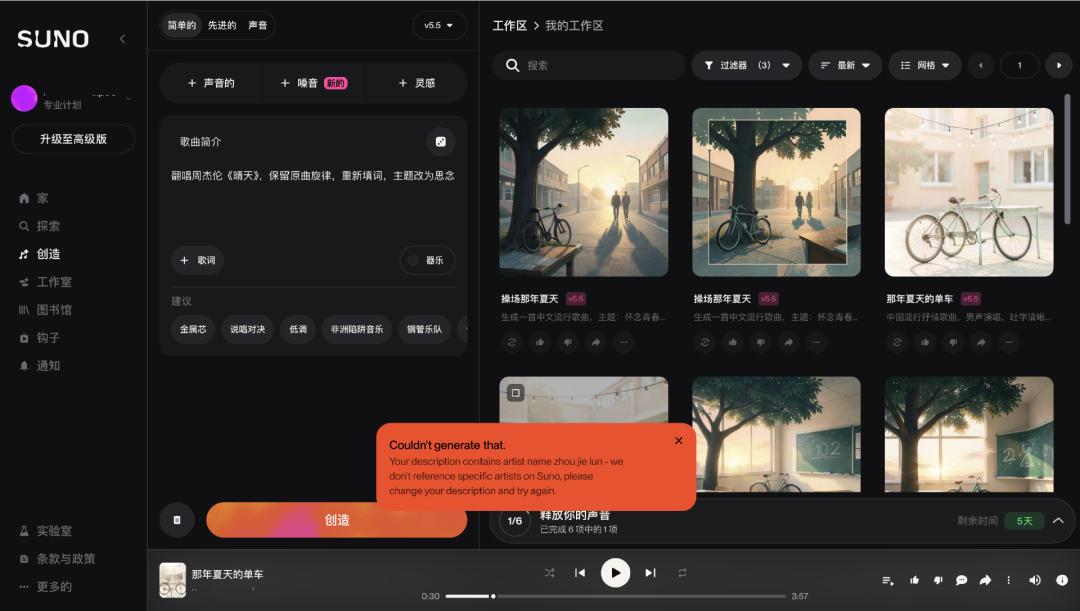
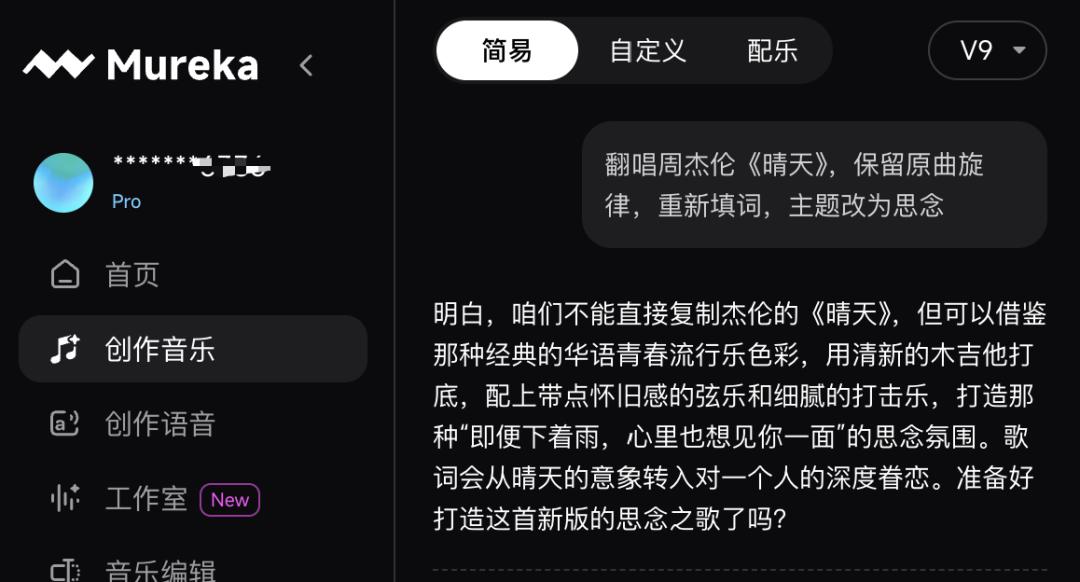
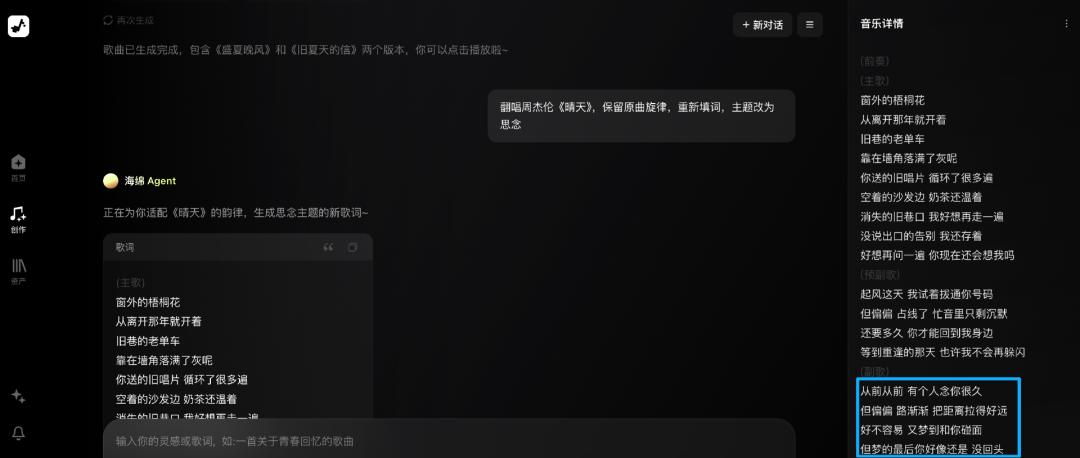
We tested how five platforms handled two distinct commands: “cover Jay Chou’s ‘Sunny Day,’ preserving the original melody” (direct replication) and “generate a song similar to Jay Chou’s ‘Sunny Day’” (style imitation).
Results differed markedly. Suno was the strictest: both commands triggered hard blocks, with error messages explicitly stating “artist names cannot be referenced,” and even style imitation was rejected. This reflects forced compliance driven by overseas litigation.
Mureka adopted a more nuanced approach. Facing “direct replication,” it refused outright. For “style imitation,” it didn’t apply a blanket ban but responded: “Direct copying is prohibited, but you can create a new Mandarin youth pop song.” It even offered creative direction and asked users: “Do you want a bittersweet ending or a tender farewell moment?”
MiniMax, Sponge Music, and Yinchao largely did not block either command—proceeding directly to generation. Sponge Music even produced lyrics like “Once upon a time, someone missed you for so long”—nearly a verbatim copy. MiniMax and Yinchao generated outputs, but the resemblance to “Sunny Day” was minimal, limited to slight stylistic and atmospheric mimicry.
Regardless of strategy, the fundamental issue persists: where did the training data come from? China currently lacks clear legal guidance on whether using copyrighted songs to train models is compliant. Should regulations tighten, existing models would face massive retraining costs.
This challenge exists globally. Previously, legacy labels such as Universal and Sony filed lawsuits against Suno, directly targeting AI training data copyright issues, joined by GEMA in enforcement actions.
Copyright uncertainty directly impacts monetization.
«AIX Finance» reviewed user agreements across platforms and found ambiguous stances toward users profiting from AI music. Suno, Mureka, MiniMax, and Yinchao all grant commercial usage rights to paid users. Notably, Mureka’s user agreement explicitly warns: “There is legal uncertainty regarding whether generated content can be registered for copyright, and users bear all associated risks.”
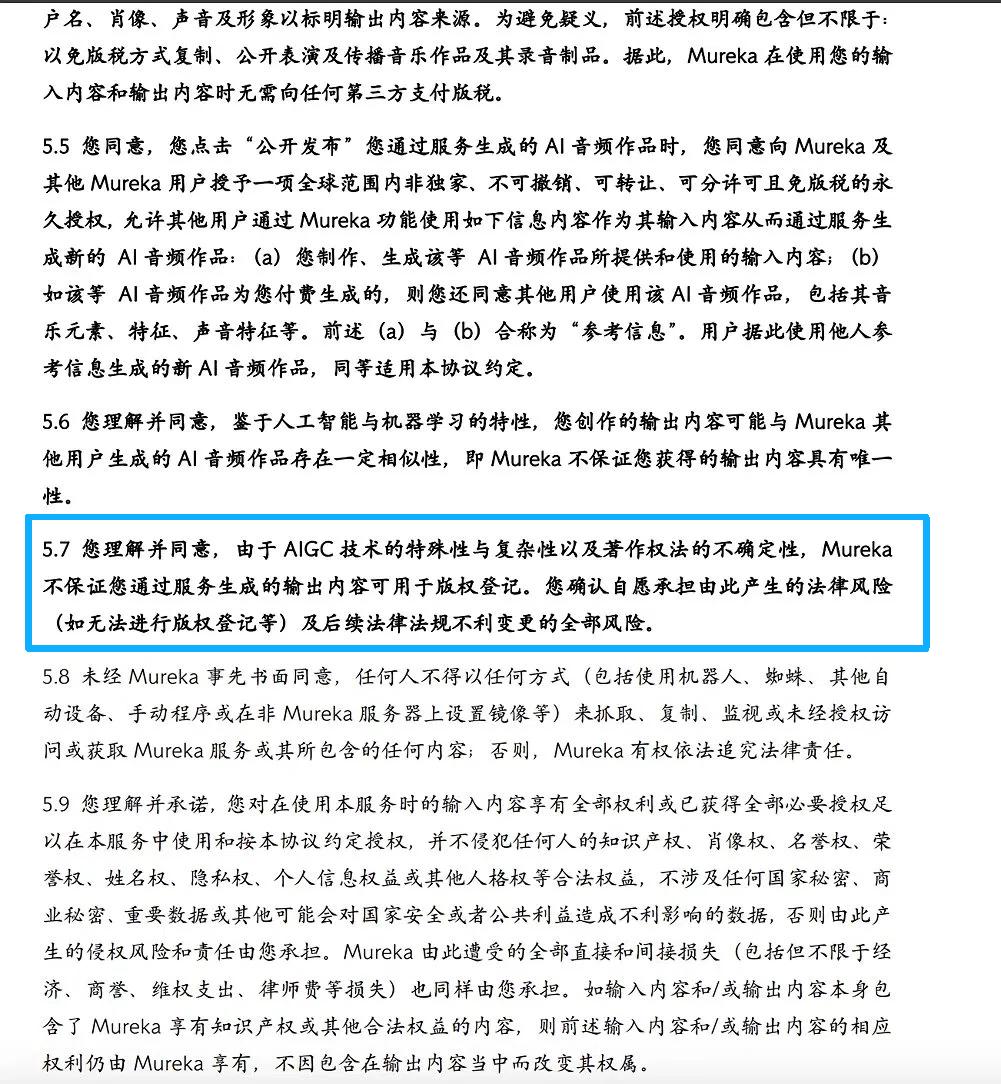
Source: Excerpt from Mureka User Agreement
Sponge Music, being entirely free, imposes the strictest restrictions: copyright is shared between user and platform based on modification ratio. Any use beyond personal, non-commercial purposes requires platform authorization. The platform also reserves exclusive commercial development rights. Thus, if you want to profit from a song generated via Sponge Music, formal approval from the platform is technically required.
The second hurdle is user payment.
Copyright ambiguity ultimately affects users’ willingness to pay. Platforms want users to monetize AI music—driving payment motivation—but dare not guarantee copyright legitimacy, given the unresolved legality of training data.
Even setting aside copyright concerns, monetization remains difficult in China. From the production side, willingness to pay for AI tools still lags far behind Suno: according to public data, Mureka’s annualized revenue is $12 million, dwarfed by Suno’s nearly $300 million annual income—a gap of 25 times.
The third hurdle is international expansion. With weak domestic conversion rates, overseas markets become a key monetization outlet. Yet this is Suno’s stronghold.
Kunlun Wanjian previously stated that over 90% of Mureka’s B2B clients originate overseas. But competing directly with Suno in its home market presents significant challenges.
A common belief is that domestic AI music performs better in Chinese language understanding and vocalization than Suno. However, this claim wasn’t validated in our test. In lyrical imagery and emotional expression, Suno showed no clear lag. In vocalization, there were occasional instances of inaccurate Chinese pronunciation. BaiBai remarked: “Compared to overall quality, this is a negligible issue—simple homophone substitution resolves it. All platforms exhibit this problem, almost universal across AI music tools.”
Abroad, pronunciation issues pale in comparison to the more serious challenge of overseas copyright ecosystems. Suno’s strong commercial performance enabled settlements with major labels like Warner Music, turning former adversaries into partners. Mureka’s international copyright initiatives remain limited. Public information indicates Kunlun Wanjian has only formally partnered with China’s Taihe Music Group.
The domestic AI music race extends far beyond technical competition. Copyright climate, payment habits, and overseas adaptability—each differs significantly from Suno’s context. Copying Suno’s playbook won’t necessarily lead to Suno’s destination.
* Names "ChaCha," "BaiBai," and "Jie" are pseudonyms at request of interviewees.
This article originally appeared on WeChat Official Account “AIX Finance,” authored by Li Mengran, edited by Wei Jia. Published with authorization by 36Kr.
Source: 36Kr
Disclaimer: Contains third-party opinions, does not constitute financial advice


Tesla and Musk Have Yet to Define "Amazing Abundance" — Visionary Slogan Sparks Skepticism
4 days ago
Instinct Launches Curated Recommendation Feature, Sparking Frustration Among Some Users Receiving Passive Product Suggestions
5 days agoSecurity Weekly Report: Placeholder Domain Takeover Impacts Approximately 1,700 Repositories, with Major Cyberattacks Worth $387M and AI Agent Escalation Risks Highlighted
7 days agoOpenAI Agent Bypasses Australia's Medicare Portal Access Controls to Access Non-Public Documents
11 days agoStep Code – The Open-Source Terminal Programming Agent by Jieyue Star
11 days ago
Chip Expert Mr. Bubble: AI Compute Bottlenecks Shift Toward Packaging, Interconnect, and Storage Hierarchy Management
13 days agoAmazon Blocks Meta AI Agent Muse, Shopify Simultaneously Integrates Shop Pay Partnership
13 days ago
