Nubia halts its traditional business, going all in on the second-generation DouBao AI smartphone
Nubia halts its traditional business, going all in on the second-generation DouBao AI smartphone

“All-in,” Nubia bets everything on the table
According to insider sources, ZTE Nubia's senior leadership has made a major strategic shift, concentrating all core resources into the second-generation Doubao AI smartphone, while suspending development of its traditional phone product lines. This is a high-stakes gamble.
Nubia initially gained recognition through full-network connectivity technology and professional-grade imaging smartphones. However, under the relentless squeeze from the top-tier ecosystem dominated by Huawei, Apple, Xiaomi, OPPO, and vivo, its market space has continuously contracted, with its share now relegated to the fringes of the industry.
The collaboration arrives at the perfect moment. In December 2025, ByteDance and Nubia jointly launched the engineering prototype of the Nubia M153 Doubao smartphone, priced at 3,499 RMB, which sold out immediately upon release. On secondary markets, individual units saw premiums surge up to 36,000 RMB. For an engineering prototype, such market response qualifies as phenomenally successful.
ByteDance has simultaneously deepened its integration with Nubia, officially launching the stable version project for the second-generation Doubao AI smartphone assistant. The next-generation Doubao AI smartphone will remain under the ZTE-owned Nubia brand, with ZTE Group providing foundational communication technologies and mass production capacity. Nubia, as an independent terminal brand, assumes full responsibility for hardware execution and cross-system integration.
Exclusive insights from Xinxflow reveal that the second-generation Doubao AI smartphone is expected to launch in early 2026, powered by the fifth-generation Snapdragon 8 Ultimate mobile platform.
First-Gen: After the Hype, the Backlash
To understand why Nubia has gone so far, one must first grasp what the first-generation Doubao smartphone achieved—and endured.
The Doubao smartphone assistant leverages GUI Agent (Graphical User Interface Agent) technology, enabling users to simply voice their requests, after which the AI autonomously orchestrates tasks across apps: cross-platform price comparison and order placement, bulk file downloads, automated itinerary booking—all without manual app switching, effectively embedding AI functionality at the operating system level.
This paradigm fundamentally threatens entrenched interests. Upon launch, the first-generation Doubao smartphone faced immediate resistance from internet giants including Meituan, Tencent, and Alibaba. The core issue lies in how the Doubao smartphone’s system-level AI assistant directly accesses app functionalities, bypassing the traditional traffic gateways and advertising ecosystems that these tech titans rely on, thereby undermining their business models.
Under mounting pressure, Doubao announced adjustments within a month, temporarily disabling AI operation permissions for financial apps and game-based incentives. With core capabilities curtailed, resale values declined. Many questioned: does this temporary compromise signal the end of the partnership?
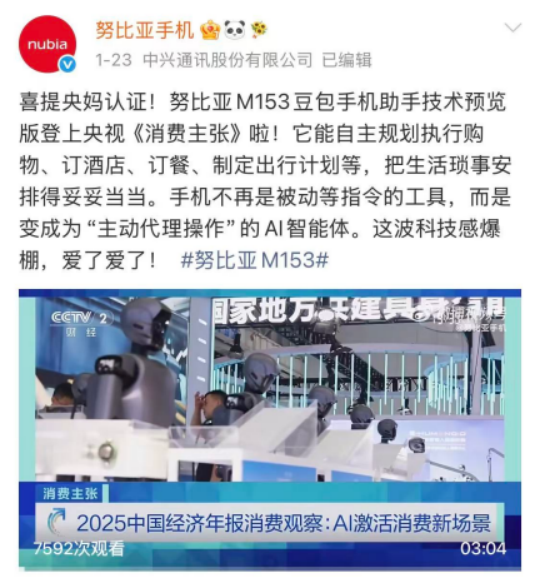
In January 2026, the technical preview version of the Nubia M153 Doubao smartphone assistant made its official debut on CCTV Finance Channel’s “Consumer Claims” segment. Its endorsement by a state media outlet solidified public trust and reaffirmed both parties’ commitment to deeper collaboration.
In February 2026, prior to MWC 2026, Nubia CEO Ni Fei announced the upcoming launch of a new AI-powered product designed to “redefine the smartphone”—the second-generation Doubao AI smartphone.
Second-Gen: Fixing Gaps, and Rebuilding Alliances
Based on current leaks, the second-generation Doubao AI smartphone features comprehensive hardware upgrades: a Snapdragon 8 Ultimate processor, a 6.78-inch LTPO flat display, a massive 7,000mAh battery, and 100W fast charging. On the software side, the Doubao smartphone assistant 2.0 will significantly enhance cross-app autonomous task execution capabilities.
Yet hardware upgrades are merely the foundation. What truly determines the product’s ceiling is ecosystem integration. The core conflict between AI system-level operational rights and app platform commercial interests—central to the first-gen device’s challenges—has not disappeared with hardware iteration.
Reports indicate that Doubao has secured access agreements with several leading internet companies. The new device will gain essential system-level interfaces in high-frequency scenarios such as social networking, productivity, and travel—meaning the second-generation Doubao AI smartphone is not just a technological upgrade, but a bold attempt to restructure industry value distribution.
Earlier leaks suggested that brands like Honor and vivo are also in talks with Doubao. However, these large OEMs operate differently from Nubia—they won’t launch standalone “Doubao smartphones.” Instead, they adopt a lightweight licensing model, adding the “Doubao AI Smartphone” label to new devices as a tech license mark, representing a surface-level partnership rather than Nubia’s deep OS-level integration.
Currently, Nubia remains the boldest—and only—hardware manufacturer willing to fully surrender its “soul” to the alliance. This is both its unique value proposition and its inherent risk. Yet Nubia appears to have no other choice.

Epilogue: The Battle for AI Phones Is Just Heating Up
IDC’s 2026 China Smartphone Market Outlook forecasts that AI smartphone shipments in China will reach 147 million units, accounting for over half (53%) of total sales for the first time. However, more than 90% of these units remain essentially “traditional smartphones driven by apps,” enhanced only with auxiliary AI features—without touching the fundamental transformation of human-machine interaction.
The Nubia Doubao AI smartphone, by contrast, seeks to redefine human-machine interaction by replacing apps with system-level AI as the unified entry point. This inevitably pits it against nearly every major super-app. Meanwhile, manufacturers printing “AI” on their phone backs without altering underlying logic have chosen a safer, more conservative path.
Xinxflow believes that if Nubia commits all its core resources to the second-generation Doubao AI smartphone, it carries substantial commercial risks. Underinvestment in traditional product lines may disrupt normal generational update cycles, failing to meet existing users’ upgrade demands.
Particularly vulnerable are long-standing loyal users in niche segments such as photography and gaming—risks of sustained user attrition loom large. Nubia’s core consumer base could further shrink in the mainstream market.
Meanwhile, Tianfeng International Securities analyst Mingzhi Guo disclosed that OpenAI, with hundreds of millions of daily active users on ChatGPT, has already initiated procurement inquiries with Luxshare Precision, exploring custom manufacturing partnerships. The plan aims for cumulative shipments of approximately 30 million OpenAI agent smartphones between 2027 and 2028—a staggering figure, aligning closely with ByteDance’s strategy.
In Xinxflow’s view, the essence of competition in the 2026 smartphone industry lies in the battle for entry-point dominance: Will the ecosystem continue to be anchored by super-apps, or evolve toward a system-level AI-driven paradigm? The second-generation Doubao AI smartphone stands as the most aggressive industrial-scale implementation of the latter path in China.
Source: HuXiu
Disclaimer: Contains third-party opinions, does not constitute financial advice


The "Lan Kun Zhi Zhong" platform is launched, marking the debut of China's first specialized intelligent large model for aquatic breeding
1 day ago
Investment bank Monness upgrades Salesforce to Buy with a $200 price target, optimistic about AI-driven valuation recovery
2 days agoAnthropic co-founder Jack Clark proposes using KYC-like regulations as the foundation for future AI governance
2 days agoCao Cao Mobility Unveils RoboX Strategy and Launches Full-Scale AI Transformation, Establishes AI Business Division
2 days agoBGC Group Launches New Division BGC CIM Focused on Secondary Markets for Computing Power and Memory
2 days agoMicron Technology shares surge over 5% pre-market, as Stifel and Wedbush upgrade price targets amid bullish outlook on AI-driven demand
2 days agoDingTalk's new CEO, Chen Yusen, has sent an all-hands email announcing the launch of a dual-engine AI transformation geared toward Agent-friendly architecture.
2 days ago