At 17, unlocked the iPhone; at 18, took on NVIDIA—AMD proactively sent chips
At 17, unlocked the iPhone; at 18, took on NVIDIA—AMD proactively sent chips

In March 2025, George Hotz published an article on his personal blog titled simply “AMD YOLO,” meaning “no retreat, go all in on AMD.”
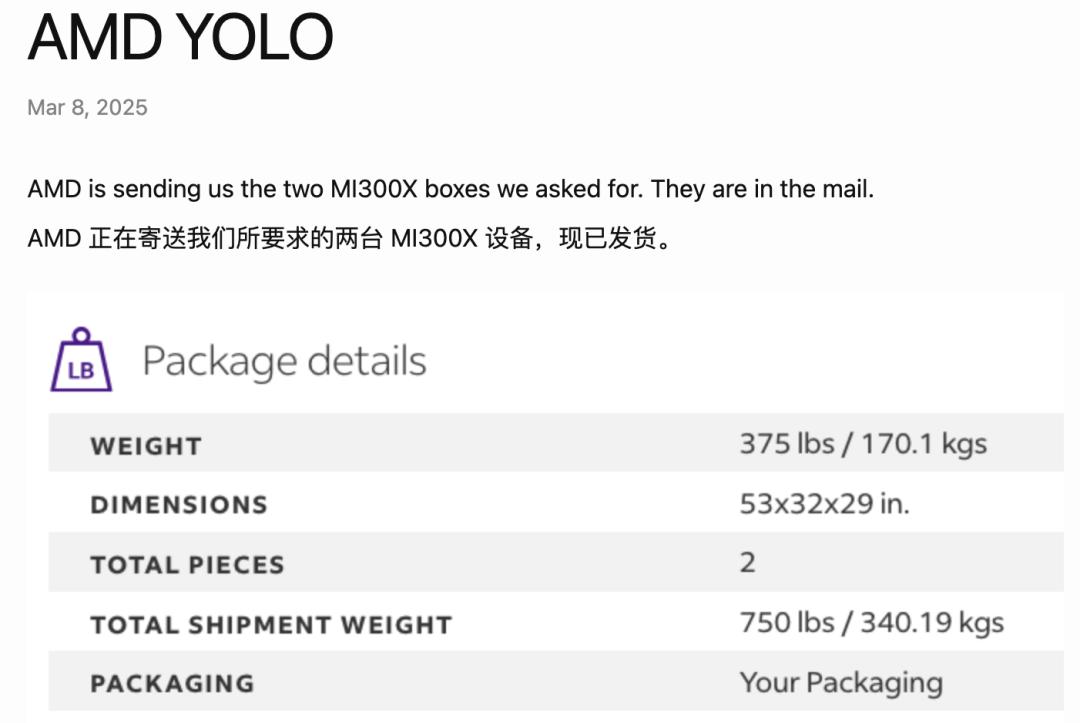
Hotz wrote in the post: AMD is shipping us two MI300X units—the flagship datacenter AI accelerator from AMD—and they’re already en route.
The MI300X is AMD’s flagship product betting on AI compute power, typically in high demand among cloud providers and large model companies. Now, it’s being shipped to tiny corp—a company that at the time had no office, operating entirely through GitHub and Discord.
The recipient of this package? The hacker known as geohot—George Hotz.
The name geohot first gained recognition in 2007, when a 17-year-old Hotz released a video demonstrating the world’s first iPhone jailbreak.
In 2007, at age 17, George Hotz showed off the first globally unlocked iPhone via webcam. The video garnered nearly two million views, spreading his name across the hacker community.
He later faced legal action for hacking the Sony PS3. This time, he aimed to do something bigger: break down NVIDIA’s CUDA moat from the software side.
“CUDA is ecosystem, not moat”
“CUDA is ecosystem, not moat.”
In his blog, Hotz bluntly stated that CUDA—the GPU computing platform developed by NVIDIA—is not the impenetrable moat many assume. It is merely an early-mover ecosystem.
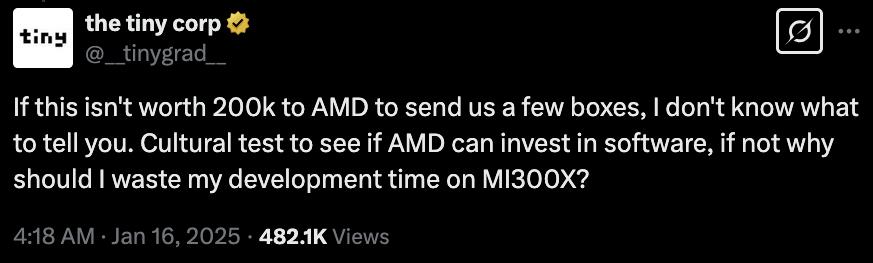
In the blog, he shared a screenshot of a tweet from January 2025, where he referred to AMD sending him chips as a “cultural test”: to see whether AMD was truly willing to invest in software.
By March, in this blog post, he delivered his verdict: AMD passed the test. He believes AMD will not abandon software development. If so, there is no justification for NVIDIA’s hardware to be priced 16 times higher than AMD’s.
The implication: at the time, NVIDIA’s market cap was roughly 16 times that of AMD. The underlying hardware difference wasn’t that vast. AMD even achieved double throughput with its RDNA4 architecture Tensor Cores, while NVIDIA artificially halved performance on its own cards.
So where did the 16x gap come from? Hotz’s answer lies in software—more precisely, in software complexity and the ecosystem lock-in that grows from it.
Developers are accustomed to CUDA; toolchains revolve around it. Thus, even if AMD’s hardware is superior, no one wants to touch it. What has held back AMD isn’t chip design—it’s the lack of a competitive software stack.
Naturally, this is Hotz’s judgment, not an official statement from AMD.
He didn’t just talk—he personally invested $250,000 in AMD, publicly bullish, betting on a five-year horizon. In his blog, he wrote:
Either NVIDIA is severely overvalued, or AMD is severely undervalued.
Hotz penned these words in March 2025, when NVIDIA’s market cap was approximately 16 times that of AMD.
By May 2026, NVIDIA’s market cap reached about $5.2 trillion, while AMD stood at roughly $76 billion, narrowing the gap to around 7x. During that year, driven by strong demand in AI datacenters, AMD’s stock surged dramatically, outperforming NVIDIA significantly.
Certainly, this doesn’t prove Hotz was right. AMD’s revaluation stemmed primarily from its own GPU shipments and financial results. Yet, market sentiment did align with Hotz’s thesis: the 16x valuation gap was not as solid as once believed.
From unlocking iPhone to challenging compute hegemony
How could a programmer who’d never designed a chip dare challenge NVIDIA? The story begins when he was 17.
In the summer of 2007, Apple launched the first-generation iPhone, exclusive to AT&T. At 17, Hotz was a T-Mobile user who wanted an iPhone without switching carriers. So he decided to open up the device.
As reported by The New Yorker, he used a screwdriver to pry open the back cover, located the baseband processor restricting carrier access, soldered a wire to it, applied voltage, and disrupted its code. The next morning, he announced live on camera: “This is the world’s first unlocked iPhone.”
The video received nearly two million views, making him the most famous hacker globally at the time. Two years later, he turned his attention to Sony’s PS3, cracking what was touted as an unbreakable gaming console—leading to a lawsuit from Sony, eventually settled out of court.
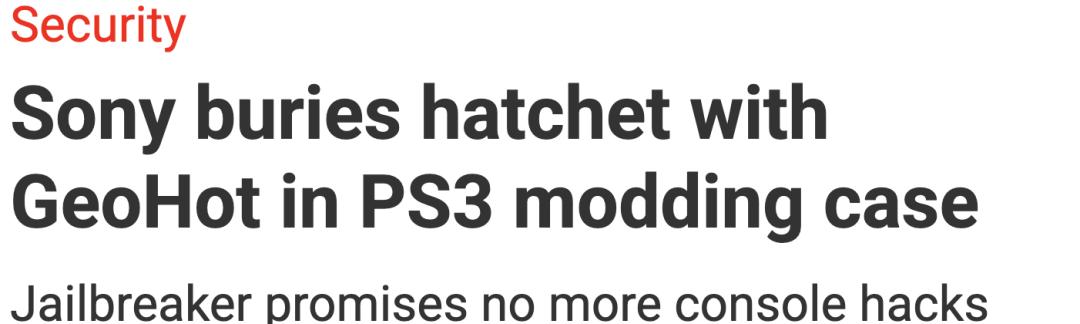
In 2011, Sony sued George Hotz over the PS3 hack. The case ended in a settlement, with Hotz agreeing to a permanent injunction and vowing never to engage with Sony products again.
For Hotz, a hacker is to computers what a plumber is to pipes.
His methodology has remained unchanged for over a decade: within a closed system, find the component that can “communicate” with you, then figure out how to make it comply.
Two thousand lines of code, rewriting an entire AMD stack
The iPhone and PS3 hacks proved Hotz’s capabilities.
But breaking CUDA requires more than one person—it demands real substance. That’s where tinygrad comes in: an open-source deep learning stack led by Hotz.
In fact, Hotz’s obsession with breaking closed systems has long extended beyond consumer electronics. In 2015, he founded comma.ai, a self-driving startup, where he single-handedly built a highway-capable autonomous driving system in his garage—directly competing with Tesla.
Today, comma.ai remains active, and its open-source driving model, openpilot, runs on tinygrad.
The official GitHub description calls it an end-to-end system: from tensor library and automatic differentiation, to IR (intermediate representation) and compiler, JIT compilation, graph execution, optimizer components for training, and data loading—all integrated into one cohesive stack.
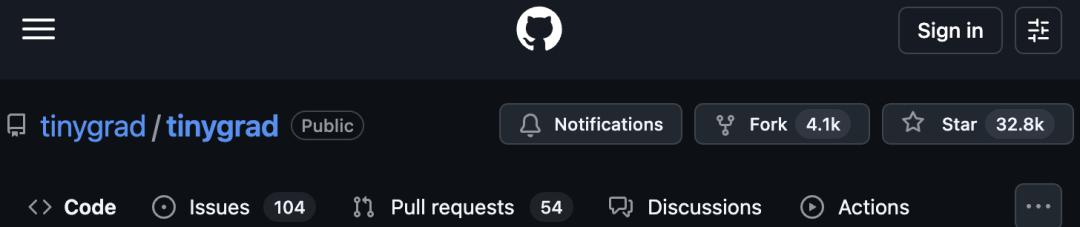
Official GitHub repository for tinygrad—an open-source deep learning stack led by Hotz, supporting multiple backends including CUDA, AMD, METAL, QCOM, and WEBGPU. https://github.com/tinygrad/tinygrad
The system’s defining feature is its “extreme minimalism.”
tinygrad already supports CUDA, AMD, METAL, QCOM, and WEBGPU backends. While other frameworks require developers to master entire complex instruction sets when adapting to new hardware, tinygrad only needs the new hardware to support roughly 25 fundamental operations—basic arithmetic like addition, subtraction, multiplication, and division—to integrate.
Yet Hotz’s primary focus remains on AMD.
According to tech media Phoronix, in January 2025, tiny corp had already written its own driver, runtime, libraries, and emulator. At that time, the AMD stack totaled about 12,000 lines of code—just one RDNA3 assembler away from being fully sovereign.
By March, Hotz announced in his blog that tiny corp now had a complete AMD stack—from hardware up to the PyTorch layer—with the sole exception being the LLVM compiler framework.
He also added: developers don’t need to learn tinygrad’s syntax—they can continue using familiar PyTorch code, as the backend automatically switches to this AMD stack.
The 12,000-line figure refers only to the January 2025 version of the AMD stack. The tinygrad project has continued growing; by v0.13.0, it reached 22,853 lines. Hotz himself cited a figure of 18,935 lines (excluding tests) by late 2025.
Whether 12,000 or 18,000, this is a staggering contrast when placed in industry context.
A software stack capable of driving GPUs and running full training processes usually spans millions of lines. As Hotz put it, tinygrad is 1,000 times smaller than those alternatives.
This means CUDA’s complexity isn’t rooted in physical laws. It can be rewritten from scratch by a small team using a minimalist approach—a belief Hotz firmly holds.
Tinybox: putting a compute machine on the shelf
If the story ended here, tinygrad would still just be a GitHub project. But Hotz’s ambition goes beyond code.
tiny corp officially sells a computer called Tinybox. Its website lists several models—red, green, pro, exa—with full configuration, pricing, and shipping details openly displayed. Orders are fulfilled within a week after payment.
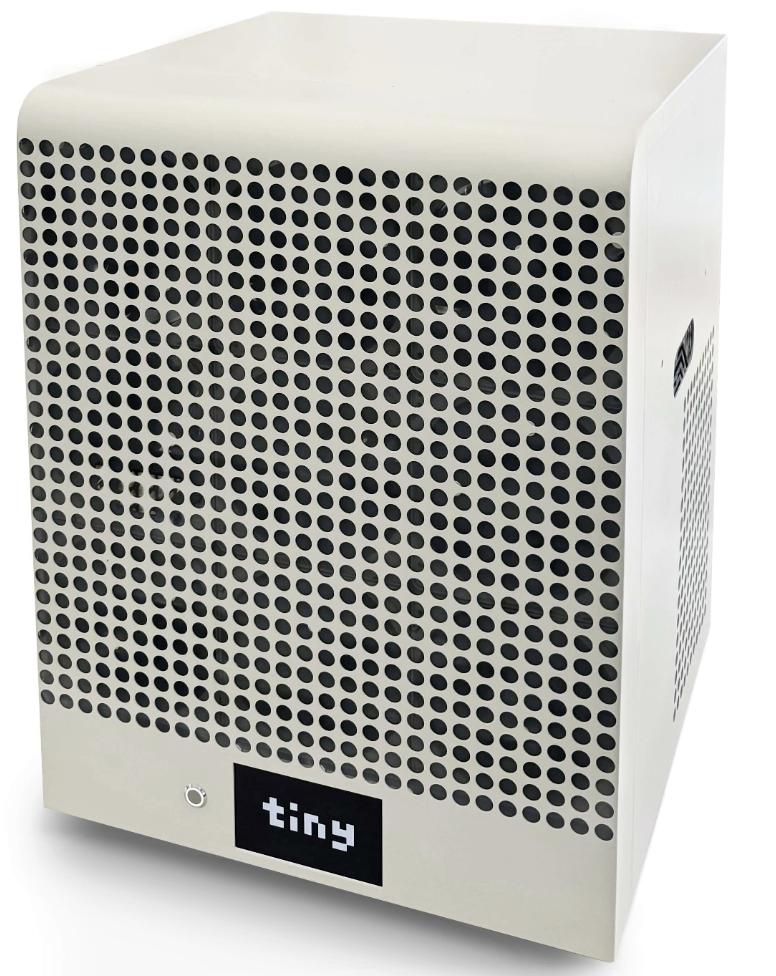
tiny corp’s official product: Tinybox.
Tinybox competed against machines priced about 10 times higher in the MLPerf Training 4.0 benchmark. According to Hotz’s blog post from late 2025, this computer sales line generated approximately $2 million in annual revenue. He reinvests this income directly into funding the entire R&D effort at tiny corp.
In the same blog post, Hotz revealed they had signed a contract with AMD to run Llama 405B training using MI350X chips—negotiations conducted largely publicly on Twitter.
tiny corp defines its mission in one sentence: commoditize the petaflop.
A petaflop is a unit of computing power—1 quadrillion floating-point operations per second (10¹⁵)—commonly used to measure supercomputers and AI compute capacity.
What Hotz aims to achieve is to turn each petaflop of compute power into a commodity—making AI accessible to everyone.
When compute power can be priced like consumer electronics, ordered online, and delivered within a week, the narrative of “compute scarcity” may finally begin to crack.
A new path
The significance of Hotz’s story isn’t in the sensational notion of “a lone hacker taking on NVIDIA and ending CUDA.” CUDA remains the default choice for the vast majority of developers today.
What matters is the bet he made: that AI software stacks can be compressed to an extreme degree. If proven true, the portion of NVIDIA’s valuation built on CUDA might need to be recalculated.
And this bet is no longer just Hotz’s alone. In his “Five Years of tinygrad” post from late 2025, he noted: the first line of code was committed in October 2020. Five years later, the company now has six people, many having invested years of their lives.
To Hotz, AMD’s hardware is not the problem—software is. This is an entrepreneur’s conviction, not an official AMD stance. How much of NVIDIA’s 16x market cap premium stems from hardware versus the software wall currently being dismantled line by line?
Hotz set a five-year timeline for his $250,000 bet.
Whether this wager will be remembered as a hacker’s fantasy—or the beginning of a new path—remains unknown. But someone is now measuring the thickness of the compute moat with code.
References:
https://x.com/heyrimsha/status/2058870147964874796?s=20%
https://geohot.github.io/blog/jekyll/update/2025/03/08/AMD-YOLO.html
https://tinygrad.org/ https://github.com/tinygrad/tinygrad
https://www.phoronix.com/news/Tiny-Sovereign-Stack-AMD-Close
This article is originally from the WeChat Official Account “New Intelligence Yuan,” author: ASI Revelation, published with authorization by 36Kr.
Source: 36Kr
Disclaimer: Contains third-party opinions, does not constitute financial advice


Dell's stock has surged 230% year-to-date, prompting Seeking Alpha to examine whether its valuation is overheated
23 mins ago
Technology stocks decline amid disappointing guidance from Broadcom and Ciena, with Broadcom's share price plunging 13%
28 mins agoGoogle Labs launches experimental app Dreambeans, generating personalized stories by integrating data from Gmail and other sources
31 mins agoApple's new Siri may run on Google Cloud's Nvidia Blackwell B200 GPUs
34 mins agoAnthropic Claude Mythos Technical Preview Breached Unauthorized Access, Security Infrastructure Emerges as Critical in AI Defense
39 mins agoNVIDIA Open-Sources 550B-Parameter Nemotron 3 Ultra Model with Hybrid Mamba-Transformer Mixture-of-Experts Architecture
45 mins agoSnap Acquires Augmented Reality Firm Illumix to Strengthen AR Technology Strategy
2 hours ago