"ChatGPT might be gone in the future"
"ChatGPT might be gone in the future"

The super app from OpenAI has finally taken shape.
It still bears the name ChatGPT, but soon it will gain a new core member: Codex.
And ChatGPT is now essentially just a shell.
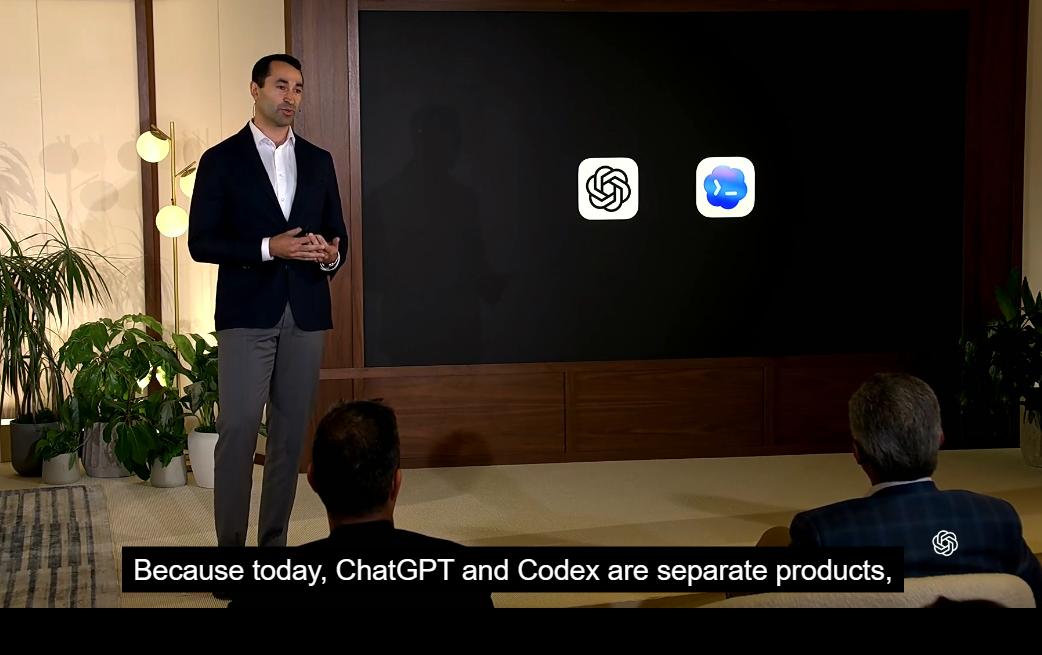
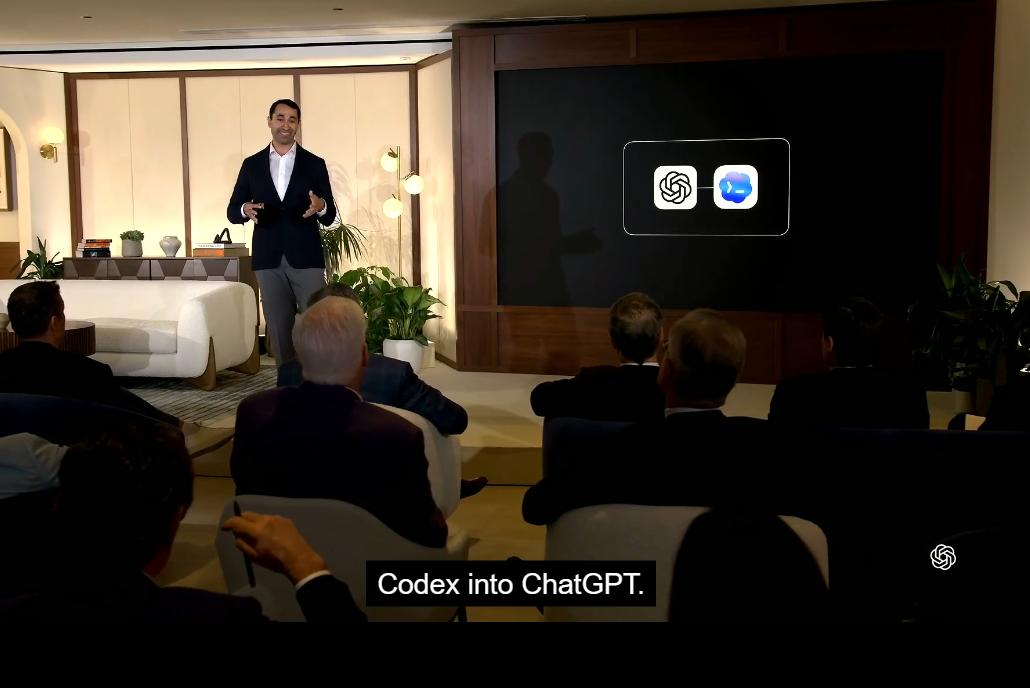
At OpenAI’s recent Intelligence at Work launch event, the company officially announced that Codex will be integrated into ChatGPT within the coming weeks.
When first hearing this news, many were momentarily confused? Didn’t ChatGPT already have a Codex option?
Only after checking did we realize it was a "fake" feature—merely a prompt to download the standalone Codex app. You couldn’t actually use Codex directly inside ChatGPT.
So in essence, once merged, chatting and task execution will happen in one single application—no more switching between apps.
But do you think that’s all?
From OpenAI’s perspective, Codex might just be the beginning.
And through this event, we’ve finally seen the full vision of the super app laid out in one go.
Codex Was Just the First Step
The entire 60-minute keynote packed high information density, but boiled down to three core announcements.
1. ChatGPT will merge with Codex—because the era has changed.
2. Codex will keep evolving—so OpenAI unveiled three major updates.
3. Codex is catching up to Claude Code, and GPT-5.5’s efficiency is a key factor.
Let’s quickly walk through them:
First, the surprising merger: why now?
Originally launched to catch up with Claude Code, Codex has now proven its worth.
Codex has surpassed 5 million weekly active users, a 6x increase since desktop launch in February.
Even more telling: 20% of users aren’t developers—they’re analysts, designers, investment bankers, and other knowledge workers—and their growth rate is triple that of developers.
This signals Codex’s strong breakout potential across user segments.
On revenue, which OpenAI closely monitors (and initially pursued because of Claude Code’s monetization success), Codex-driven enterprise revenue now accounts for 40% of OpenAI’s total, expected to hit 50% by year-end.
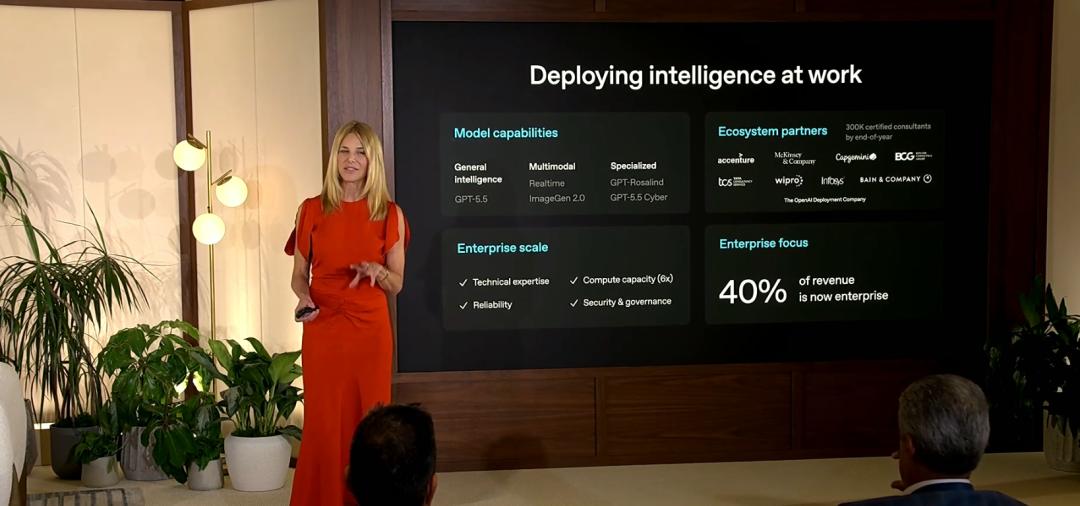
In short, Codex is growing fast, reaching broad audiences, and generating real revenue for OpenAI.
Everything suggests it’s time to move forward.
And the direction is clear: from chat to agent, from conversation to execution.
OpenAI’s product lead Alexander Embiricos put it perfectly during the event:
You may not work 24/7, but your cloud-based agent will.
One line captures the ultimate appeal of a super app: users won’t need to switch between apps anymore. Say a command, and ChatGPT understands it; then Codex calls on various agents to execute it automatically.
This integration marks OpenAI’s first step toward a true super app.
What’s next? The answer is likely obvious—browser integration.
The browser completes the puzzle: it provides the entry point for AI into the web world. With Codex, users can now perform automated tasks—searching, backend operations, workflow handling—simply by speaking into ChatGPT.
Now, with ChatGPT + Codex + Atlas browser, OpenAI is poised to deliver end-to-end execution—from chat to full-scene automation—through a single app.
But for now, let’s focus on Codex.
To empower Codex with more “soldiers” for action, OpenAI dropped three major upgrades:
Six role-specific Agent plugins covering data analysis, sales, creative production, product design, venture capital, and investment banking—integrating 62 enterprise tools including Snowflake, Figma, Salesforce, and embedding 110 built-in automation skills.

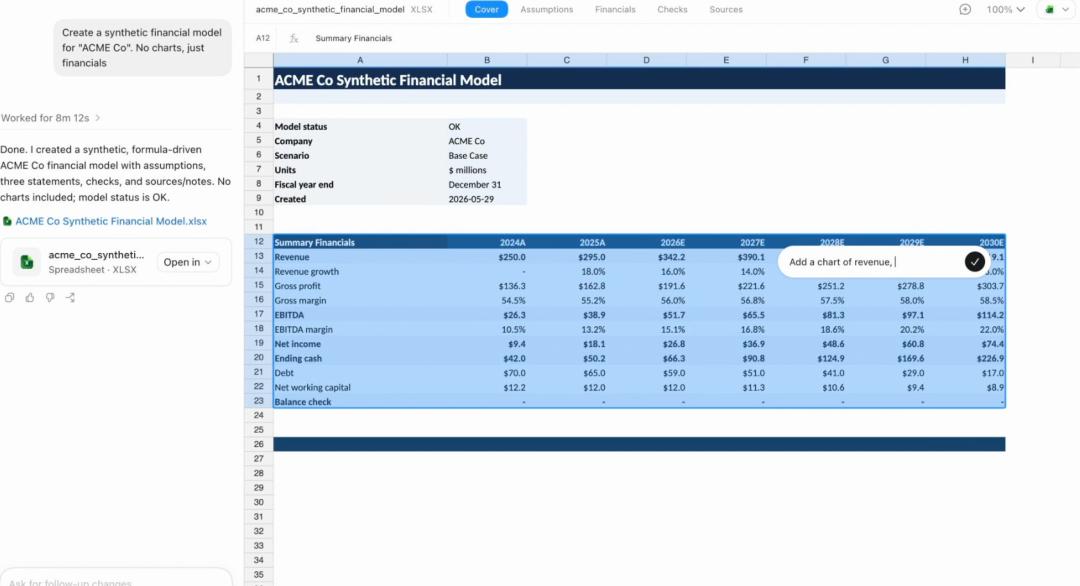
Annotations functionality allows direct editing on original documents—no need to regenerate entire texts. Developers are already using this to modify code, Markdown files, and websites generated by Codex.
Now extended to document, spreadsheet, and PPT content creation scenarios.
Sites feature enables Codex to instantly transform your work output into interactive web applications, generating a shareable URL for teams.
This is genuinely useful: previously, non-technical users could only vaguely describe needs. Now, anyone can generate an eye-catching, intuitive visual demo—dramatically reducing team communication overhead.
Currently available in preview for Business and Enterprise customers.
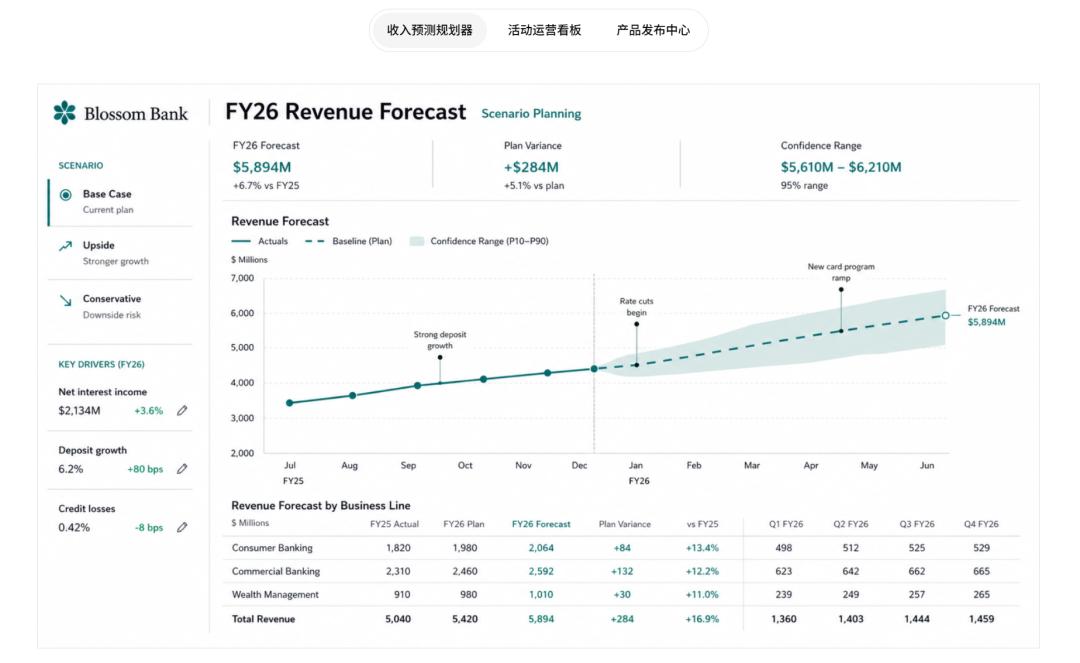
See? OpenAI is betting big on the future: more and more non-experts will shift from conversation to execution.
Some might ask: why isn’t Codex swallowing ChatGPT instead?
On the surface, it looks like ChatGPT absorbs Codex—but several details suggest the opposite direction.
During May’s organizational restructuring, Thibault Sottiaux—the architect behind Codex—was promoted to head of core products and platform, overseeing consumer, enterprise, and developer lines. Meanwhile, Nick Turley, who drove ChatGPT to 90 million weekly active users, was reassigned to enterprise products.
So now, Codex leads the ChatGPT ship—not the reverse.
Moreover, Brockman’s internal memo wording is telling:
He didn’t write “upgrade ChatGPT,” but rather “invest in a unified agentic platform.”
This merger isn’t just product integration—it’s a strategic pivot: from conversation to execution, from chat to agent.
ChatGPT brings the 1 billion-user traffic base. Codex delivers the growth engine and future narrative.
The shell is ChatGPT’s. The soul is Codex’s.
But Codex’s very existence was forced by a competitor—Anthropic.
Even GPT-5.5, mentioned in the keynote, can be seen as a response to that pressure.
Codex Was Forged by Anthropic
Looking back, without Anthropic, Codex might still be just a minor add-on inside ChatGPT today.
Let’s rewind to when Claude Code’s preview launched last year.
Claude Code achieved immediate success—its annualized revenue surpassed $2.5 billion by February, hitting $10 billion in just six months since launch—among the fastest-growing commercial software products in history.
About 4% of all public GitHub commits globally originate from it. Users spend an average of 20 hours per week.
Claude Code’s explosion made OpenAI realize: they were falling behind in the coding domain.
Behind? Then catch up.
Historically, the industry narrative was: Anthropic follows OpenAI—GPT launches first, Claude follows; ChatGPT goes viral, Claude counters.
But on the code front, the script flipped completely.
Claude Code launched in February last year. Two months later, OpenAI released its counterpart—Codex. Anthropic launched desktop first; OpenAI followed. Anthropic introduced Cowork for knowledge workers; OpenAI responded with Plugins.
Now, OpenAI is crossing the river by following Anthropic.
But the speed of catching up has been remarkable. In 14 months, from zero to 5 million weekly active users.
April 2023: Codex Cloud preview launched;
February 2024: Desktop app and dedicated model GPT-5.3-Codex released;
March 2024: Super app merger announced, acquisition of Python tool provider Astral completed;
April 2024: $100/month ChatGPT Pro launched to attract developers;
May 2024: Mobile version rolled out;
June 2024: Officially embedded into ChatGPT.
Almost every milestone echoes the shadow of Claude Code.
Yet honestly, Codex’s turnaround wasn’t due to raw code quality superiority.
Blind testing data shows Claude Code still wins 67% of the time—most developers admit its output is more robust.
But Claude Code’s usage limits are brutal, and its pricing is higher than Codex’s.
A Reddit thread with over 500 developer participants distilled a consensus:
Claude Code is smarter, but its limits make it unusable for daily work; Codex is slightly less smart but truly usable.
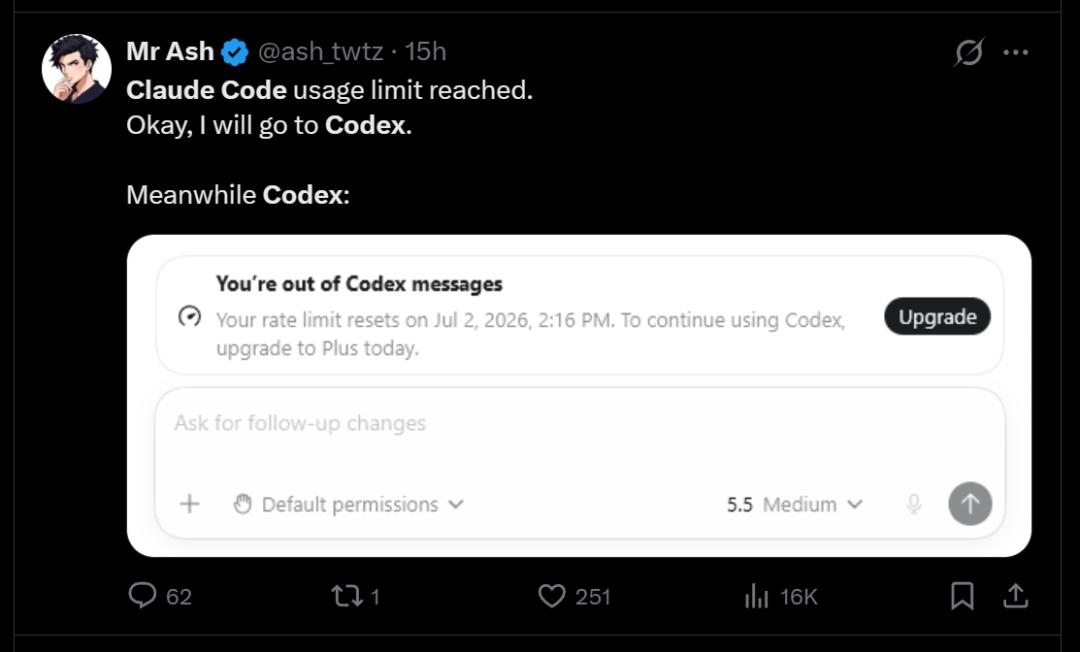
An intelligent model with severe rate limits and higher cost vs. a slightly less capable but affordable alternative.
Which would you pick? (doge)
Interestingly, during the event, OpenAI’s product lead Alexander also dropped a golden quote:
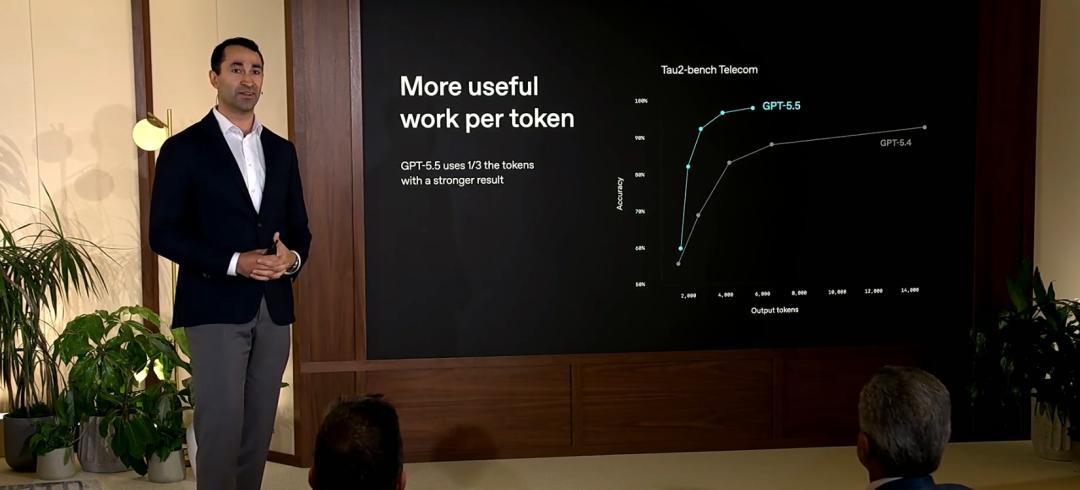
GPT-5.5 hates wasting tokens.
Using Codex with GPT-5.5 achieves the same output quality using only 1/3 the tokens.
In short, on the path to catch up with Claude Code, Codex is establishing a new standard: less token consumption, more intelligence.
Undeniably, the AI programming space is now a two-horse race.
One represents peak code capability. The other stands for top-tier productization.
But stretch the timeline further, and you’ll see: what’s at stake isn’t just the coding tool market.
As more non-experts treat agents as daily collaborators, the real battleground becomes the entry point.
And here lies a fresh opportunity for Chinese players: in the agent era, victory won’t hinge solely on model performance—but on scene mastery, ecosystem strength, application connectivity, and deep understanding of local enterprise workflows.
In fact, domestic tech giants have already entered the arena.
Some focus on developer access points, others on enterprise internal office integrations, and some on full-stack intelligent agent platforms.
No matter the path, the goal remains consistent: capture the core entry point of the agent era.
Everyone knows: leveraging China’s unique scenario window to build genuine competitive moats in agent infrastructure is the true priority.
So now the question is: who will break through first—creating China’s own Claude Code and Codex?
And even more crucially: who will become the new super entry point in China’s agent era?
One More Thing
Returning to this merger.
Given Codex’s current trajectory and industry dynamics, I’m bold enough to say:
Instead of keeping the name ChatGPT post-merger, why not simply call it Codex?
Think about it: “ChatGPT” sounds like a relic of the “chat” era. But OpenAI’s current bet is clearly no longer on chat.
The product leadership is Codex’s. The internal memo speaks of an “agentic platform.” The fastest-growing segment is execution-oriented. None of the new features relate to chatting.
Can ChatGPT still be used? Yes. Is it accurate? No.
Of course, OpenAI likely won’t rebrand. After all, “ChatGPT” has become synonymous with AI—a brand asset of incalculable value.
But a name unchanged doesn’t mean substance unaltered.
Soon, when you open ChatGPT, you may no longer face a waiting chat box—but an agent that has already completed your tasks.
At that point, whether it’s “chatting” or not will cease to matter.
In other words, ChatGPT may eventually become nothing more than a symbolic relic…
References:
[1] https://www.techmeme.com/260602/p14#a260602p14
[2] https://openai.com/index/codex-for-every-role-tool-workflow/
[3] https://www.theinformation.com/articles/inside-openais-decision-combine-codex-chatgpt
Original article from WeChat official account “Quantum Bits,” author: following frontier tech. Authorized publication by 36Kr.
Source: 36Kr
Disclaimer: Contains third-party opinions, does not constitute financial advice


Dell's stock has surged 230% year-to-date, prompting Seeking Alpha to examine whether its valuation is overheated
23 mins ago
Technology stocks decline amid disappointing guidance from Broadcom and Ciena, with Broadcom's share price plunging 13%
28 mins agoGoogle Labs launches experimental app Dreambeans, generating personalized stories by integrating data from Gmail and other sources
31 mins agoApple's new Siri may run on Google Cloud's Nvidia Blackwell B200 GPUs
34 mins agoAnthropic Claude Mythos Technical Preview Breached Unauthorized Access, Security Infrastructure Emerges as Critical in AI Defense
40 mins agoNVIDIA Open-Sources 550B-Parameter Nemotron 3 Ultra Model with Hybrid Mamba-Transformer Mixture-of-Experts Architecture
45 mins agoSnap Acquires Augmented Reality Firm Illumix to Strengthen AR Technology Strategy
2 hours ago