Selling on Xianyu with four accounts using AI-driven inventory management — earning 300,000 RMB in three months isn’t luck; it’s math.
Selling on Xianyu with four accounts using AI-driven inventory management — earning 300,000 RMB in three months isn’t luck; it’s math.
2026-07-21 07:26
Introduction: Someone conducted an experiment—opened four Xianyu accounts, used AI tools to list 3,000 items on each account. No human involvement in selling; the shelves were filled first by AI. After three months, they earned 300,000 RMB. With 670,000 views and over 700 collections—this proves that the number of people interested in this strategy far exceeds what you might imagine.
Huoshan Ge shared a profitable path from a friend. The core operation boils down to three sentences: open four Xianyu accounts, use AI tools for bulk listing, and fill each account with 3,000 products. Then simply wait—the traffic comes naturally, leading to sales.
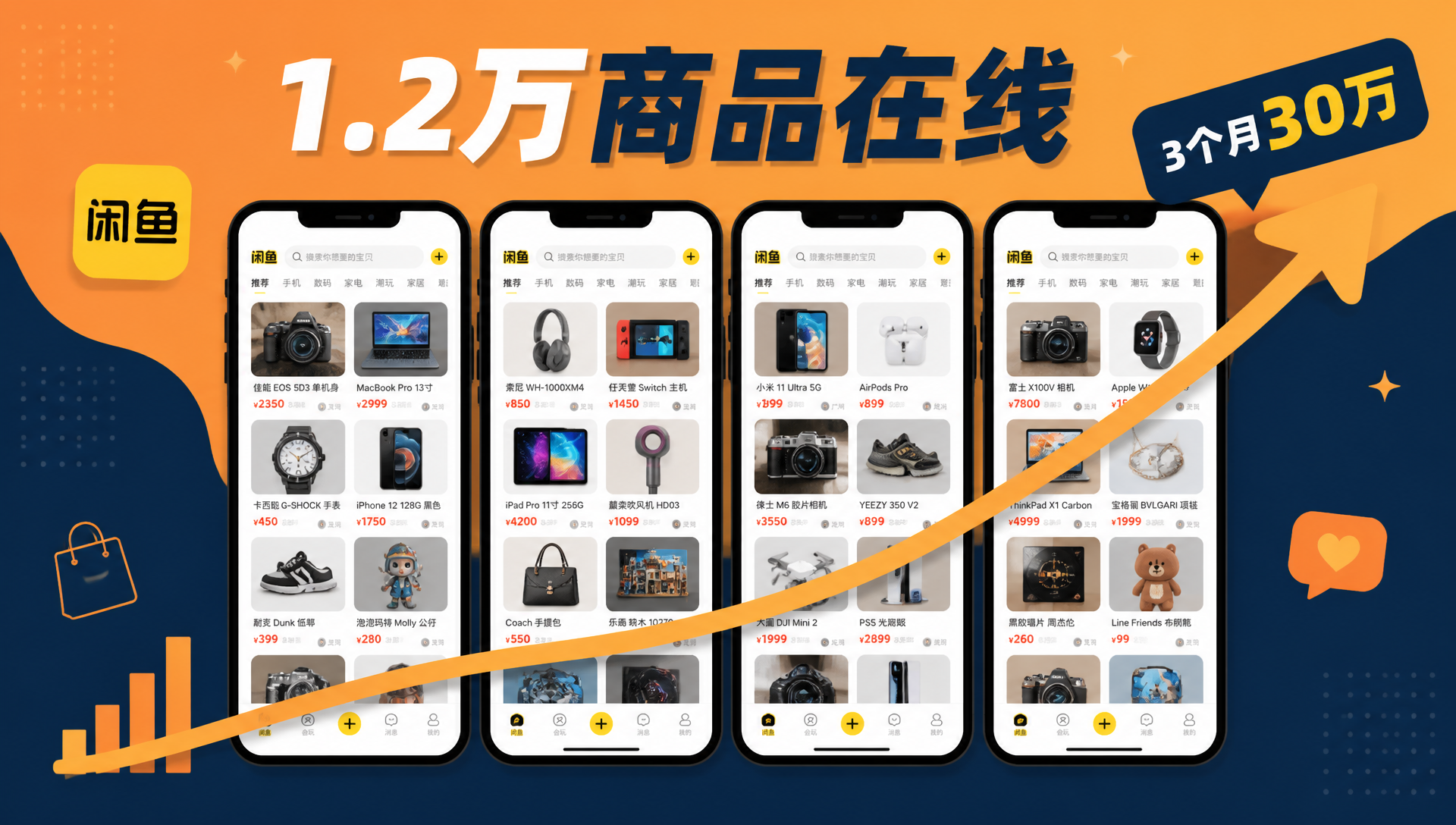
Many people’s first reaction is "How is this possible?" But do the math: four accounts, 3,000 items per account, totaling 12,000 products live online. Even if only one person clicks each product per day, that’s 12,000 daily exposures. Xianyu’s recommendation algorithm favors active sellers—more frequent listings and higher inventory volume mean greater organic traffic from the platform. This isn’t magic—it’s platform mechanics.
The Underlying Logic of This Model
Traditional Xianyu sellers manually take photos, write titles, fill descriptions, set prices, and publish items. One person can barely list ten items a day before burning out. A maximum of 300 items a month. Running four accounts simultaneously caps out at around 1,200 items.
AI breaks this bottleneck. You don’t need to manually write 1,000 titles—just feed product materials into AI, which generates 100 unique title and description variations in different styles at once. You don’t need to shoot 1,000 images—AI generates cover images using a unified brand template for batch application. You don’t need to manually list each item—use automation tools to upload in batches, 50–100 items per account daily, fully filling 3,000 items within a month.
Filling 3,000 items means your “storefront space” on Xianyu is 30 times larger than average sellers. Just like physical stores: bigger footprint, better location, more customers. The same logic applies here—more items increase visibility in search results.
300,000 RMB isn’t earned from one single sale—it’s accumulated from 12,000 micro-sales. If each item generates just a few tenths of a yuan in profit per day, 12,000 items yield hundreds of yuan daily. Dividing 300,000 RMB by 90 days gives ~3,300 RMB/day. Divided by four accounts, ~800 RMB/day per account. Divided by 3,000 items, less than 0.3 RMB profit per item daily. This figure is entirely reasonable for any normal Xianyu account selling digital goods or second-hand electronics.

Best Product Categories for Bulk Listing
Not every product is suitable for listing 3,000 units. The ideal categories have three traits: First, no need for real photos—or AI can generate cover images. Second, no physical inventory required; delivery is done via link. Third, low unit price but high repeat purchase rate—customers will search for similar items after buying.
The most fitting category is digital assets. PPT templates, resume templates, AI prompt packs, software source code, study material bundles, e-books—these have extremely high scalability. Create one product titled “100 Professional Work Presentation PPT Templates,” use AI to generate one cover image, price it at 19.9 RMB, list it once, and it stays forever. Sell two today, three tomorrow—after a month, hundreds of sales accumulate.
The second category is second-hand electronic accessories. Phone cases, data cables, tempered glass screens, power banks—source these from wholesale markets or Pinduoduo at a cost of a few RMB per piece, sell for 10–15 RMB. No complex copywriting needed—just use a title like “iPhone 16 Tempered Glass Screen Anti-Blue Light & Drop-Resistant,” paired with AI-generated template images. After bulk listing, leverage long-tail traffic—hundreds of thousands search “tempered glass screen” daily, and your item will be seen eventually.
The third category is custom services. Logo design, poster creation, PPT beautification, resume polishing—no inventory needed. Take one order, complete one job. Use AI to generate 100 service descriptions from different angles, pair each with a sample image, and fill your shelves. Customers searching any keyword related to your service will see your listing.

How to List 3,000 Items Without Triggering Risk Controls
The most critical operational challenge. Xianyu doesn’t impose hard limits on listing quantity, but has implicit risk controls—if you list 1,000 items in one day, the system will flag you as a spammer, resulting in traffic throttling or even account suspension.
Rule One: Batch Uploads. Upload 50–100 items per account per day, completing 3,000 over a month. Don’t rely on manual reminders—use AI tools to automate batch uploads. Ensure variation in title style between today’s batch and tomorrow’s to avoid detection as templated behavior.
Rule Two: Different Products Across Accounts. Don’t sell identical items across all four accounts. Account one sells PPT templates, account two resumes, account three AI prompts, account four e-books. Keep product categories non-overlapping, images stylistically distinct, and title phrasing varied. Xianyu’s risk algorithms detect similarity between accounts—high similarity increases the chance of being flagged as multiple accounts controlled by a single entity.
Rule Three: Slow Start, Gradual Acceleration. The first month is critical—the system monitors new account behavior. For the first two weeks, list only 20–30 items per day. Use this time to identify high-search-volume keywords and top-performing categories. In the last two weeks, accelerate to 50 items per day based on data. By the second month, trust from the system is established, allowing stable daily uploads of 80–100 items.
Rule Four: Don’t Let AI Write Everything. Never use pure AI-generated titles and descriptions. Always personalize them with your own language—add colloquial expressions, real-life scenarios, or personal experience. Phrases like “I’ve personally used this template for a year” convert three times better than generic AI copy like “Professional Business Presentation PPT Template.” Fully AI-generated content is easily detected by systems and feels robotic to buyers.

From Individual Seller to Automated Production Line
Once this model is operational, you’re no longer just “running Xianyu”—you’re managing an automated e-commerce production line. The upstream is AI generating content and images; the midstream is automation handling batch listings; the downstream is platform traffic flowing to you automatically. Your daily work shifts from “constant uploading” to “monitoring data, adjusting categories, optimizing keywords.”
You don’t need four accounts initially. Start with one, run it for a month. Once products stabilize, data becomes clear, and you understand what sells and what doesn’t, then launch the second. Huoshan’s friend didn’t earn 300,000 RMB in the first month—first month was mostly setup and data testing. Second month accelerated, third month exploded. He’s a case of correct category selection combined with strong execution—not a formula that says “open four accounts and make 300,000 RMB.”
AI frees you from the tedious task of manual listing, leaving only strategic work: choosing categories, pricing strategies, title optimization, timing of listings, and risk avoidance. These require your own thinking and iteration—AI can’t replace them. But the time saved allows you to focus deeply on these high-leverage decisions.
Act now while this strategy is still under the radar. When every seller on Xianyu starts using AI for mass listing, the winner won’t be the one who lists the most—but the one who started earliest.

Disclaimer: Contains third-party opinions, does not constitute financial advice
Town – An active AI personal assistant that collaboratively coordinates schedules
17 hours ago
Seven exclusive closed-door sessions with top-tier decision-makers, uncovering the most authentic insights and cutting-edge judgments on AI deployment
1 day ago
The "rat race" in East Asian education is being re-exported through AI
1 day ago
ABot-Earth 0.7 – The World’s First 3D-Native Urban World Model Launches by Gaode
1 day ago
JPMorgan Bullish on Meta: Muse, Model API, and Subscriptions Drive $820 Price Target
1 day ago
GPT-6 Tops the Charts, Biggest Shock After AlphaFold, Emerges as the Most Powerful AI for Antibody Prediction
1 day ago
Nobel Heroes & AI4SCI Summit 2026 to Launch in Singapore This October
1 day ago
EchoWM – JD.com's Open-Source Interactive Multimodal World Model
1 day ago


