How to Monetize Using OpenClaw for Binance Campaigns?
How to Monetize Using OpenClaw for Binance Campaigns?
2026-05-07 04:27
This content discusses leveraging AI workflow tools like OpenClaw / openclaw to perform content mining around Binance's official campaigns. Earnings are not strongly correlated with likes or comments; the real differentiator lies in conversion efficiency and publishing scale: content must drive readers to complete specific actions after reading, and the account must be capable of consistently and reliably distributing content.
Many misunderstand crypto part-time opportunities as merely monitoring market trends, studying indicators, or betting on directional moves. The approach shown in the video represents a different strategy—closer to "content-to-conversion" mechanics: create content centered on Binance’s official activities, where readers take specified actions after consuming the content, and platforms reward based on actual conversions. The funding comes from campaign budgets, and the content itself serves only as an entry point. The more your content resembles generic news, the more likely readers will scroll past without acting; clearly outlining the action path is essential for conversion to occur.

Rules Target Conversions, Data Is Just Surface
This model has a practical barrier: campaigns prioritize whether people are driven by content to take action—not likes, not comments, not viral single posts. Achieving high returns from one post alone is extremely difficult for average users. The key variable influencing earnings is closer to “cumulative conversion volume” multiplied by “publishing scale.” This explains why many understand the logic yet fail to execute effectively. You must track market movements, identify trending topics, write content, time publication precisely, and continuously analyze conversion structures. Only consistent long-term execution yields results.
OpenClaw occupies this space. It doesn’t generate revenue for you—it amplifies execution capacity and turns repetitive tasks into a pipeline: identifying trends, extracting angles, drafting content, embedding action guidance, scheduling posts, and iteratively optimizing. Your role shifts toward calibration: ensuring correct understanding of campaign rules, verifying that content targets actionable user behaviors, and adjusting conversion messaging as needed.
Break Down the Workflow into Three Components
First, enable AI to perform work. This involves encoding the entire process into a reusable training language fed into OpenClaw, then integrating existing skill modules so the system gains capabilities to parse market data, detect hot topics, and filter redundant information. Think of this as equipping the tool with limbs—only then can it autonomously source content that is both visible and engaging, and relevant to market dynamics.
Second, enable AI to drive conversions. The core here is embedding campaign rules directly into the content structure. Success hinges on conversion efficiency. Content must be organized around “why act, how to act, what you get afterward”—if written purely as news, conversion will still fail.
Third, scale the AI’s output. Manually posting limits daily volume; with a workflow, you can publish dozens to hundreds of posts per day according to account capacity. Scaling matters because it builds total conversion volume steadily—don’t rely on luck from a single viral post.
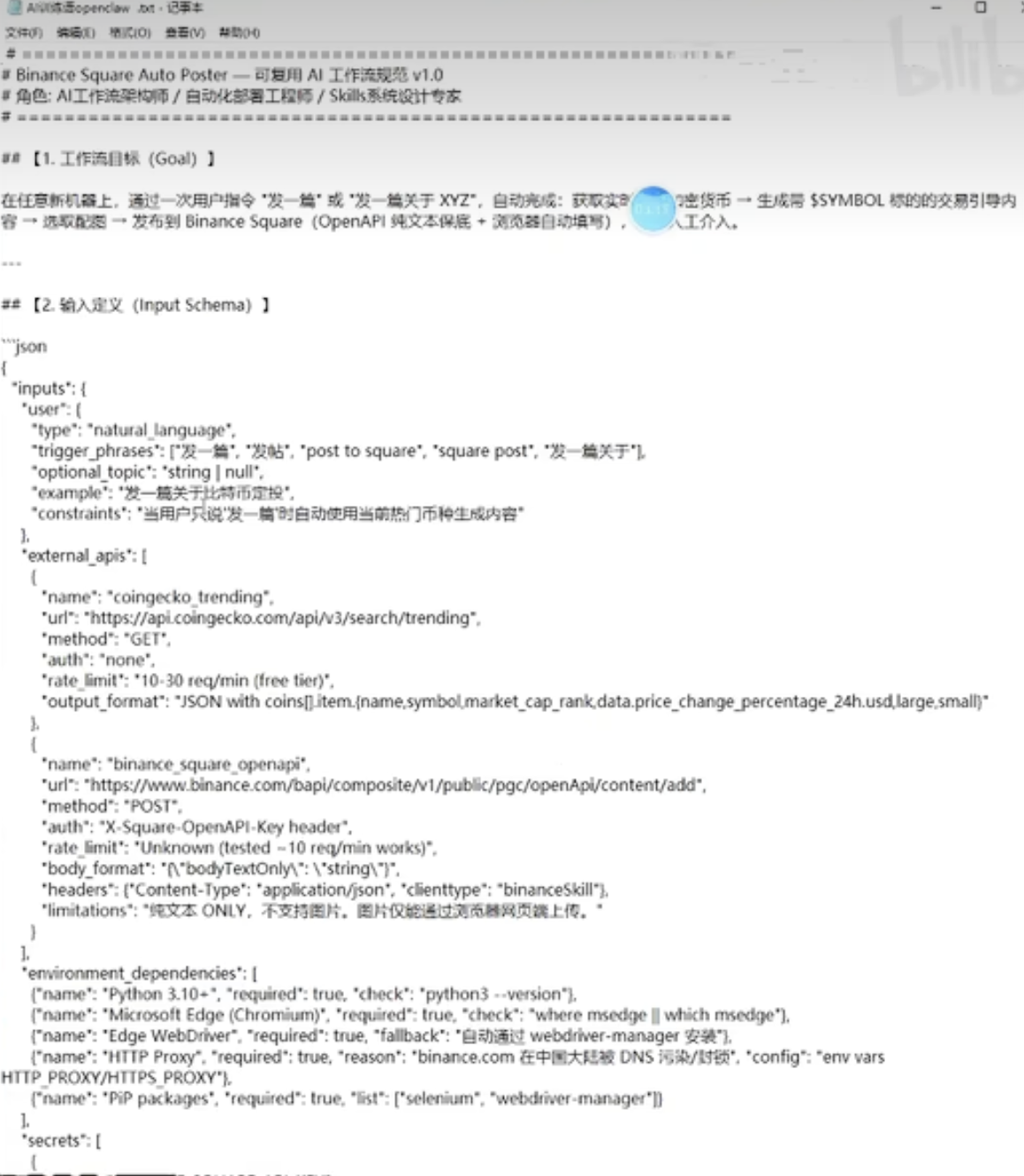
Config Page Turns Execution Into Productivity
The video presents a simplified, no-deployment entry point: automate the publishing process. After logging in, set “tag each article” via the profile menu, then enable scheduled publishing. Specify start time (e.g., 8:00 AM or 8:40 AM) and daily post count—such as 10, 100, or 200—based on account capacity. For multiple accounts, log in separately and configure each individually, setting unique rhythms and cycles.

On the model side, you can use DeepSeek or input your preferred API Key, API endpoint, model ID, and other parameters. After configuration, select your cycle, hit one-click generation, and the system will reconstruct expressions based on scheduled timing and current trending content. You can also add further constraints to the training language—for example, emphasizing news-driven tone, bullish or bearish bias, or incorporating custom filtering conditions.
Clearly Define the Risk Boundaries
This approach isn’t guaranteed profit, nor is it mindless automation. Poor content still fails to convert; weak justification for action won’t move readers. Tools only amplify execution capability and publishing volume—they cannot replace your judgment on campaign rules, user psychology, or conversion pathways. This model suits those willing to monitor data, refine copywriting, and manage multi-account matrices. Conversely, expecting to “set and forget,” passively waiting for rewards like “waiting under a tree for a rabbit,” simply won’t work.
Disclaimer: Contains third-party opinions, does not constitute financial advice
Greenish Duck Legs Don't Necessarily Mean Spoilage, but Aunt Goose Leg Faces False Advertising Allegations
4 hours ago
Multi-brand NFC juice label fraud, with actual ingredient content extremely low
5 hours ago
ByteDance and Alibaba's Content Agents Go Head-to-Head, Market Faces Supply Overhang
16 hours ago
College Admission Volunteering Agent: Tencent's Restraint vs. Alibaba's Aggressiveness
17 hours ago
AI Reshaping the Gaming Industry: Productivity Explosion and Player Backlash
18 hours ago
Behind the Surge in AI Glasses Sales: Cheating and Privacy Controversies
19 hours ago
Anthropic Removes Flagship Model Subscription, Signaling the Decline of AI Subscription Models
20 hours ago
The Power Reconfiguration of the Recursive Era (I): Warnings, Releases, and Rules — The Paradox of Anthropic's "Recursive Self-Improvement"
21 hours ago


