Horizon Robotics' market cap surpasses domestic GPU peers, Tencent's unrealized gain exceeds 40 billion yuan
Horizon Robotics' market cap surpasses domestic GPU peers, Tencent's unrealized gain exceeds 40 billion yuan

2026-11-13 12:00
Introduction: Major Enterprise Orders and DSA Architecture Signal Explosive Growth in AI Training Market. On November 12, the domestic AI chip sector witnessed a significant stock rebound, with Syntony Technologies (688801.SH) leading the gains.
November 12, the domestic AI chip sector experienced a strong stock rebound, with Syntony Technologies (688801.SH) posting the top gains.
On that day, Syntony Technologies’ share price surged dramatically, closing at ¥558.88 per share, up 13.13%, with total market capitalization reaching ¥240.5 billion. During intraday trading, the stock hit a peak of ¥588 per share, marking a new all-time high since its listing.
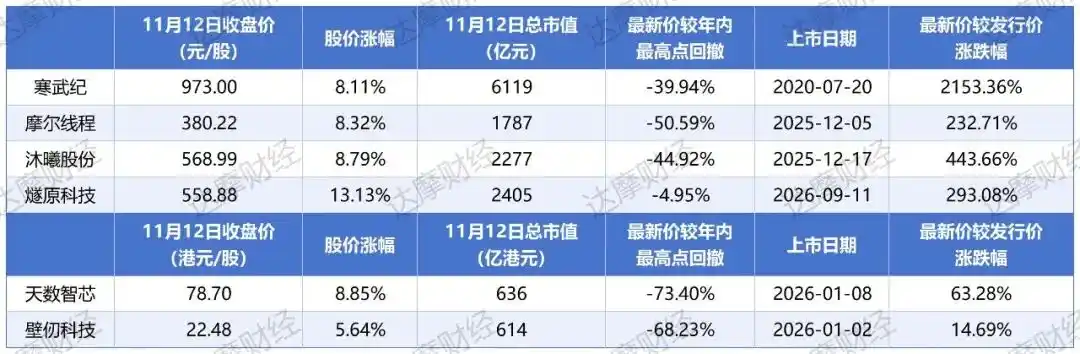
Other domestic AI chip firms also saw substantial stock rallies.
Cambricon (688256.SH) briefly breached the ¥1,000 mark during intraday trading, closing up 8.11% at ¥973 per share, with a total market cap of ¥611.9 billion. Moore Threads (688795.SH), Muxi Semiconductor (688802.SH), and Tian Shu Intelligent Chips (9903.HK) on the Hong Kong exchange all rose over 8%, while Bitmain Technologies (6082.HK) gained more than 5%.
This year, the domestic AI chip sector has experienced extreme volatility. In the first half, stocks across the sector surged, benefiting early entrants such as Cambricon, which went public in 2020, and newly listed domestic AI chip firms from December 2023 to January 2024. However, since July, global tech markets cooled down, triggering a broad correction in the domestic AI chip sector, causing valuations to decline across the board.
Cambricon, Moore Threads, and Muxi Semiconductor have seen their latest share prices drop by approximately 40% to 50% from this year’s highs, while Tian Shu Intelligent Chips and Bitmain Technologies, both listed in Hong Kong, have fallen over 60% from their peaks.
In contrast, despite missing the initial growth phase, Syntony Technologies—listed only in September—has maintained relatively stable stock performance. Now, Syntony’s total market cap has surpassed that of Moore Threads, Muxi Semiconductor, and Bitmain Technologies, making it the highest-valued firm among the “Four Little Dragons” of domestic GPUs.
As Syntony’s stock price climbs, its founding team and investors have also realized significant paper gains. Currently, founder Zhao Liding and Zhang Yalin hold 8.13% and 8.08% respectively after shareholding structure transparency, with each holding market value approaching ¥20 billion. Additionally, Tencent, the company’s largest external shareholder, has unlocked over ¥40 billion in unrealized gains through its stake.
Behind Syntony’s Market Cap Reversal
Although Syntony Technologies has overtaken competitors like Moore Threads and Muxi Semiconductor in market cap, from an earnings perspective, there remains a notable gap in revenue scale and profitability.
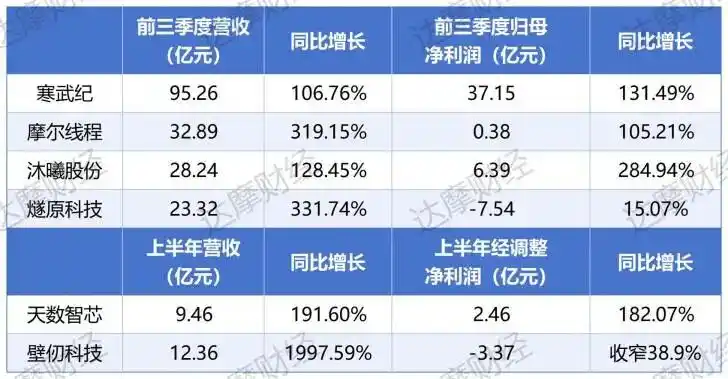
In the first three quarters of this year, Syntony generated revenue of ¥2.332 billion, a year-on-year increase of 331.74%; its net loss attributable to shareholders was ¥754 million, narrowing by 15.07% year-on-year. By comparison, both Moore Threads and Muxi Semiconductor posted higher revenues than Syntony, and both achieved profitable operations in the first nine months.
An analysis of these AI chip companies reveals that performance differences stem not only from one-time gains but also from structural factors such as product mix and operational strategy.
For example, Muxi Semiconductor’s sharp rise in net profit was largely driven by ¥543 million in fair value changes recognized on trading financial assets. Excluding this gain, Muxi’s non-recurring net profit attributable to shareholders stood at ¥259 million for the period.
Product architecture also significantly impacts profitability. Among A-share listed domestic AI chip firms, Cambricon, Moore Threads, and Muxi Semiconductor primarily use GPGPU (General-Purpose GPU) architecture, whereas Syntony Technologies employs DSA (Domain-Specific Architecture)—the same technology path as Huawei Ascend and Google TPU.
Compared to GPGPU, DSA sacrifices general-purpose flexibility in favor of superior efficiency in specific workloads, making it particularly well-suited for inference and training scenarios—especially inference. In 2025, over 80% of Syntony’s AI accelerator card and module revenue will come from inference products.
Given Chinese enterprises’ stringent cost requirements for inference deployments, Syntony’s gross margin has been compressed, negatively affecting profitability. In the first three quarters of this year, Syntony’s gross margin stood at 32.15%, compared to 53.71% for Moore Threads and 54.99% for Muxi Semiconductor.
Despite weaker financial performance relative to its peers, how did Syntony achieve market cap reversal?
From a secondary market perspective, Moore Threads and Muxi Semiconductor listed in December 2023, with both experiencing restricted share unlock events in June and September 2024, and another major unlock scheduled for December 2024. In contrast, Syntony’s first unlock is not expected until March 2025, resulting in a smaller circulating supply.
Currently, Syntony’s circulating shares amount to approximately 17.9 million, representing 4.16% of total shares. At the latest share price, this circulating supply corresponds to a market value of around ¥10 billion.
In business development, Syntony launched its fourth-generation product, L600, in July this year—a training-and-inference integrated accelerator module. According to CEO and COO Zhang Yalin, the L600 delivers compute performance comparable to NVIDIA H20 GPU and significantly exceeds it.
According to the company’s prospectus, Syntony has already partnered with clients to advance R&D in large-scale AI model training applications based on its fourth-generation product. Compared to inference, training-oriented AI chips typically carry higher gross margins. If Syntony successfully penetrates the training market, future gross margins could further expand.
Beyond its core relationship with Tencent, Syntony is actively expanding its external sales channels.
At a September investor conference, founder Zhao Liding stated that progress in acquiring other internet clients has been promising. The fourth-generation product has passed hardware and model compatibility tests with potential clients A, F, and B, and is now entering gray-scale testing, with expectations of small-scale delivery by 2026 and mass deployment by 2027.
At the National Chip Expo in October, Syntony also unveiled the "CloudRise ESL64-O," a high-performance super-node co-developed with ZTE. Designed for high-density integration and zero-cable architecture, the solution supports cluster networking at scale exceeding ten thousand GPUs. With growing demand for low-latency intelligent computing clusters, this offering is poised to accelerate Syntony’s commercialization roadmap.
However, competition remains intense. Huawei Ascend currently leads the domestic AI chip market, using the same DSA architecture as Syntony. For Syntony to broaden its market reach, direct competition with Huawei Ascend looms large—an formidable challenge.
Source: Damo Finance
Disclaimer: Contains third-party opinions, does not constitute financial advice


HuggingFace's "AI Duck" Goes Viral, Boosting Chinese Chip Supplier Rockchip
09-02
Yushu Surges 629% on First Day of Trading, Humanoid Robots Sell 5,500 Units
08-19
14 Executives Depart, Horizon Unleashes a Robot Legion
08-11
Nokia Snatches AI Optical Chip Race, Stock Soars 52%
08-07
Yushu's 61 Billion IPO: Who Will Make Money?
08-07
AI stocks down 40%-60%, yet NVIDIA's valuation is at a 10-year low
08-06
HBM Bottleneck Migration, NVIDIA Also Aims to Downgrade
08-06


