Google Gemini 4 Hydrogen: 2.5x Speed Boost, Hallucination Rate Reduced to Just 8%
Google Gemini 4 Hydrogen: 2.5x Speed Boost, Hallucination Rate Reduced to Just 8%

2026-11-13 10:29
Introduction: 2.5x Speed Boost, Only 8% Hallucination Rate. What is Gemini 4 Hydrogen? Gemini 4 Hydrogen is Google's high-efficiency model in the Gemini 4 series, designed for fast response, low cost, and AI Agent execution capabilities, targeting everyday coding, tool invocation, and continuous task workflows.
What is Gemini 4 Hydrogen?
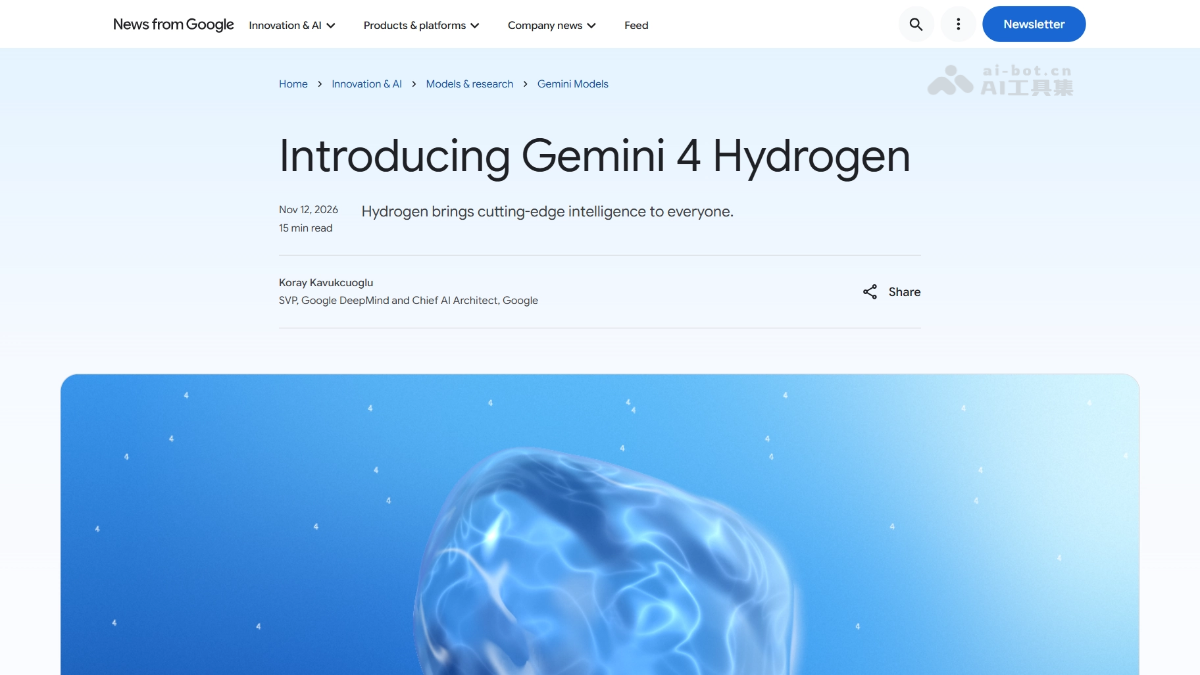
Gemini 4 Hydrogen is a high-efficiency model launched by Google as part of the Gemini 4 series, emphasizing rapid response, low cost, and AI Agent execution. It is tailored for daily coding, tool invocation, and sequential task execution. Gemini 4 Hydrogen defaults to a high thinking level with an intelligence score of 51, surpassing Argon (50), and reaches xhigh level at 54, approaching flagship performance; it delivers 2.5x faster speed than Gemini 3.8 Flash, with a hallucination rate of only 8%. The model supports multimodal inputs including text, images, audio, and video, features a million-token context window, and is priced at $1.5 per million input tokens and $7.5 per million output tokens.
Key Features of Gemini 4 Hydrogen
- High-Efficiency Code Generation: Rapidly write, debug, and iterate code, capable of batch-parallel file reading and precise "surgical" modifications without altering unrelated code.
- Agent Execution Capability: Excels in multi-step tasks, tool invocation, and continuous execution; automatically adapts and adjusts strategies when tool calls fail or search results are empty.
- Multi-Model Coordination (Orchestrator): In Antigravity, it autonomously collaborates with Carbon/Argon—Carbon handles architectural design while Hydrogen performs parallel execution—reducing resource usage by 24% and accelerating tasks by 19%.
- Four-Tier Reasoning Intensity: Adjustable reasoning levels—low / medium / high (default) / xhigh—enabling flexible trade-offs between intelligence, speed, and cost.
- Multimodal Knowledge Work: Supports text, image, audio, and video inputs, with up to one million tokens of context and maximum one million-token output, capable of processing complex PDFs, tables, charts, and long videos to generate cited reports.
- Web and 3D Development: Generates complete websites, 3D scenes, and interactive applications from a single natural language prompt, supporting advanced effects like WebGL shaders.
- Ultra-Low Hallucination: Achieves only 8% hallucination rate, excelling in visual reasoning and minimizing fabricated information.
- Office Suite Integration: Transforms thousands of Google Sheets cells into dynamic pixel art, auto-generates and self-validates Google Slides presentations, and converts financial data into interactive models.
- Enhanced Search Capabilities: Better understands complex search intent; upgraded Query Fan-out technology enables results containing images, comparison tables, and structured data.
- Security Alignment: Reduces agent overreach by up to 81%, improves resistance to indirect prompt injection by 2.3x, and achieves a truthfulness score of 96.7%.
Technical Principles Behind Gemini 4 Hydrogen
- Model Lineage: A high-efficiency variant derived via distillation from Carbon, adapted from Gemini 4 Carbon. It retains Carbon’s architecture, training data, and hardware foundation, compressed through distillation, quantization, and inference optimization into a “fast-execution” tier—similar to the relationship between Flash and Pro models.
- Adjustable Reasoning Budget: The four-tier thinking level model offers low / medium / high (default) / xhigh reasoning intensity. This essentially allows users to control “reasoning token consumption.” The internal reasoning process shares the same 1,048,576-token window with input and output. Higher tiers consume more tokens on internal reasoning, scaling intelligence, latency, and cost in tandem.
- Native Parallel Tool Invocation: Designed for Agent scenarios, Hydrogen natively supports batch-parallel execution of file reads, searches, and other tool calls—not sequentially checking files. When a tool call fails or a search returns no result, it automatically adjusts strategy.
How to Use Gemini 4 Hydrogen
- General Users (Free)
- Gemini: Visit the Gemini website, select “Gemini 4 Hydrogen” from the model dropdown menu to begin conversation.
- Google Search: No action required—searches are automatically powered by Hydrogen; simply ask questions in natural language.
- Multi-turn Tasks: Issue complex instructions directly (e.g., “retrieve emails from my Gmail and write a report combining Drive documents”), and the model will automatically select tools and execute step-by-step.
- Developers / API Users
- Access AI Studio: Visit the Google AI Studio website—any user tier (including free users) can experience Hydrogen directly in the model selector.
- Get API Key: Create a key on the “Get API Key” page in AI Studio for programmatic access.
- Call API: Specify the model
gemini-4-hydrogenvia the Gemini API endpoint and use thethinking_levelparameter to set reasoning intensity at low/medium/high/xhigh. - Multimodal Input: Pass text, images, audio, video, and PDFs via API—context and output support up to one million tokens each.
- Paid Users (Pro / Ultra Subscription)
- Antigravity: Access Google Antigravity to enable Hydrogen, experiencing Orchestrator-driven automatic model coordination and parallel Agent workflows.
- Google Sheets: Call Gemini within spreadsheets to transform data into interactive models or pixel art using Hydrogen.
- Enterprise Users
- Gemini for Business: Deploy Hydrogen via API or model dropdown in the enterprise management console for team collaboration.
Core Advantages of Gemini 4 Hydrogen
- Exceptional Cost-Effectiveness: At xhigh level, single-task cost is only 32% of Claude Sonnet 5.5’s highest tier, with uniform pricing across the entire one-million-token window—no tiered pricing.
- Industry-Leading Speed: 2.5x faster than Gemini 3.8 Flash, with output reaching ~200 tokens per second, positioned at the Pareto frontier of intelligence versus latency.
- Outstanding Intelligence: Default high-level intelligence score of 51 exceeds Argon (50); xhigh level reaches 54, approaching Claude Sonnet 5.5 and GPT-6.1 Sol.
- Lowest Hallucination Rate: 8% hallucination rate in AA-Omniscience testing—far below Sonnet 5.5 (43%) and GPT-6.1 Sol (52%).
- Superior Agent Execution: Native parallel tool calling and automatic recovery from failures; Terminal-Bench 4.1 score jumps from 18.2% to 57%.
- Multi-Model Collaboration: Works with Orchestrator to automatically coordinate with Carbon—saving 24% resources and speeding up by 19%, balancing quality and cost.
- Multimodal Long Context: Supports text/image/audio/video inputs, with one-million-token input/output window—ideal for handling complex PDFs, spreadsheets, and long-form videos.
Project Repository for Gemini 4 Hydrogen
- Official Website: https://blog.google/innovation-and-ai/models-and-research/gemini-models/introducing-gemini-4-hydrogen/
Competitive Comparison with Similar Models
| Comparison Dimension | Gemini 4 Hydrogen | Claude Sonnet 5.5 | GPT-6.1 Sol |
|---|---|---|---|
| Intelligence Score (Highest Tier) | 54 (xhigh) | 55 | 55 |
| Intelligence Score (Default Tier) | 51 (high) | — | — |
| API Pricing (Input/Output per Million Tokens) | $1.5 / $7.5, flat rate across full window | ~$3 / $15 (estimated) | ~$0.6 / $3 (estimated) |
| Single Task Cost (Highest Reasoning Tier) | $3.16 (baseline) | ~$9.9 (3.1x Hydrogen) | ~$1.26 (40% of Hydrogen) |
| Terminal-Bench 4.0 | 54% | 64% | 56% |
| Terminal-Bench 4.1 | 57% | 63.9% | — |
| Hallucination Rate (AA-Omniscience) | 8% | 43% | 52% |
| Output Speed | ~200 tokens/sec | Slow | Medium |
| Context Window | 1M Token (input) | 200K (estimated) | 400K (estimated) |
| Multimodal Input | Text/Image/Audio/Video/PDF | Text/Image | Text/Image |
| Free Availability | Supported: (App/Search/AI Studio) | Not Supported | Not Supported |
Use Cases for Gemini 4 Hydrogen
- AI Programming & Code Review: Daily code writing, debugging, and codebase Q&A; supports batch-parallel file reading and precise modifications without affecting unrelated code—ideal as a high-speed execution engine for development teams.
- Enterprise Knowledge Work: Processes complex, million-token documents such as PDFs, spreadsheets, charts, and long videos to generate cited, structured reports—perfect for legal research, tax analysis, and financial modeling.
- Interactive Web/3D Content Generation: Generates full e-commerce sites, 3D cityscapes, and mini-games (e.g., voxel islands, drifting games) from a single prompt, supporting WebGL shaders and physical interactions—drastically lowering prototyping barriers.
- AI Agent Automation Workflows: Combined with Antigravity’s Orchestrator, Carbon plans tasks while Hydrogen executes code-writing, testing, and validation in parallel—ideal for multi-Agent collaboration in complex software projects.
Source: AI Tools Hub
Disclaimer: Contains third-party opinions, does not constitute financial advice


Step Code – The Open-Source Terminal Programming Agent by Jieyue Star
09-24
Hy4 Preview Lightweight Version – Tencent Hunyuan's Open-Source Hy4 Quantized Compression Model
09-02
Claude Fable 5.1 – Anthropic's Latest Flagship Large Model
09-02
Open-source Retool is here, drag-and-drop backend with 60+ components
08-19
Claude Opus 5 is Here: Half the Price Approaching Fable 5
07-25
Tencent Open-Sources 260 Real-World Tasks to Test AI Workforce Capabilities
07-25
Meituan Open-Sources AI Exam Platform: 813 Minecraft Tasks
07-25


