AI Cloud Titans' Stock Prices Drop 44% and 36% Within Month, Financial Reports Highlight Funding Pressures
AI Cloud Titans' Stock Prices Drop 44% and 36% Within Month, Financial Reports Highlight Funding Pressures

2026-11-10 14:00
Lead-in: Revenue doubling is easy, but the real challenge lies in debt rollover. Amid rising debt costs and a surge in AI infrastructure investment, the stock prices of two emerging cloud computing firms, CoreWeave and Nebius, have each nearly halved within a single month.
Original Text
Amid rising debt costs and a surge in AI infrastructure investment, the stock prices of two emerging cloud computing firms, CoreWeave and Nebius, have each nearly halved within a single month.
This week, both companies are set to release their Q3 earnings reports on November 10 and November 12, respectively. This timing is particularly delicate—markets are awaiting an answer: Is this sell-off an overreaction, or a rational repricing?
From a fundamental perspective, both companies continue to exhibit strong revenue growth trajectories. Analysts project CoreWeave’s revenue will double by 2027, while Nebius’ revenue could grow more than twofold. Yet the crux of the issue isn’t revenue—it’s the massive debt burden underpinning this growth.
Why Stock Prices Fell Nearly in Half Within a Month
According to Chris Beauchamp, Chief Market Analyst at IG, Meta’s credit default swap (CDS) spread hit a record high in late October—following Meta’s renewed upward revision of its capital expenditure forecast. Investors promptly began selling off the most leveraged segment of the AI infrastructure chain: so-called “neocloud” companies. These firms often spend several times their annual revenue on data center infrastructure.
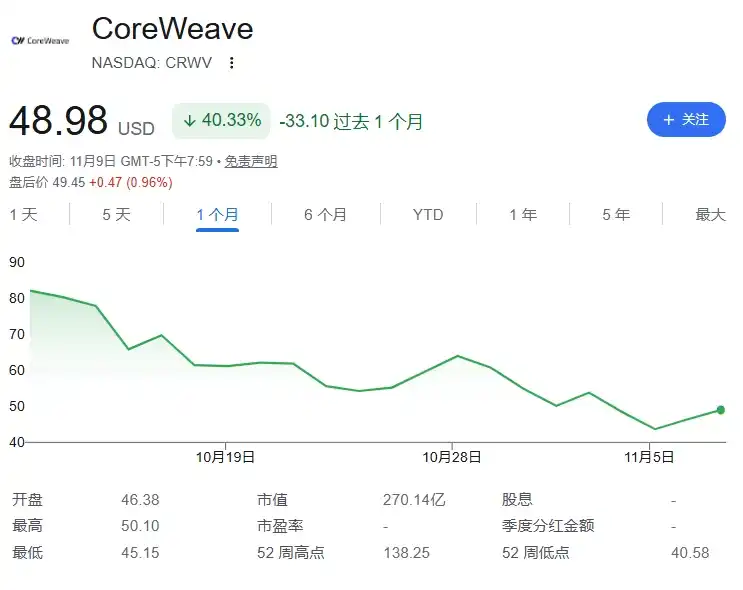
CoreWeave was hit first. The company carries approximately $50 billion in debt, and in mid-October, yields on its 2031 maturity bonds approached 16%, while its CDS spread expanded to around 1200 basis points—levels typically reserved for borrowers with questionable solvency.
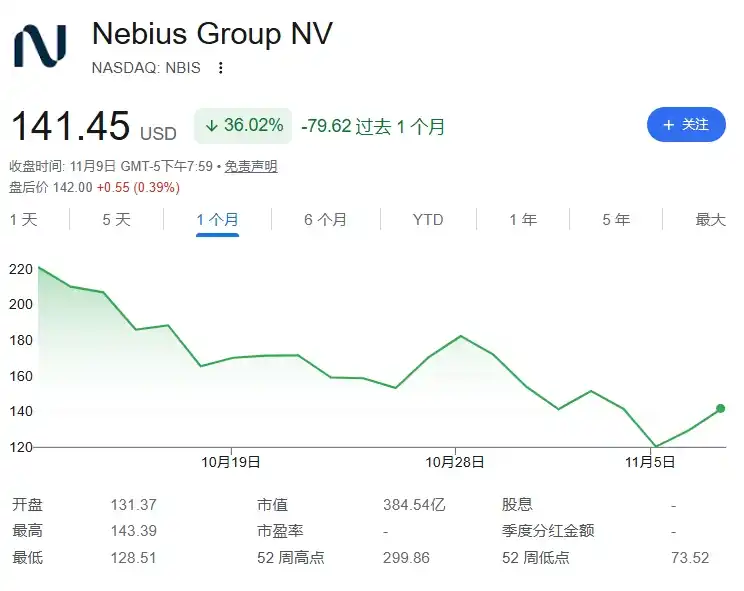
Nebius has a smaller debt profile and recently secured a $3.5 billion financing arrangement, yet its stock decline was nearly identical to CoreWeave’s. This indicates investors made little distinction during this round of selling.
CoreWeave and Nebius stocks plummeted 44% and 36% respectively over the past month.
Earnings Expectations: Strong Revenue Growth, But Persistent Losses
For CoreWeave, market consensus expects Q3 revenue of $3.55 billion. StarMine’s smart estimate stands at $3.54 billion—nearly identical, implying an upside surprise of only about 0.06%. In contrast, first-quarter upside was 5.73%, and second-quarter narrowed to 0.59%, indicating analysts are increasingly aligned with the company’s growth pace. EBITDA is expected at $2.05 billion, translating to roughly 58% margin, though the company is still projected to report a loss of $1.16 per share. The fourth quarter is expected to narrow to $0.55 per share.
For Nebius, revenue expectations stand at $908 million, with SmartEstimate slightly higher at $916 million—implying a positive surprise of about 0.96%. First- and second-quarter upside were 7.43% and 1.67% respectively, also trending downward. EBITDA is expected at $353 million, corresponding to ~39% margin. The company is projected to report a loss of $0.69 per share, which may widen to $0.95 in Q4 before gradually improving.
Bull Case: Has the Sell-Off Already Priced in Excessive Pessimism?
From a pure numbers perspective, both companies’ growth narratives remain compelling.
According to IG, citing consensus data, CoreWeave’s 2026 revenue is projected at $12.86 billion, expected to rise to $26.47 billion by 2027—an increase of ~106%. Nebius is projected to grow from $3.37 billion in 2026 to $11.98 billion in 2027, a ~255% increase. These projections are supported by CoreWeave’s backlog of over $129 billion in revenue commitments and Nebius’ long-term contracts exceeding $40 billion.
In valuation terms, CoreWeave’s current EV/EBITDA stands at 14.6x (based on trailing twelve months), while Nebius’ forward EV/EBITDA has sharply contracted from 191.4x (trailing twelve months) to 6.4x. Analysts’ average price targets are $131.41 for CoreWeave and $286.53 for Nebius—implying upside potential of ~183% and ~121% respectively versus current share prices.
On the business front, there are positive developments. Palantir has designated Nebius as a preferred sovereign AI infrastructure partner, opening potential government revenue streams. Nebius also completed its acquisition of Inferize in October, strengthening its inference capabilities. Meanwhile, CoreWeave is expanding into Denmark and plans to build a global AI network backbone spanning the UAE, India, Indonesia, Singapore, Australia, South Korea, and Japan starting Q4.
Bear Case: Debt Challenges May Outweigh Revenue Growth
However, growth fueled by debt remains sustainable only if refinancing can be achieved on reasonable terms.
CoreWeave raised its capital expenditure forecast in August to $35–39 billion—roughly three times its 2026 revenue forecast. With bond yields approaching distressed levels, the market’s central question is no longer whether clients need compute—but whether lenders are willing to keep funding. Any sign of forced contraction in the capex range could be interpreted as financing constraints rather than strategic adjustment.
Nebius’ financing position is relatively healthy but not without risk. Its $3.5 billion senior secured financing agreement with Citigroup has a term of just 364 days, with interest at SOFR plus 275 to 350 bps—meaning short-term funding is being used for long-term assets. Management plans to transition toward asset-backed financing based on contract orders, but executing this in a clearly tightening market poses significant challenges.
Additionally, CoreWeave faces notable customer concentration risk, with major clients including Microsoft, OpenAI, and Meta. Since its IPO, CEO Michael Intrator has sold nearly $1 billion in stock through pre-arranged trading plans—a concern that could spark governance scrutiny at this juncture. Nebius, meanwhile, may face inquiries regarding its former parent, Yandex, which withdrew its 2026 guidance after Russian data centers were attacked—despite both entities now operating independently.
The Earnings Call Is the Real Decider
In a typical quarter, a modest beat combined with stable guidance would suffice. But this is no ordinary quarter.
Given that both companies’ revenue expectations are close to consensus, the actual numbers may matter less than management’s tone and clarity during the earnings call. Investors are primarily focused on updates regarding financing conditions, the timeline for achieving free cash flow positivity, and the diversification of the customer base. The market especially anticipates CoreWeave providing a forward-looking free cash flow roadmap extending through 2030.
Profitability performance is equally critical. CoreWeave’s ~58% EBITDA margin is central to its debt-servicing argument; Nebius’ ~39% margin, while rapidly improving from a low base, remains vulnerable. Any deterioration in margins at either company could reinforce the narrative that "GPU leasing economics are less attractive than the growth rate suggests."
According to IG analysis, the following signals could mark a turning point in market sentiment: CoreWeave clearly reaffirming its $35–39 billion capex range with transparent funding sources; delivering a credible, forward-looking free cash flow turnaround plan, ideally covering up to 2030; new order data demonstrating customer diversification beyond current hyperscalers and AI labs; Nebius providing concrete details on asset-backed financing for its $4 billion contract backlog and a clear re-financing strategy for its 364-day facility; evidence of post-acquisition growth in Inferize’s inference business; and a narrowing of CoreWeave’s bond yields and CDS spreads following the earnings release—these metrics may reflect market sentiment more accurately than stock price movements.
As Chris Beauchamp wrote in his article: “If both companies can demonstrate that capital is secured and margins remain stable, the market may conclude that the >40% sell-off has already priced in excessive pessimism. If the calls instead revolve around refinancing uncertainty and ambiguous answers, then the stock halving may represent rational pricing—not an overreaction.”
Source: Friends of Planet King
Disclaimer: Contains third-party opinions, does not constitute financial advice


Yushu Surges 629% on First Day of Trading, Humanoid Robots Sell 5,500 Units
08-19
Yushu's 61 Billion IPO: Who Will Make Money?
08-07
AI stocks down 40%-60%, yet NVIDIA's valuation is at a 10-year low
08-06
HBM Bottleneck Migration, NVIDIA Also Aims to Downgrade
08-06
AI Servers Fuel Demand for Minor Metals: Prices Surge Over 70% in Half a Year
08-06
AI is not a search bar—it's a supercomputer costing just a few dozen dollars
08-05Cloud vendors first declined then surged—why the divergence in AI assets?
08-05


