Xiaopeng IRON's former lead developer launches startup focused on robotics' most challenging component — the "hand"
Xiaopeng IRON's former lead developer launches startup focused on robotics' most challenging component — the "hand"

2026-11-10 10:00
Introduction: Stability and scalability matter more than dexterity. "Workplace Bonus" (ID: ZhiChangHongLi) “Aimo, Can Help” · 01 Dexterity Hand
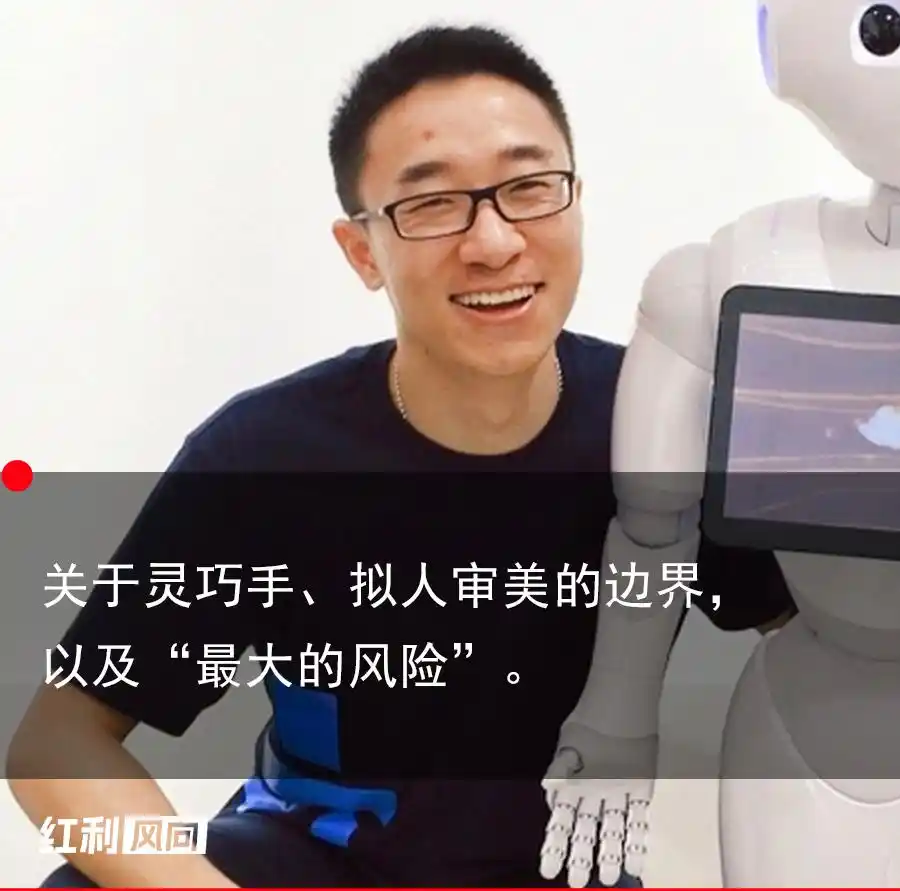
"Workplace Bonus" (ID: ZhiChangHongLi)
“Aimo, Can Help” · 01
The Three Hurdles of Dexterity Hands · 02
Aesthetics and Anthropomorphism: Navigating the Uncanny Valley · 03
Decoding Aimo’s Organizational Structure · 04
The Artisan’s Heart · 05
Shi Xiaoxin hasn’t spoken publicly in four months.
The last time the outside world heard from him was a WeChat post from early June: “Honored to have stayed here for 1,675 days, encountering such a lovely and warm team… packing up, setting off again.” The farewell banner prepared by his team read, “My boss is free now.” At that time, as the product planning lead for Xpeng’s humanoid robot IRON, the buzz from its catwalk performance had barely faded, with mass production on the horizon.
At the end of October, in Shenzhen, he sat before us as the founder of Aimo Robotics. This marked his first media interview since launching his startup.
Aimo specializes in dexterity hands—the most challenging and expensive component of humanoid robots. The field is no longer empty. With over 10,000 units shipped annually, iMotions has already established market presence; Qiangnai Technology, Xingdong Jiyuan, Pascini, and others hold their own niches. A list of mainstream players includes ten companies… Almost every investor he meets asks the same question: Is it too late to enter now?
“Persistence determines timing,” he said. “You may miss this wave’s rewards, but you’ve also avoided its pitfalls.”
This veteran robotics engineer, with 13 years of experience, rarely talks about end goals or visions. Instead, we discussed less glamorous topics—hand lifespan, manufacturability, hardware stability, and post-delivery reliability.
He calls these the “floor-level” requirements.
Listening to Shi Xiaoxin’s methodology feels like conversing with a master craftsman. For instance, he says overcoming the uncanny valley in anthropomorphic design relies on “form, spirit, and intelligence” each occupying their rightful place; hiring isn’t about persuasion, but finding “those who row together, not just ride”; organizational structure doesn’t need to mimic large corporations—only two metrics matter: atmosphere and efficiency.
Perhaps everything known and certain will one day be replaced by AI. When asked for advice to young people, this cautious interviewee offered a key insight into his own career choice: “In this era, certainty is the greatest risk.”
This sentence also serves as a high-level summary of his decision over the past four months.
“Aimo, Can Help”
The name “Aimo” was finalized in July. How did it come about?
Shi Xiaoxin: It stems from a phrase—AI Motion, combining Artificial Intelligence with motion intelligence. Over time, people began interpreting it as AI plus more—extending AI into the physical world, even beyond its current possibilities.
In internal chats, we also playfully extended it to sound like “Ai Mo Neng Zhu”—“Aimo, Can Help”—prompting us to reconsider what “assistant” truly means. Hands can solve many problems.
When spoken aloud, it felt natural and catchy. That’s how we adopted it. Naming is a brain-burning process—it must be unique yet meaningful, and good options are scarce.
What have you and your team been focused on over the past four months? Any surprises?
Shi Xiaoxin: Building a company from zero to one. Incorporation, finding office space, securing the first round of funding—all phases involving learning, familiarity, and control. Unexpected challenges were mostly procedural and formal: legal matters, for example. Fundraising was both familiar and foreign—we all know the primary market, and many have interacted with institutions—but actually running a company and engaging with investors brought new realities. What should a company present to investors? What do they care about? How to sustain long-term operations? These are seldom touched upon when working as a corporate manager.
The Three Hurdles of Dexterity Hands
There’s a saying in the industry: the ultimate competition in humanoid robots hinges half on the hands. Do you agree?
Shi Xiaoxin: Mostly yes. From a hardware and body perspective, the hand’s value is roughly equivalent to the rest of the body—including operational complexity and difficulty. One could say half the value lies in the hands.
I prefer another interpretation: the true value comes from two core components—hands and brains—making it a 50-50 split. They must evolve synergistically. Biology supports this. Human hands are far more dexterous than those of apes; hand evolution and brain evolution have co-developed. The brain drives hand advancement, while hand dexterity further accelerates brain development.
If ranking key factors affecting dexterity hand development—freedom of motion, load capacity, cost, lifespan—what would you prioritize?
Shi Xiaoxin: We currently identify three critical points.
First, usability. This involves longevity and stability—our top priority. The issue isn’t lack of hands, but scarcity of hands that are usable and sustainable over time.
Second, manufacturability: producing with excellent craftsmanship, controlled costs, and reasonable timelines. A superior product fails if it cannot be efficiently and rapidly manufactured.
Third, dexterity—linked to degrees of freedom. From 2021 to 2024, early-stage tasks focused on simple actions like grasping and placing. Even dexterity hands were often used as basic grippers—two-finger clamps with minimal motion. In recent years, frontier labs increasingly favor high DOF for complex dexterous operations. Most have hit bottlenecks with grippers and low-DOF hands. The next phase will demand ever-higher dexterity.
Freedom of motion itself is relatively deterministic—we can achieve full DOF operation. Reducing DOF is primarily a trade-off between cost and structural simplification.
Load capacity isn’t currently the main constraint. What matters more is task complexity; loads can be managed via tools. Cost reduction focuses on design and manufacturing—this is the foundation of mass production, an area where we excel.
Are there any technical paths you’re determined to avoid?
Shi Xiaoxin: Not necessarily. But we won’t explore all major actuation methods—cable-driven (tendon-based), pushrod (linkage-based), direct-drive (motor directly in joint)—in depth. Past experience has already yielded conclusions; we’re committed to direct drive. Within this path, we remain open-minded, exploring various structures, joint transmissions, and motor configurations.
Back in March, at the MIIT’s AI Standardization Technical Committee workshop, you proposed a framework for general-purpose intelligent grading in humanoid robots, dividing autonomous capabilities into levels. Based on your own model, where does today’s leading product stand? Where does Aimo aim to be?
Shi Xiaoxin: Let me correct a premise first. The hand is more of a critical component—not something we’d classify by intelligence level, as it doesn’t represent the whole robot. To generate value, a hand needs an arm; an arm needs a controller (the brain); extending further, locomotion via legs or base completes the body. Thus, value creation requires at least an arm and a brain—this is, in essence, robotic grading.
From a general robot grading perspective—there’s a gap between technology exploration and product maturity. Many believe tech has reached a certain level, but product standards exceed exploratory results. Measured by product benchmarks, I believe the entire industry is still only at L2, or even below—some haven’t even reached L2. Extreme scenarios are often overlooked.
From a hardware standpoint, hand maturity lags behind the body by two to three years. The benchmark is scale and reasonable pricing. Currently, a pair of hands can cost more than all other body parts combined.
For Aimo, we’ll first solidify hardware capable of L2 functions, motion control, and foundational edge-side models (local, cloud-independent models). Only then can we build toward L4 and L5. If remote operation itself is unreliable, and hands fail or break during use, advancing intelligence will inevitably hit a wall.
How long do you estimate this process will take?
Shi Xiaoxin: In the next one to two years, dexterous operation capabilities will see significant growth. Reaching L4 and L5—realizing our ideal physical AI and practical deployment—will take longer, perhaps 3 to 5 years.
But these 3–5 years aren’t a clear boundary. They represent a phase: progress may begin in specific scenarios, initially imperfect or limited to one context, then expand to ten, a hundred, or even a thousand. The journey could extend further—we’re preparing for long-term commitment.
You once said you’d “stick to real robots, not paint big pictures.” In your view, what’s a real robot, and what’s a big picture?
Shi Xiaoxin: A real robot is a product that genuinely solves customer problems—a floor-level requirement delivering tangible value. A “big picture” isn’t inherently negative; it represents technological potential, the ceiling. But realizing that ceiling depends on numerous conditions and time.
Showing the ceiling is hard; demonstrating real-world value through execution is harder. Today’s real challenge is defining your floor: Can you deliver the hardware? Once delivered, can it actually be used? Will it break during use? “Diving deep into hardware details” is exactly what we—and many genuine robotics firms—are facing now.
This year’s World Robot Conference featured scenes in sorting, catering, healthcare, inspection—processes were undoubtedly bumpy, but such attempts are essential. Experimentation differs from painting big pictures. Failure to meet final standards simply means progress is ongoing. For example, in sorting, several scalable, successful players will eventually emerge. But so far, few can deliver reliably. Value realization still depends on hardware stability, system throughput, and success rate.
Heard you once aimed to become the “Yuzu of dexterity hands”—Yuzu is one of China’s largest robotics companies by output and revenue. Does that count as painting a big picture?
Shi Xiaoxin: Maybe. (Laughs) But Yuzu is undeniably a great company. This reference reflects an internal alignment: achieving scalable applications with concrete industry indicators—like widespread customer acceptance and scale. Without scale, it’s hard to judge quality. From an operational standpoint, we need revenue capability. Yuzu sets a benchmark for this direction.
Aesthetics and Anthropomorphism: Navigating the Uncanny Valley
People who’ve met you say you care deeply about aesthetics. Is this innate or cultivated?
Shi Xiaoxin: I don’t have an art background, but when you encounter a beautiful, well-designed product, you instinctively sense it’s meticulously crafted. With enough exposure, you naturally distinguish quality.
It also reflects a product-oriented mindset: beauty signifies seriousness. You can focus solely on function, but a beautifully designed, carefully refined product reveals the creator’s dedication and aspiration. Beauty is hard to achieve—implying higher standards and attention to detail.
Have you ever rejected a design because it passed engineering checks but failed aesthetic judgment?
Shi Xiaoxin: Yes. Design functionality and design beauty are two distinct levels—representing different industrial maturity thresholds.
IRON offers many examples. Early on, we could have used existing joints to meet performance and functional needs. Why shape the entire body into curves? We discarded many purely functional designs to align structure with human aesthetics. Challenges arose, but ultimately proved feasible without sacrificing performance. When elevating aesthetics to a high standard, it’s not impossible or detrimental to function—but demands superior industrial design and implementation capability.
Beyond curves, what else defines a robot as visually appealing?
Shi Xiaoxin: We consider more than static aesthetics—ensuring it looks equally beautiful in motion. This is often overlooked in early designs: a product may look fine standing still, but movement feels off. That’s why the catwalk debut was such valuable feedback—an experiment testing both static and dynamic presentation. Placed before the public, did everyone feel it was good?
Another example: design ethics. IRON features fabric and skin coverings. During movement, some skin areas wrinkle and stretch. Mechanically irrelevant, but imagine it as a sentient being—how odd it feels. Wouldn’t it be uncomfortable? Like a person with clothes violently pulled—unbearable. It’s not a mechanical perception but a human one. From a design standpoint, wrinkles must appear natural and relaxed—only then does the whole robot feel truly human-like.
Moreover, anthropomorphism: we may have taken a shortcut. Aesthetic consensus varies across objects—round vs. square earbuds, for instance. But humans share a genetic affinity for our own form, making aesthetic agreement easier. Slender, elegant silhouettes align better with mainstream taste. Biologically inspired design harmonizes understanding—highly perceptible. So we’ll continue building humanoid robots.
Anthropomorphism carries the well-known risk of the “uncanny valley”—robots grow more relatable as they resemble humans, but reach a point where they feel unsettling. Some recent anthropomorphic products received poor user feedback. Where’s the boundary?
Shi Xiaoxin: Poorly designed anthropomorphism easily triggers discomfort—industry consensus. Yet, the desire for human-like products persists, driving constant efforts to cross the uncanny valley.
We received positive feedback once: when IRON walked out—people didn’t find it weird, but rather affectionate and symbiotic.
From a design angle, I follow a three-part standard: “Form, Spirit, Intelligence”—all essential.
Form: overall appearance, primarily static visuals;
Spirit: dynamic responses—natural gestures, turns, glances, soulful reactions;
Intelligence: whether it responds like a human in conversation.
To truly cross the uncanny valley, scores above 90 are needed. 0–40 relies mainly on Form—visuals are the first impression. 40–80 hinges on Spirit—can’t stand rigidly motionless, nor move against human intuition. Beyond 80 requires Intelligence. Only when all three are effectively unified can the uncanny valley be crossed.
Can you isolate them? What happens if one is missing?
Shi Xiaoxin: Form and Spirit alone resemble current exhibition robots—nodding, blinking—but can’t meet expectations of a human-like entity. Strong alienation remains: it’s an object, not intelligence, not a person.
Form and Intelligence done right, but Spirit lacking—example: a silicone doll with voice AI. Looks great, speaks well, but speech doesn’t match lip movements. Laughing uncontrollably with no facial muscle change—this induces terror.
Spirit and Intelligence strong, but Form weak—take MOSS from *The Wandering Earth*. Highly intelligent, expressive with light and imagery, but lacks embodied form. Fear persists—you don’t know its limits. This fear stems from uncertainty.
Thus, our design philosophy: perfect the form, ensure dynamic expression of spirit, and achieve sufficient intelligence. Organic integration naturally crosses the uncanny valley.
Does this mean Aimo’s hand must look exactly like a human hand?
Shi Xiaoxin: Yes. Hand training data is human; operating environment is human; objects handled are human-manipulated—like a knob. A non-human hand faces inherent capability limitations.
Biologically, we believe anthropomorphism equals the upper limit of dexterous operation. If the hardware is anthropomorphic, the upper bound is inherently high—approaching or exceeding human ability. Non-human hands may have more efficient actuators in some evolutionary branches, but currently, the human hand remains the best solution.
Naturally, anthropomorphism increases complexity and cost. Is it necessary? We see it as an engineering challenge. Aimo has already mapped pathways for structural simplification and cost reduction. We’re confident we can achieve extreme anthropomorphism and stability while minimizing cost and complexity.
Decoding Aimo’s Organizational Structure
Will Aimo always focus on hands, or will it expand?
Shi Xiaoxin: From day one, Aimo was a product company—not just a component supplier. Problems currently center on hands, so we focus on hands. We also have our own arms and upper-body platforms—expansion is planned. Starting with hands, but not ending there.
We’ve targeted global markets from the outset, aiming for broad adoption, rich feedback, and continuous iteration.
Talent-wise, we built a relatively complete system from day one, including a global talent strategy—even from campus recruitment, we planned to bring in overseas talent.
Your speed of establishment is impressive—your official account, talent systems—look nothing like a typical startup. How did you assemble such a team so fast?
Shi Xiaoxin: Two things mattered most: shared conviction and alignment on the mission, reducing skepticism significantly. Second, the founding team members mutually respected each other. Once individuals and the vision were aligned, the team formed rapidly—driven by shared ideology.
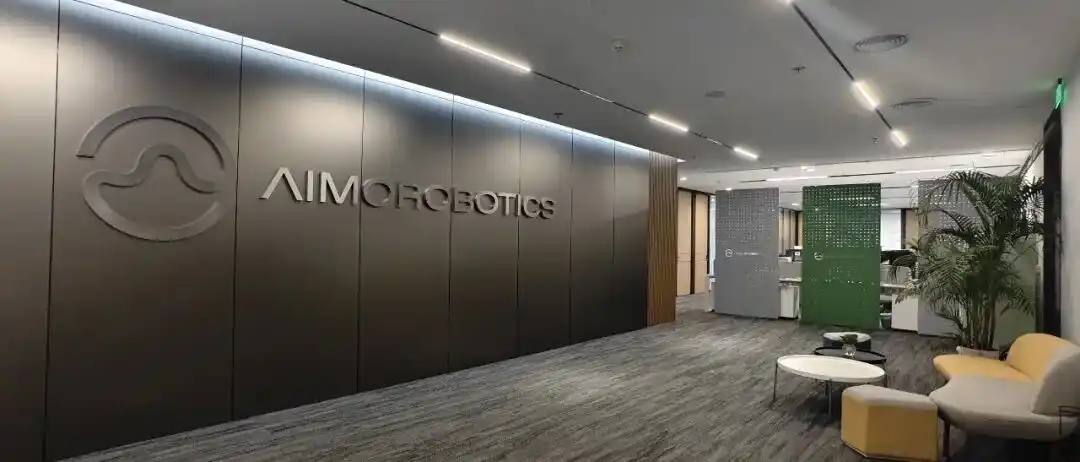
Entrance to Aimo Robotics’ new office
Most candidates hold offers from major platforms. How do you convince them to join a company months old?
Shi Xiaoxin: We rarely persuade. Startups offer greater potential but higher risk—persuasion is costly and inefficient. We focus instead on whether individuals have clarity: Is this direction truly what they want? Are they sure and committed? We communicate vision, organizational purpose, and management style—seeking alignment, not persuasion.
Our first twenty-plus employees weren’t persuaded—most held big-platform offers. In large companies, you’re carried along, gain resources, but rarely influence strategic direction or product decisions. In startups, you lead the company forward in your expertise—driven by will and capability.
We internally say: we need people who row together, not just ride. If you bring your own oars, that’s ideal. This is our talent standard.
Have you ever turned down a highly capable candidate?
Shi Xiaoxin: Yes. Many skilled individuals don’t align with our values. No right or wrong—just misfit. We seek people not chasing trends—trends shift, and trend-chasers leave. True commitment stems from personal judgment.
We want people who stay after the bubble bursts. I’ve lived through multiple waves. Whether boom or bubble, it’s natural—comes and goes. First, we need passionate robotics enthusiasts who know their purpose, have their own judgment. Call it enduring cycles, or simply: when the industry isn’t hot, can you still clearly decide whether to keep going?
So we accept temporary skill gaps—but clear goals, alignment with our direction, and willingness to learn continuously.
We welcome fresh graduates. Several undergraduates and interns are highly enthusiastic, productive, and clearly motivated—happy and focused on their work.
Yet, this field evolves rapidly. Some teams rush to adopt every new thing. How do you balance “steadfastness” and “adaptability”?
Shi Xiaoxin: Steadfast doesn’t mean inflexible. New tech solutions? Of course we must explore, study, adapt. Ignoring new developments turns steadfastness into blind rigidity. Adjustment is part of steadfastness—when cognition diverges from reality, quick correction is essential.
Internally, we say: long-term goals never change. Shifting long-term goals distorts current decisions and rhythms. Our goal remains: to build outstanding physical AI products. Even if physical AI cools, we won’t pivot. This doesn’t conflict with the high-dynamic nature of algorithm/model fields—we’re adapting models to new tech, but our core direction and resolve are firm.
Many ex-big-company founders replicate corporate processes. What deliberate choices has Aimo avoided in organization?
Shi Xiaoxin: Our early team members all came from big companies—beneficial for understanding corporate mechanics. But processes and management are tools, serving goals.
Early on, we believed: the two key metrics are organizational culture and efficiency. Under this goal, processes and management emerge organically and dynamically. From a product logic perspective, processes are just features—enterprise is a complete product, employees are users. Process quality is judged by employees themselves—what works for them is real quality.
Over the past three to four months, our organizational flow emerged naturally through collaboration. “I need to do this, but no process exists?” So we built one—Who does it? Who approves? Who are upstream/downstream? Who handles resources? Later entrants reuse this pattern.
It’s essentially a bottom-up collaborative model. We monitor efficiency—any issues trigger process adjustments.
We encourage internal transparency—sharing business insights. Even with 20+ people, we introduced leadership training—rare in startups, uncommon even in big companies beyond exec levels.
Do you have an “on-call” culture internally?
Shi Xiaoxin: Yes—what we call collaboration and part-time roles. Industrial designers double as brand ambassadors; algorithm engineers serve as cultural ambassadors. We form virtual teams to execute tasks. Whether office layout, renovation, or website—everyone spontaneously unites around a goal, not hiring dedicated staff. It fosters broader involvement, deeper understanding of the business—something hard to achieve in big companies.
How has AI driven real efficiency gains in your R&D and operations?
Shi Xiaoxin: Programming tools are a prime example. Now almost no one codes manually—manual coding is called “ancient method.” Today, we generate and validate code ourselves, including test workflows.
Another excellent case: software like SolidWorks. Non-experts struggle to use it—only specialists create drawings, then align with downstream teams. A product requests a dimension, typically requiring text-to-3D conversion—weeks of refinement, then rechecking. Now, using AI-assisted tools, a rough 3D model can be generated overnight—enough for joint placement, prototyping, and intent expression. Downstream teams save one to two weeks compared to traditional workflows.
AI’s impact is clearest in bridging professional and upstream/downstream boundaries—boosting communication, validation, and experimentation efficiency. Led by our IT head, we collect intelligent agents and skill modules from various workflows, refine them into tools for R&D and business teams. Future incentives might include number of deployed agents (autonomous AI programs) and skill modules (reusable AI capabilities). We’re also piloting Agent tools in physical testing: AI connects to oscilloscopes to analyze signal metrics, detects anomalies, adjusts low-level driver code, then validates.
The Artisan’s Heart
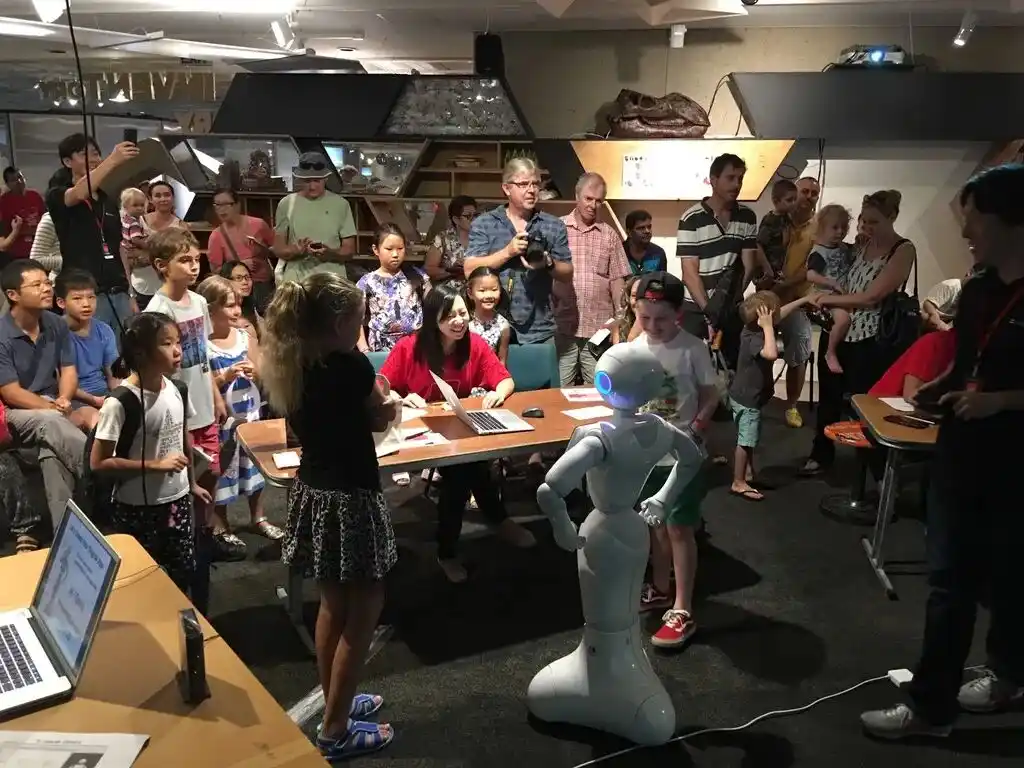
Looking back at your career path—2013 at SoftBank with NAO and Pepper, 2018 at Coolpad with “Bao Xiao Mi,” later managing international expansion, then at Xpeng. What did each stage leave behind?
Shi Xiaoxin: First stage: conceptual and visionary building. I was direct in job hunting—upon returning, I searched “robotics.” The first result was Aldebaran, a French humanoid robot company later acquired by SoftBank—I joined immediately, ignoring salary or title. At Aldebaran, I progressed from R&D to solutions, then client engagement—shaping my vision: what is a humanoid robot? How to coexist with humans? What future service scenarios? It gave me global perspective—business spanned North America, Latin America, Europe, and Asia. I deeply understood regional differences in robotics development pace and attitudes.
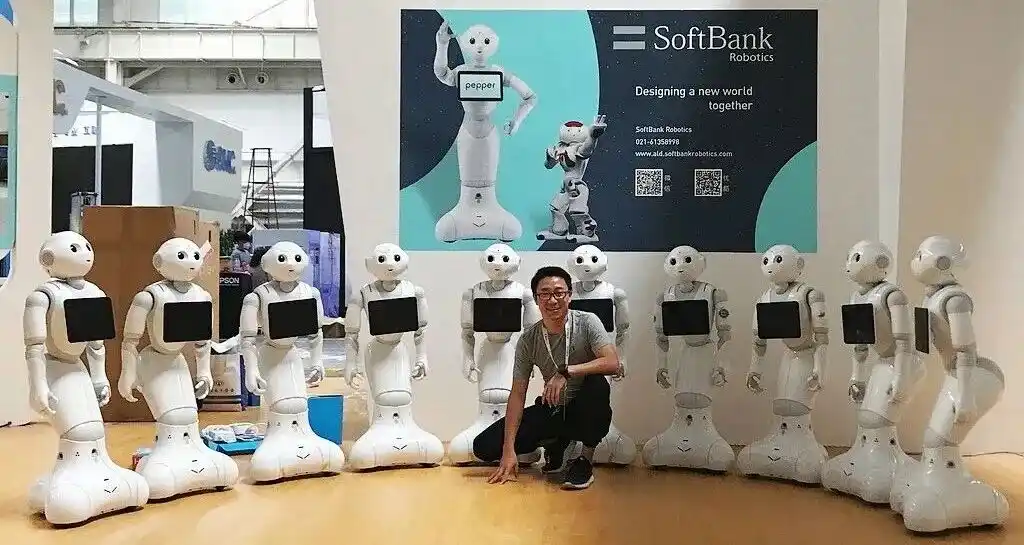
Shi Xiaoxin worked at Aldebaran, acquired by SoftBank
Second stage at Coolpad with “Bao Xiao Mi”: focused on commercialization challenges—grounded in real user scenarios: how products function, problems encountered, solutions. Anyone who’s done this knows the floor-level importance: how to build that floor, ensure product reliability, usability—time-consuming and experience-intensive. Including how customers buy a second unit. This taught me the path from commercialization to real-world application.
Third stage at Xpeng: responsible for overall product planning and styling R&D. Deep takeaway: when defining a product from zero to one, what matters—how to set high standards, technical feasibility, handling difficulties, maximizing potential. Also learned what’s possible and impossible, and how much resource hardware development demands.
During the Coolpad years, service robots were labeled a bubble. How is today’s embodied intelligence boom fundamentally different?
Shi Xiaoxin: In sum, not much difference. Initially rule-based programming—NAO and Pepper exemplified this. Then semi-automated tech—NLP and SLAM (Simultaneous Localization and Mapping): conversations became possible, but crude; robots could move but struggled in hotels and restaurants. Now, model-driven, accelerated by GPT.
Each wave advanced the field, leaving substantial technical accumulation. Regardless of bubble size or burst, staying committed to your vision remains vital.
Difficulty is becoming clearer. Back in the NAO era, we had Romeo—a 1.4-meter full-scale humanoid—already in 2013–2014, yet walking two steps was hard. Today, people can jump and bounce. Realizing growing difficulty comes from seeing more possibilities, with technology advancing dramatically. Earlier, belief was blind; now, we know how to proceed, but recognize the task is hard—break it into stages, step by step.
Most striking: early NAO days, I doubted we’d see general-purpose robots serving millions in our lifetime. Pepper raised the possibility, but still seemed distant—basically, believing, but unsure of the path. After decade-long waves, we now suspect it may happen within our generation—possibly everywhere in ten years. That’s the biggest change.
Who in the industry do you most respect?
Shi Xiaoxin: The most influential figure is Bruno Maisonnier, founder of Aldebaran Robotics (France). He’s my industry mentor. He started in 2005—over twenty years ago. At that time, “embodied” hadn’t even been coined—just “robots,” general-purpose service robots. My initial vision was shaped then.
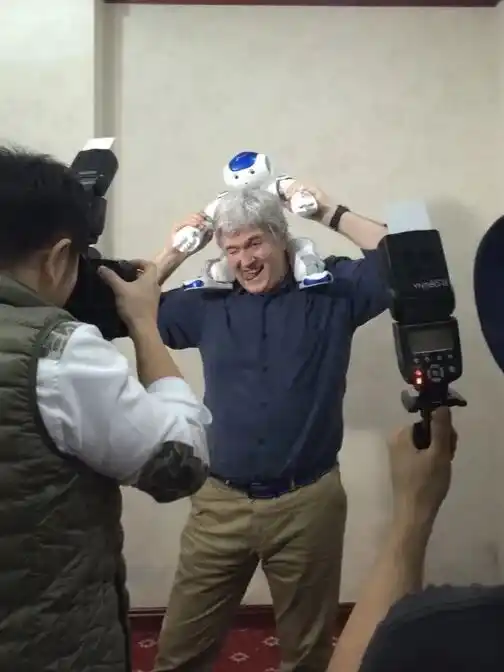
Bruno Maisonnier, founder of Aldebaran (left), and Shi Xiaoxin with him (right)
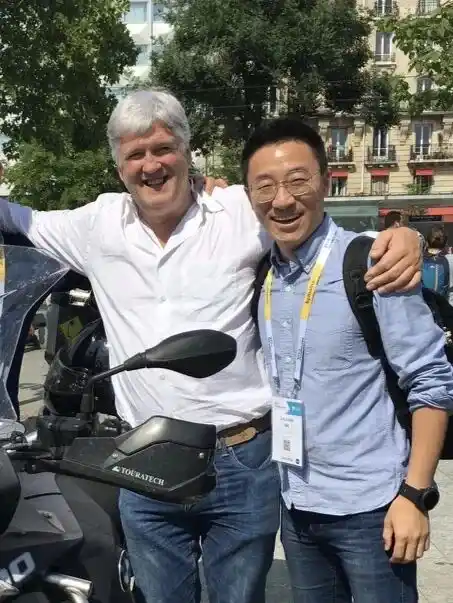
Bruno Maisonnier, founder of Aldebaran (left), and Shi Xiaoxin with him (right)
Many call NAO the pioneer of humanoid robots—fairly so. To date, I still believe NAO’s product maturity and commercial ecosystem are the most comprehensive globally: OS, programming tools, business ecosystem, channels, even an app store—remarkably complete. Many educational robots bear NAO’s legacy.
Three moments stand out. First, organizational culture. Bruno flew from Paris to Shanghai with no rest—landed, entered the office, sat on the floor with engineers, discussing technical details. Former banker, senior executive—no need to prove himself this way, even riding motorcycles across France in his later years. You see how a true robotics enthusiast works.
Second, design sensibility. NAO and Pepper’s design aesthetic remains timeless—complete and cohesive. NAO’s hand, in its first generation, was already highly human-like—and tendon-driven (cable transmission).
Third, human-robot symbiosis. NAO served autism therapy—our solution genuinely helped reduce communication barriers. Deeply humane. Another example: how did NAO get its name? After robot creation, no name existed. At a product event, Bruno brought it to a French elementary school. During interaction, a child named it “NAO”—perfectly smooth in both Eastern and Western pronunciation.
Aldebaran’s culture of communication and exchange is exactly what I aim to recreate at Aimo.
“Workplace Bonus” (ID: ZhiChangHongLi)
After today’s conversation, I sense in you a deep artisanal quality forged over years in the industry. But investors don’t always trust artisans turning entrepreneurs. What’s the toughest question you’ve faced from investors?
Shi Xiaoxin: The most common challenge: “Is it too late to enter dexterity hands now?” People believe the field is mature—our entry seems disadvantageous.
My stance hasn’t changed. Broadly speaking, when persisting in general-purpose robotics, timing is irrelevant. Miss this wave’s rewards? Avoid its pitfalls. Enter the next wave—still opportunities, still challenges. Whether Aldebaran, SoftBank, Coolpad, or Xpeng, I’ve stayed on my core path—long enough to endure.
More precisely, I don’t believe dexterity hands or robotics are now in a red ocean. We see unresolved problems—precisely meaning opportunity: vast room for truly great products, perfectly timed for us.
Moreover, this era is ideal. In 2022–2023, I once doubted: “Is the humanoid robot direction wrong? Why human-shaped, general-purpose?” But GPT provided two breakthroughs: first, generalization—handling novel scenarios and tasks—is possible—humanoid robots exist for generalization; second, it boosted industry confidence. Software capability can be solved.
So whether born in the ’60s or ’00s, I believe everyone should join this mission—age irrelevant. Everyone finds their role: youth use AI to accelerate coding, hardware experts attack supply chains, capital with resources support the ecosystem. This deserves collective effort. Because I believe, I’m unafraid of challenges.
Last question. Our readers include many professionals hesitating to leave big platforms. If you could give one piece of advice, what would it be?
Shi Xiaoxin: In this era of rapid AI advancement, certainty is the greatest risk.
Known and certain things will be replaced by AI. Humans outperform AI in uncertain domains—finding certainty within uncertainty is where human value lies. If you’re in a platform doing things in a fixed, predictable way, either adjust your work or switch platforms or industries.
For humans, the future likely means exploration and creation. Robots will handle most repetitive, certain tasks.
Also, remember: risk and reward are directly proportional.
Written by Chen Tong | Cover image: Provided by interviewee
Follow + Star to track trends in “industry, company, talent” 👇
Source: Workplace Bonus
Disclaimer: Contains third-party opinions, does not constitute financial advice


HuggingFace's "AI Duck" Goes Viral, Boosting Chinese Chip Supplier Rockchip
09-02
Yushu Surges 629% on First Day of Trading, Humanoid Robots Sell 5,500 Units
08-19
14 Executives Depart, Horizon Unleashes a Robot Legion
08-11
Yushu's 61 Billion IPO: Who Will Make Money?
08-07
Former Huawei Genius Youth: Building 5,000 Reliable Robots This Year Won't Exceed 3 Companies
08-05
China's climbing robotic vacuum cleaner captures 70% of the global market
08-05Musk spent nearly half of the Tesla earnings call discussing AI and robotics, with automotive business accounting for less than one-third of total revenue
08-05


