An AI virtual puppy earns $110,000 monthly—this strategy hasn't been tried by anyone in China yet

An AI virtual puppy earns $110,000 monthly—this strategy hasn't been tried by anyone in China yet

2026-07-17 09:08

Introduction: A three-person studio in South Korea created an AI-generated virtual Shiba Inu named Damaiz, achieving 85,000 YouTube subscribers and monthly ad revenue of 110,000 RMB within 10 months. Meanwhile, the average monthly salary for a white-collar worker in Seoul is 20,000 RMB. A fake dog earns 5.5 times more than a real person. This isn’t magic—it’s a replicable methodology.

First, clarify this: Damaiz is not a real dog. It has no physical body, cannot be adopted, and won’t get sick or die. It’s a 3D-rendered Shiba Inu brought to life through AI voice synthesis, animated with Blender to blink and tilt its head, and monetized via YouTube’s monthly payout on the 21st. It’s a production-line-driven virtual IP, not a pet you raise.

The reason this case is worth deconstructing isn’t because it made 110,000 RMB—it’s because it validates a complete path: AI-generated virtual avatar + multilingual subtitles + global YouTube ad revenue sharing. Layered together, this model enables a small team of 3–4 people to build a six-figure content business monthly. And this lane remains largely untapped in China.

How Does Damaiz Actually Work?

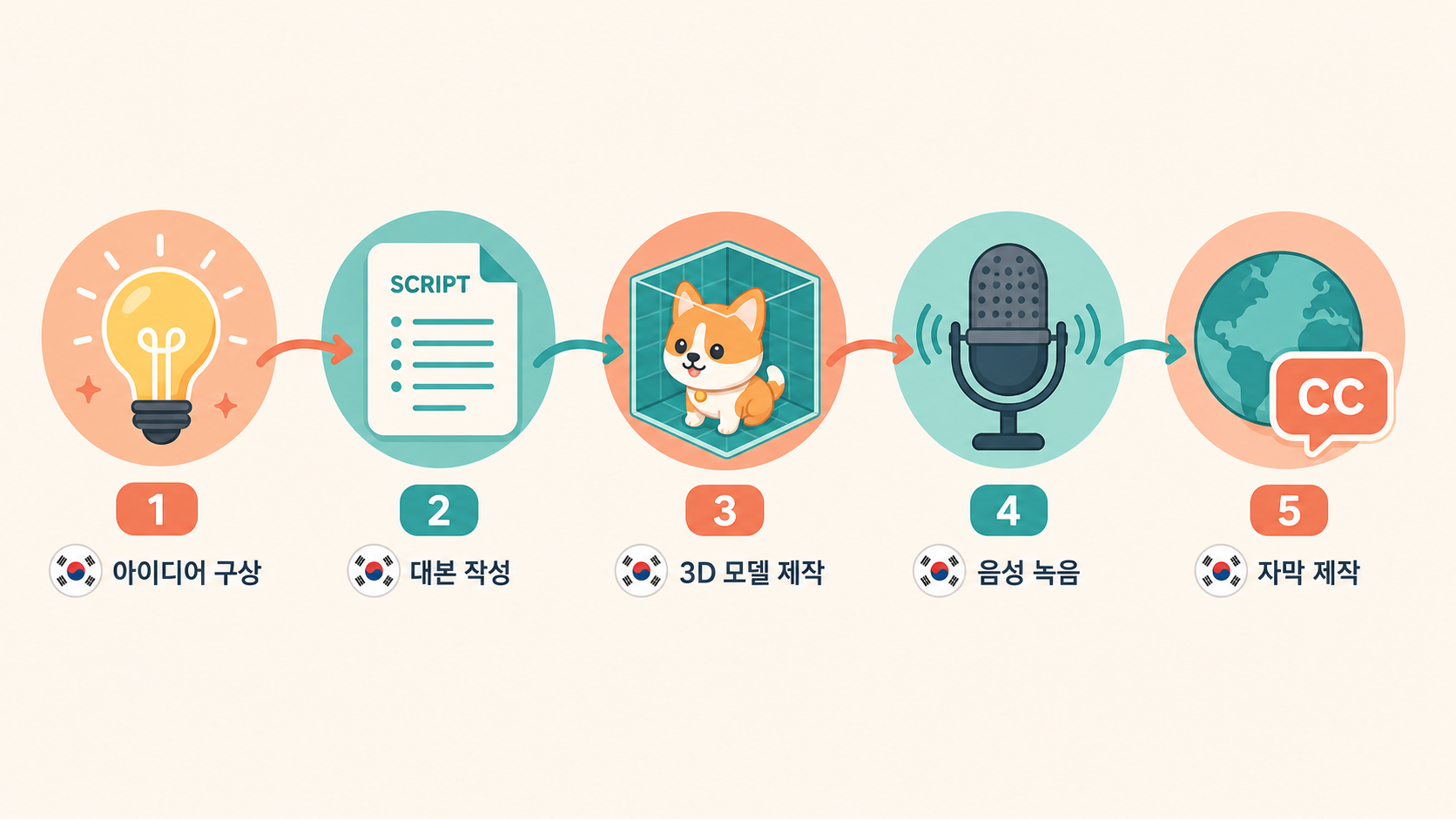
Let’s examine its production workflow. From topic selection to video launch, a single 8- to 12-minute video follows this full-stack process:

Topic Selection. It avoids hardcore educational content and instead leans into light-hearted mini-dramas—“Damaiz Wants Sushi,” “Damaiz Takes the Subway for the First Time,” “Damaiz Learning English.” Cuteness sells content, but storytelling is what keeps viewers watching for minutes. Topics are decided internally through team brainstorming, not driven by trends, relying instead on long-term instinct for viral pet content.

Scriptwriting. Initial drafts are written in Korean using ChatGPT or Claude, then polished by a native Korean speaker. AI-generated scripts often lack rhythm and comedic timing—native editors mainly refine tone and pacing. After editing, each line is mapped to specific facial expressions and gestures.

Avatar & Animation. The 3D model is built in Blender, establishing core poses: sitting, standing, walking, jumping, tilting the head, blinking. Facial expressions and lip-sync details are enhanced with AI tools. There’s no need to rebuild from scratch per video—existing motion libraries are fine-tuned. It takes 1–2 months upfront to build a robust action library; thereafter, only expression and mouth movement adjustments are needed per video.

Voiceover. Korean AI voice generation options include Typecast, Naver Clova Voice, and ElevenLabs’ Korean model—commercial licenses cost $50–$150/month (~350–1,000 RMB). For kawaii (cute) tones, voice cloning plus post-production tuning is required—this demands a video editor skilled in audio software. A few key lines use live human voice for emotional depth.

Subtitles. Each video includes four language subtitles: Korean, English, Japanese, and Chinese. YouTube’s auto-translate quality varies widely—native speakers must proofread each batch, costing 200–400 RMB per video. With 8–10 videos per month, subtitle budget totals 2,000–4,000 RMB. The challenge with Chinese isn’t translation—it’s localizing internet slang and cultural references.

Overall, one 8- to 12-minute video can be produced in 2–3 days, with 2–3 videos released weekly. A team of just three people can sustain this pace.

What Does 110,000 RMB Really Mean?

Let’s break down the numbers.

The core cash flow engine is YouTube Partner Program (YPP) ad revenue sharing. No donations, no product sales, no brand deals—just pure platform payouts based on views, settled reliably every month on the 21st. Among all monetization models, this offers the highest predictability.

The 110,000 RMB figure breaks down as follows: Damaiz currently averages 8–10 million monthly views. YouTube’s CPM (cost per mille) varies by region and content type—Korean-language CPM is relatively low, but English-language CPM can be 3–4 times higher. Over 60% of Damaiz’s views come from overseas, which lifts the overall CPM. The final 110,000 RMB is a weighted average across multiple language CPMs.

For comparison: Ad revenue margins are lower than e-commerce—dropshipping can achieve 30–50% net profit, while ad revenue essentially packages traffic and sells it per thousand impressions at a low unit price. But the upside? No need to manage sales teams, customer service, returns, or inventory. For a 3-person team, this “set-and-forget” model is far more sustainable than dropshipping.

If subscriber count grows from 85,000 to 250,000–300,000, monthly ad revenue could stabilize at 300,000 RMB, with net profit between 150,000–300,000 RMB. For a 3–4 person studio, this represents a very respectable ceiling.

How to Replicate This Model in China

Start with cost structure, then execution strategy.

3D Modeling & Animation: One animator can spend 1–2 months building a base motion library upfront. Afterwards, each video uses pre-existing animations with minor adjustments. Monthly salary in second- and third-tier cities ranges from 8,000–12,000 RMB. Blender is open-source and free. Mixamo can be used for skeletal animation, while Live2D offers a low-cost 2D dynamic alternative.

AI Voiceover: Commercial-grade tools cost $50–$150/month (~350–1,000 RMB).

Multilingual Subtitle Proofreading: Outsource each video for 200–400 RMB. With 8–10 videos monthly, subtitle costs total 2,000–4,000 RMB.

Monthly total cost: 12,000 RMB (labor) + 1,000 RMB (AI tools) + 3,000 RMB (subtitles) ≈ 16,000 RMB, plus ~4,000 RMB in miscellaneous expenses. As long as monthly views exceed 2 million, ad revenue covers costs and turns a profit. Damaiz’s 85,000 subscribers generate 8–10 million monthly views—so 50,000 subscribers represent the breakeven point.

Startup recommendation: No need to quit your job or go all-in. Start with a side project. Partner with someone who has 3D modeling skills. Choose a cute animal avatar—Shiba Inu, cat, rabbit—all work. Use Blender to create the base model. Then release 2–3 short videos (3–5 minutes) weekly with bilingual (Chinese-English) subtitles on YouTube. The first 10–12 months are cold-start phase—expect only thousands of views and no income. But if content quality stays consistent and uploads are weekly, subscriber growth will gradually accelerate.

Why choose cute animals over other niches? Because pet content is globally universal—no cultural translation needed. A Shiba Inu being adorable makes sense to Koreans, Americans, and Japanese alike. Cooking, children’s animation, ASMR, fitness—same principle. The key is selecting the right niche and using AI to compress production cost to one-third of traditional methods.

Capacities and Risks of This Model

This isn’t without limits. Virtual pet IPs lack three critical elements that cap their potential.

First: Emotional anchoring. Viewers connect with real pets because they know they’re real—there’s a tangible life tied to daily routines, creating emotional investment that translates into willingness to pay. Virtual avatars lack this layer—the attachment is to the story and persona, not the entity itself. Emotional depth is inherently weaker.

Second: Offline engagement. Real pet IPs can host live events—performances, signings, photo sessions, pet meetups—high-value, high-margin monetization. Virtual pets have no physical form, so they can’t do these. At best, they offer livestream interactions and AR filters.

Third: Viral momentum from real-world incidents. Real pets get sick, injured, or pass away—each event triggers emotional waves, boosting visibility and followers. Maru the Shiba Inu gained tens of thousands of new followers the day he died. Virtual pets experience no such surprises—growth relies solely on consistent content quality, leading to a flat, predictable curve.

Together, these limitations cap monthly revenue at around 500,000–800,000 RMB—unachievable for top-tier real pet accounts. But for a 3–4 person studio, this is already a very high ceiling.

Damaiz’s story is often misrepresented as “a talking dog earns 5x more than a white-collar worker”—that’s the hook, not the answer. The real insight is this: Starting this year, pure content IPs are entering a new structural paradigm—powered by an AI toolchain, global distribution platforms, and ad revenue mechanisms. This system requires neither a real protagonist, nor on-camera charisma, nor fluency in English or Japanese. It only demands one thing: Can you pick the right content type and survive the 10–12 month cold start? Survive it, and you’ll be the next Damaiz.

Disclaimer: Contains third-party opinions, does not constitute financial advice

Recommended Reading

This company raised $400 million by "talking its model into existence"

54 mins ago
This company raised $400 million by "talking its model into existence"

AI Server in Hand, Why Can't You Utilize Even 30% of the Computing Power?

1 hour ago
AI Server in Hand, Why Can't You Utilize Even 30% of the Computing Power?

7 Billion Dollar Unicorn Founder: 90% of Enterprises Don't Use the Strongest AI Models

1 hour ago
7 Billion Dollar Unicorn Founder: 90% of Enterprises Don't Use the Strongest AI Models

WAIC Filled with "Computing Power Walls," Why Have Super Nodes Suddenly Gone Viral?

2 hours ago
WAIC Filled with "Computing Power Walls," Why Have Super Nodes Suddenly Gone Viral?

OpenAI Slams Kimi for Open-Sourcing, Oil Prices Surge Too

2 hours ago
OpenAI Slams Kimi for Open-Sourcing, Oil Prices Surge Too

Qwen-Image-3.0 – Alibaba Tongyi Launches Third-Generation Foundation Model for Image Generation

3 hours ago
Qwen-Image-3.0 – Alibaba Tongyi Launches Third-Generation Foundation Model for Image Generation

Trillion-dollar robotics deployment stuck at distribution cabinets and batteries

3 hours ago
Trillion-dollar robotics deployment stuck at distribution cabinets and batteries

Andrew Yao: AI Has Boundaries, Which Actually Make It Safer

3 hours ago
Andrew Yao: AI Has Boundaries, Which Actually Make It Safer