Create AI Life Replication Short Videos from Scratch, Go Viral and Gain Tens of Thousands of Followers with One Hit
Create AI Life Replication Short Videos from Scratch, Go Viral and Gain Tens of Thousands of Followers with One Hit
2026-06-29 10:24
The hottest short video trend this year isn't e-commerce or store scouting—it's AI Life Replication
The concept is simple: use AI to generate a first-person immersive script, taking viewers through a full day in a specific profession or identity—delivering food, working as a real estate agent, being a small-town mom—then pair AI-generated visuals and voiceovers to create 2-4 minute videos
On Douyin, Bilibili, and Video Accounts, single videos routinely get tens of thousands to millions of views, with extremely high completion rates and terrifying follower growth
The best part? The cost is virtually zero. You don’t need to know how to shoot, edit, or write copy—AI handles everything
Below is a fully validated workflow, with specific tools and replicable Prompts for each step. Just follow along
End-to-End Workflow Overview
Script → Storyboard → Images → Voiceover → Editing — five steps to publish
Beginners are recommended to use WorkBuddy, which offers an all-in-one workflow that can produce a video in about one hour; experienced users can compress it to under 30 minutes per video

Step 1: Script (The Soul of the Video)
If the script fails, everything else is wasted. The good news? There’s a proven Prompt that’s been tested countless times—just copy and paste to use
Topic selection wisdom: The more relatable, the more likely to go viral. Delivery riders, ride-hailing drivers, real estate agents, factory assembly line workers, small-town moms—people aren’t watching out of curiosity, they’re watching themselves
Core requirements for the Prompt: Second-person perspective, starting from a concrete life crisis (a family member falling ill, financial collapse, being cornered), moving forward without pause, ending with a powerful closing line
The closing line must not be cliché motivational fluff. It should echo back elements and numbers from the story—like “I’ve paid off three people’s lives. By the time it came to me, my account was empty, and the counter had already closed”
The full script should be around 1,000–1,200 words—no melodrama, but emotionally lethal. Emotion isn’t conveyed through adjectives, but through actions—“He didn’t cry” hits harder than “He was heartbroken” by a hundredfold
Feed this Prompt into DeepSeek or WorkBuddy, replace the final theme, and you’re ready. ChatGPT works too—results are comparable
Key point: The initial AI draft will likely have a “syrupy” tone. Always review. Check if emotions align, if numbers are believable, and if the ending has punch. If unsatisfied, keep iterating until perfect—a process of refinement
Step 2: Storyboarding (Breaking Text into Visuals)
Once you have the script, let AI break it down into shot-by-shot storyboards. A 3-minute script typically generates around 50 scenes, each with a detailed visual description—ready to feed directly into image generation tools
Directly copy this Prompt: Send the script to AI and ask it to decompose it into visual scene breakdowns, outputting both corresponding text and clear visual descriptions per scene
Critical requirement: Maintain consistent character portrayal and uniform visual style across all scenes. Set the art style to animation, and ensure each visual description is highly specific—include subject’s actions, expressions, lighting, and background environment in detail
Focus check: Does AI correctly link emotional turning points with visual shifts? This forms the foundation for editing rhythm. Avoid vague descriptions like “a person walking on the street”—optimize until you have close-ups, emotional cues, and rich context
Step 3: Image Generation (Most Time-Consuming but Most Critical)
Visual quality directly determines whether viewers stay or scroll away
Recommended tools: Ji Meng (jimeng.jianying.com) and WorkBuddy. Ji Meng delivers high-quality images and allows secondary editing on first-generation outputs—but has limited credits. WorkBuddy offers solid image quality and sufficient credits; extra credits can be bought cheaply on Xianyu
Three-step operation:
Step 1: Test 1–3 images first to lock down the style. Pick three representative scenes—opening, emotional turning point, and closing—and generate them separately. Focus on three things: consistency of style, appropriateness of mood (life replication videos shouldn’t feel overly sweet or staged—must feel authentic and narrative-driven), and absence of artifacts (AI often struggles with hands and text—any distortion means regenerate immediately)
Step 2: After style confirmation, batch-generate all storyboard images. Name files by scene number for easy import into CapCut later, maintaining order
Step 3: Rigorous review—this step cannot be skipped. Go through every image one by one after generation: Does the visual match the emotional tone of the script? Are there any distortions, ghost elements, or strange artifacts? Is color grading and stylistic consistency maintained across frames? If anything fails, redo it immediately—viewers spot imperfections instantly

Step 4: Voiceover (The Soul of Sound, Directly Impacts Completion Rate)
A great voiceover can double your completion rate
Free option: ttsmaker.com — select a voice closest to natural human speech
Advanced technique: Import the voiceover into Grok, which automatically removes all pauses longer than 0.5 seconds. Instruct Grok: “Remove all pauses exceeding 0.5 seconds to tighten pacing and natural flow, but do not cut mid-sentence.” Optimized audio feels tighter—audiences are less likely to skip
Voice selection tip: Avoid overly broadcast-like tones or heavy AI inflections. Look for a documentary-narrator vibe that feels everyday and grounded. Try 2–3 variations—you’ll find the right fit quickly
Step 5: Editing (One-Stop Synthesis with CapCut—No Experience Needed)
Batch import images: Drag all generated images into the timeline in scene-number order. Each image defaults to 3–5 seconds, matching the duration of the corresponding voice line. Fine-tune transitions so cuts sync precisely with sentence breaks
Hook in the first 3 seconds—the critical window for retention. Zoom in slowly on the first image to grab attention. Add a vignette or soft glow filter for cinematic feel. Display title text in large font for 1–2 seconds: “Take You Through 100 Life Avatars,” but avoid keeping it on screen throughout. Insert a 0.5-second black transition before entering the main content
Import voiceover: Drag the optimized audio into the audio track and align it with visuals
Add BGM: Use low-key, slow-paced instrumental or ambient music. Keep volume at 20%–30% of voice level—never overpowering. Apply musical variation or crescendo at key emotional turning points to amplify impact. Let BGM fade out over 5 seconds at the end, syncing with the final frame fading to black
Add subtitles: CapCut’s auto-caption feature generates subtitles instantly after voice import. Recommended fonts: Source Han Sans or Alibaba PuHuiTi. Use white text with black stroke. Enlarge or highlight key lines in different colors for emphasis
Export settings: 1080p resolution, 30fps frame rate, MP4 format. Landscape 16:9 for Bilibili and Douyin long-form content; portrait 9:16 for Xiaohongshu and Douyin feed
Viral Formula
Relatable topic × Authentic details (numbers, ledgers) × Emotional arc (anticipation → depletion → silence) × Strong closing visual
Proven trending topics: One day as a delivery rider, a Didi driver, a factory assembly line worker, a 35-year-old real estate agent, Day 100 as a small-town mom, Year 6 as a Beijing migrant at 28, Day 30 after failed college transfer, I’m the owner of a small noodle shop
The common thread? Viewers aren’t watching out of curiosity—they’re seeing themselves. The stronger the identification, the better the metrics
How to Monetize
Video Account Creator Revenue Share: Enable the Creator Program and earn ad revenue from comment section ads. Higher view counts mean higher earnings—top-performing videos can generate income for up to a month
Multi-platform distribution: Publish one video across Douyin, Xiaohongshu, Video Account, and Bilibili simultaneously—same effort, multiple revenue streams. Adjust aspect ratios per platform: landscape for Bilibili and Video Account, portrait for Douyin and Xiaohongshu
Brand collaborations: Once you hit 10,000 followers, brands will naturally reach out. Sponsorship fees range from thousands to tens of thousands depending on audience size
Private domain coaching: Package your video creation experience into a course and teach others how to scale production. Some already earn six-figure monthly incomes doing this
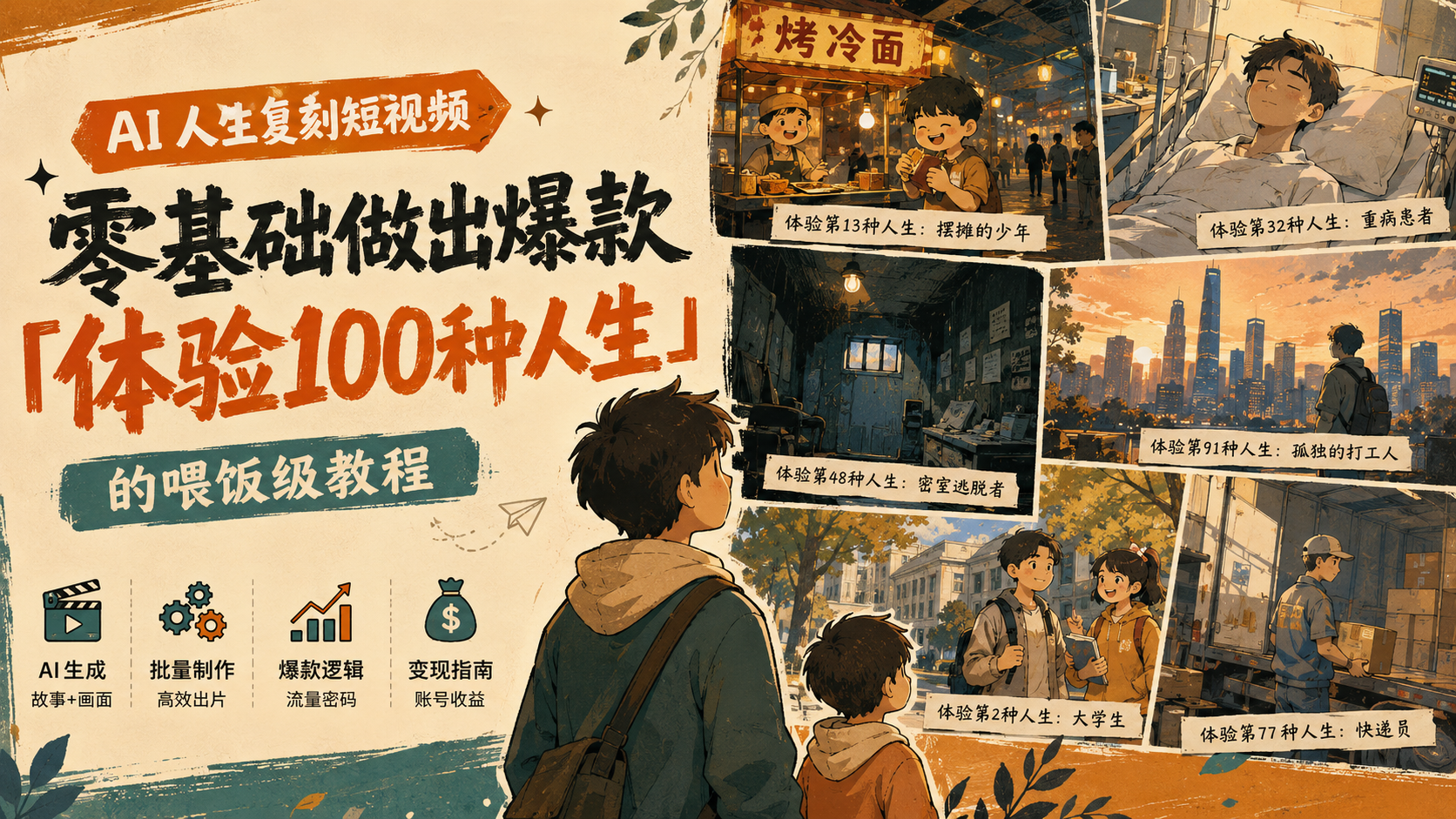
The true core of this entire workflow? Mastering Prompt engineering, then relentlessly iterating and optimizing
You don’t need to write scripts, draw pictures, record voiceovers, or edit videos. You just need to recognize what makes something good—and instruct AI to refine it until it’s perfect
Now go try your first “Life Avatar”
Disclaimer: The above is based on personal observation and sharing, not investment or business advice
Disclaimer: Contains third-party opinions, does not constitute financial advice
This company raised $400 million by "talking its model into existence"
53 mins ago
AI Server in Hand, Why Can't You Utilize Even 30% of the Computing Power?
1 hour ago
7 Billion Dollar Unicorn Founder: 90% of Enterprises Don't Use the Strongest AI Models
1 hour ago
WAIC Filled with "Computing Power Walls," Why Have Super Nodes Suddenly Gone Viral?
2 hours ago
OpenAI Slams Kimi for Open-Sourcing, Oil Prices Surge Too
2 hours ago
Qwen-Image-3.0 – Alibaba Tongyi Launches Third-Generation Foundation Model for Image Generation
3 hours ago
Trillion-dollar robotics deployment stuck at distribution cabinets and batteries
3 hours ago
Andrew Yao: AI Has Boundaries, Which Actually Make It Safer
3 hours ago


